

Archive position — measured, not model output
0 likes on Devpost
2,263 of the 7,850 archived projects have more likes, and 5,587 share exactly 0 — so this project's #4,713 place in the like-ranked listing is a tie-break inside that group, not a ranking.
Projects (log scale)
Likes on Devpost. ▲ marks this project's group.
Show the figures
| Likes | Projects | Share of archive |
|---|---|---|
| 0 | 5,587 | 71.2% |
| 1 | 1,758 | 22.4% |
| 2 | 284 | 3.6% |
| 3–4 | 132 | 1.7% |
| 5–9 | 75 | 1.0% |
| 10+ | 14 | 0.2% |
 User Stories BotA demo video on every pull request
Get a demo video on every new feature
GitHub App that watches your pull requests and records a narrated, captioned demo.
Save time on demo prep and make informed decisions faster with a video walkthrough of every new feature.
Executive Summary
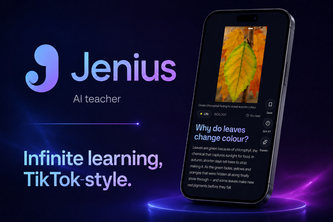
What the company appears to be: Jenius: Infinite Learning is a self-reported AI-powered educational platform built as a mobile-first Progressive Web App (PWA), designed to deliver short-form, interactive learning content through an infinite scroll feed inspired by TikTok. It claims to personalize learning based on user interaction rather than traditional onboarding or fixed curricula.
What changed: The author reports building a complete MVP from concept to production in ~3 days using OpenAI Codex and GPT-5.6, with ten original educational cinematics and adaptive learning logic. The system uses deterministic state tracking combined with generative AI for explanations.
Single most important open question: Is there evidence of real user engagement or adoption beyond the single developer's account? The description contains no data on users, retention, usage metrics, or revenue — only self-reported claims about product functionality and design decisions.
This analysis is based entirely on the author’s own description. No external verification, traction data, customer names, or financials are available. All statements reflect the author’s self-reporting; none have been independently confirmed.
What The Product Actually Is
The description states that Jenius is:
- A mobile-first Progressive Web App (PWA) built with React, TypeScript, and Vite.
- Powered by a deterministic state engine tracking lesson progress, attempts, misconceptions, understanding, saved concepts, review history, and experience points.
- Uses OpenAI API for flexible explanations and content generation, while maintaining control over progression and learner state.
- Delivers short-form cinematic animations, clear explanations, interactive challenges, misconception-aware feedback, alternative AI explanations, and key takeaways.
- Includes features like offline support via IndexedDB, installable PWA mode, and a Discover feed with For You personalization.
The product is described as an AI teacher built around an infinite learning feed, using a hybrid approach combining deterministic logic with generative AI for personalized learning experiences.
Positioning & Claim Evolution
The author claims:
- Jenius turns curiosity into a personalized learning journey through a TikTok-style feed.
- It avoids traditional course structures and lengthy onboarding processes.
- Learning begins immediately, without requiring learners to define themselves upfront.
- The platform adapts using interaction history and evolving understanding — not static profiles or fixed curricula.
These claims suggest a shift from structured, curriculum-based learning toward exploratory, curiosity-driven education. However, there is no evidence of how these claims translate into actual user behavior or product performance.
Target Customer & ICP
The description states:
- The target audience includes learners who start with questions like “Why is the sky blue?” or “How do vaccines work?”
- It aims to appeal to a broad audience interested in science concepts.
- Learners can ask Jenius to teach new topics, save concepts, and continue exploring previously loaded lessons offline.
No specific customer segments, personas, or market size data are provided. The positioning is broad and aspirational, but lacks clarity on who the core users are or how they would be reached.
Business Model & Pricing Evidence
Not evidenced.
There is no mention of pricing models, monetization strategies, subscription plans, or any indication of how the platform intends to generate revenue.
Technical & Delivery Signals
The description states:
- Built with React, TypeScript, Vite, and deployed on Vercel.
- Backend uses Node.js + Express, hosted on Google Cloud behind Nginx with HTTPS.
- Uses Firestore for caching and managing usage limits.
- Implements a custom motion engine using Codex sessions, FFmpeg for media processing.
- Supports offline use via IndexedDB.
- Utilizes OpenAI Codex and GPT-5.6 extensively in development.
- Includes automated tests, documentation, release verification, and schema enforcement.
The technical stack is detailed, suggesting a developer-focused MVP with strong engineering discipline. However, no production-scale deployment data or performance metrics are shared.
Traction & Maturity Signals
Not evidenced.
There is no evidence of user numbers, retention rates, usage frequency, or product adoption beyond the single developer’s account. The project was submitted to a hackathon and deployed live at jns.fun, but no real-world traction data is provided.
Competitive Context
Not evidenced.
No mention of competitors, market positioning, or competitive advantages. The description does not reference existing platforms like Duolingo, Brilliant, Khan Academy, or others in the edtech space.
Open Questions & Risks
- Single-person team: Only one member listed (Vijay Lakshminarayanan), which raises concerns about scalability and long-term maintenance.
- No traction data: No evidence of users, engagement, or revenue — only a self-reported MVP.
- Unverified claims: The entire product is described as built by one person in three days; no third-party validation or user testing.
- Hybrid architecture risk: Combining deterministic logic with generative AI may introduce inconsistency if not carefully managed.
- Limited scope: Only ten fully produced science concepts are mentioned, suggesting a narrow initial offering.
These factors indicate high uncertainty and potential risks related to execution, scalability, and commercial viability.
Questions the description leaves open
- What is the actual user base or engagement level beyond the developer's own use?
- How does the hybrid deterministic + generative AI model ensure consistent learning outcomes?
- Are there any plans for monetization or revenue streams?
- What are the long-term goals for content expansion and platform growth?
- How will the platform scale beyond a single developer’s capacity?
- Has the product undergone any form of user testing or feedback collection?
Overall Assessment
Not evidenced.
There is insufficient evidence to assess whether this project warrants investment or partnership interest. The description lacks key commercial indicators such as traction, revenue, customer data, or a clear path to monetization. While the technical execution appears strong, the lack of real-world validation and business metrics makes it difficult to evaluate its potential for growth or impact.
User Stories BotA demo video on every pull request
Get a demo video on every new feature
GitHub App that watches your pull requests and records a narrated, captioned demo.
Save time on demo prep and make informed decisions faster with a video walkthrough of every new feature.
Source
Submitted to the OpenAI 2026 hackathon on Devpost. Project home on Devpost. Back to the full gallery on Devpost.
This competitive analysis was produced by top-founders.com (opens in a new tab)
Generated by a language model from this project's public Devpost page — its tagline, the author's own write-up and any built-with tags listed there — as captured in August 2026. Short quotations are the author's words. It is an opinion on the idea as a business, not on the people behind it, and it reflects the description as published then. If the project has moved on, request a correction below. The analysis is not independent research and contains no verified traction, revenue or customer data.
An independent guide by KFG International LLC — not affiliated with, endorsed by, or connected to Devpost or OpenAI.