

Archive position — measured, not model output
0 likes on Devpost
2,263 of the 7,850 archived projects have more likes, and 5,587 share exactly 0 — so this project's #6,676 place in the like-ranked listing is a tie-break inside that group, not a ranking.
Projects (log scale)
Likes on Devpost. ▲ marks this project's group.
Show the figures
| Likes | Projects | Share of archive |
|---|---|---|
| 0 | 5,587 | 71.2% |
| 1 | 1,758 | 22.4% |
| 2 | 284 | 3.6% |
| 3–4 | 132 | 1.7% |
| 5–9 | 75 | 1.0% |
| 10+ | 14 | 0.2% |
 User Stories BotA demo video on every pull request
Get a demo video on every new feature
GitHub App that watches your pull requests and records a narrated, captioned demo.
Save time on demo prep and make informed decisions faster with a video walkthrough of every new feature.
Executive Summary
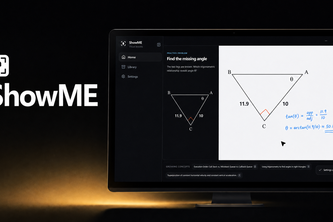
What the company appears to be: ShowME is a self-reported desktop application for Windows that uses AI to generate visual lessons from user-selected screen content. The author describes it as a tool that allows users to point to diagrams, code, or interfaces and receive interactive, narrated explanations.
What changed: This is a single-author project submitted to the OpenAI 2026 hackathon. No prior version or commercial history is evidenced. It is described as a working Windows application with full end-to-end functionality including screen capture, AI lesson generation, local validation, and voice interaction.
The single most important open question: Is there any evidence of traction, revenue, customers or adoption beyond the author's own development work? The description contains no data about usage, monetization, or market response.
Analysis basis: This report is based entirely on the self-reported project description supplied by the caller. It contains no archived history, third-party verification or independent sources. All claims are unverified and should be treated as stated by the author only.
What The Product Actually Is
The description states that ShowME is:
- A "visual lesson compiler for the desktop"
- A Windows application that lives on a "small dynamic island at the top of the screen"
- An application that "captures only the visual context" selected by the user
- Capable of turning visual content into lessons with "explanations, progress, annotations, voiceover, motion, quizzes, student controls, and deterministic interactions"
- A tool where users can "point to the exact thing causing confusion" and get explanations around that context
The product is described as using AI (specifically GPT-5.6) to generate lesson plans from visual context, but with strict local validation before rendering.
Positioning & Claim Evolution
The author's positioning claims:
- "ShowME makes every screen teachable"
- "Don't explain it. Make it visible."
- The product is positioned as an alternative to text-based AI explanations for spatial, sequential or dynamic concepts
- It aims to make AI teaching more interactive and exploratory rather than just providing answers
The claim evolution shows a progression from inspiration (AI should teach, not just solve) to execution (a working Windows application that allows visual interaction with AI-generated lessons).
Target Customer & ICP
Not evidenced. The description does not state who the target customer is or what the ideal customer profile might be.
Business Model & Pricing Evidence
Not evidenced. There is no mention of pricing, monetization strategy, or business model in the self-reported description.
Technical & Delivery Signals
The author states:
- Built with Electron, TypeScript, React, Node.js
- Uses separate desktop windows for different components
- Has a "small typed preload bridge" connecting sandboxed interface to privileged operations
- Main process controls screen captures, provider requests, credential encryption, local storage, and window behavior
- Rust worker manages physical-pixel cropping and key protection through Windows DPAPI
- Python worker verifies deterministic lesson calculations
- SQLite database stores settings, validated lessons, feedback, and optional learning memory
- Model outputs are treated as "untrusted data"
- Uses JSON schema validation (Zod) and closed lesson plan schemas before rendering
- Voice recognition runs locally on Windows
- Screenshots stay in short-lived memory and expire
Traction & Maturity Signals
Not evidenced. The description states:
- It's a working Windows application rather than a design demonstration
- Full path works: screen selection, visual model input, structured lesson generation, local validation, trusted rendering, narration, follow up questions, and local history
- Wake phrase works locally
- Microphone and speaker devices can be selected
- Voice questions can use several transcription services
- Credentials are encrypted for the current Windows user
- 82 targeted tests passed in latest release check
- Production application packaged successfully
- Real screen capture completed full path through vision model into validated lesson
However, there is no evidence of revenue, customers, or adoption beyond the author's own development work.
Competitive Context
Not evidenced. The description does not mention any competitors or competitive landscape.
Open Questions & Risks
Inferences based on self-reported information:
- The project appears to be a single-person effort (team size: 0)
- No evidence of traction, revenue, or customers
- The author states they are "especially proud" of the lesson boundary and verification work, suggesting this is a core technical challenge that may have limited scalability
- The product is described as working on Windows only, with Mac support still in development
- The use of GPT-5.6 (which does not exist) is an open question for verifiability
- The project appears to be a hackathon submission without evidence of commercialization or market validation
Questions the description leaves open
- What specific market problem are you solving, and who are your target users?
- How do you plan to monetize this product?
- What is your go-to-market strategy?
- Are there any existing competitors in this space?
- What are the technical challenges you've encountered that might impact scalability or performance?
- How do you plan to expand beyond Windows to other platforms like macOS and Linux?
- What is the timeline for product development and release?
- What are your plans for user feedback and product iteration?
Overall Assessment
Not evidenced. There is no evidence of any investment or partnership activity, revenue, customers, or traction beyond the author's own development work. The project appears to be a single-person hackathon submission with no commercial evidence. The description contains no data about market validation, user adoption, or financial performance.
The author states this is a working Windows application but provides no evidence of any commercial viability, customer base, or revenue generation. The product is described as a proof-of-concept rather than a commercial offering.
User Stories BotA demo video on every pull request
Get a demo video on every new feature
GitHub App that watches your pull requests and records a narrated, captioned demo.
Save time on demo prep and make informed decisions faster with a video walkthrough of every new feature.
Source
Submitted to the OpenAI 2026 hackathon on Devpost. Project home on Devpost. Back to the full gallery on Devpost.
This competitive analysis was produced by top-founders.com (opens in a new tab)
Generated by a language model from this project's public Devpost page — its tagline, the author's own write-up and any built-with tags listed there — as captured in August 2026. Short quotations are the author's words. It is an opinion on the idea as a business, not on the people behind it, and it reflects the description as published then. If the project has moved on, request a correction below. The analysis is not independent research and contains no verified traction, revenue or customer data.
An independent guide by KFG International LLC — not affiliated with, endorsed by, or connected to Devpost or OpenAI.