

Archive position — measured, not model output
0 likes on Devpost
2,263 of the 7,850 archived projects have more likes, and 5,587 share exactly 0 — so this project's #2,750 place in the like-ranked listing is a tie-break inside that group, not a ranking.
Projects (log scale)
Likes on Devpost. ▲ marks this project's group.
Show the figures
| Likes | Projects | Share of archive |
|---|---|---|
| 0 | 5,587 | 71.2% |
| 1 | 1,758 | 22.4% |
| 2 | 284 | 3.6% |
| 3–4 | 132 | 1.7% |
| 5–9 | 75 | 1.0% |
| 10+ | 14 | 0.2% |
 User Stories BotA demo video on every pull request
Get a demo video on every new feature
GitHub App that watches your pull requests and records a narrated, captioned demo.
Save time on demo prep and make informed decisions faster with a video walkthrough of every new feature.
Executive Summary
What the company appears to be
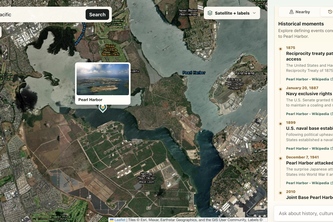
Ask Atlas is a self-reported AI-powered geography and history learning companion built as a hackathon project by one developer (Daniel Laksana). It allows users to click on a world map and chat with an AI tutor about historical, cultural, geographical, and landmark-related information for that location. The product uses LLMs to interpret user queries, maps coordinates via Geoapify, and retrieves data from Wikipedia, Wikidata, and the World Bank.
What changed
This is a self-reported MVP submitted to the OpenAI 2026 hackathon. No prior version or evolution is described; it is presented as a new creation.
Single most important open question
Is there any evidence of user adoption, revenue, or traction beyond the author’s own account?
What The Product Actually Is
The description states:
- Ask Atlas is an AI-powered geography and history learning companion.
- It allows students to explore places on a map and chat with an AI tutor about that place's history, culture, geography, landmarks, etc.
- The frontend uses ReactJS with Leaflet.js; the backend uses Microsoft Agent Framework.
- There are three agents: Location search agent, history timeline agent, and Chat Agent.
- Data sources include Geoapify, Wikipedia, Wikidata, and World Bank.
Inference The product is a map-based educational tool that leverages AI to provide contextual information about locations. It is built using a combination of LLMs, mapping APIs, and structured data repositories.
Positioning & Claim Evolution
The description states:
- “Ask Atlas helps student learn about the world through place-based exploration.”
- The tagline says: “Click anywhere on the world map and chat with an AI tutor about that place’s history, culture, geography, landmarks, and more.”
Inference The positioning is educational and exploratory. It claims to be a tool for students learning geography and history via interactive, location-based AI tutoring.
Claim vs Fact
The author claims this is a learning companion, but there is no evidence of actual student usage or adoption.
Target Customer & ICP
The description states:
- “Ask Atlas helps student learn about the world.”
- It is described as an educational tool for students.
Inference The target customer appears to be students, particularly those studying geography and history.
Absence of evidence
No specific age group, grade level, or institutional use case is provided. No evidence of segmentation or targeting beyond “student.”
Business Model & Pricing Evidence
The description states:
- No mention of pricing, monetization, or business model.
Inference There is no evidence of a business model or pricing structure. The project is presented as a hackathon submission with no indication of commercial intent.
Technical & Delivery Signals
The description states:
- Built with ReactJS (frontend), Leaflet.js (map), Microsoft Agent Framework (backend).
- Uses LLMs for query interpretation and data retrieval from Geoapify, Wikipedia, Wikidata, and World Bank.
- Development process involved Codex (GPT-5.6) for ideation, implementation, testing, and deployment.
- Regression testing was implemented to manage feature growth.
Inference The technical stack is a hybrid of frontend mapping, backend AI agents, and LLMs. The development approach used AI-assisted coding tools and included automated regression testing.
Traction & Maturity Signals
The description states:
- This is a hackathon submission (OpenAI 2026).
- It was built by one developer (Daniel Laksana).
- No mention of users, customers, or usage metrics.
- No evidence of revenue, growth, or product iteration beyond the MVP.
Inference The project is at MVP stage and lacks any traction signals. There is no evidence of user adoption or market validation.
Competitive Context
The description states:
- No mention of competitors or competitive landscape.
Absence of evidence
No indication of existing products in this space, nor how Ask Atlas differentiates from them.
Open Questions & Risks
- No traction or revenue: The project is described as a hackathon MVP with no evidence of adoption.
- Single founder: Only one person built the product; no team or scaling evidence.
- Unverified claims: All statements are self-reported and unverified.
- No monetization model: No indication of how the product would generate revenue.
- Limited data sources: Reliance on Wikipedia, Wikidata, and World Bank may limit depth or accuracy.
Questions the description leaves open
- What is your plan for scaling beyond a single developer?
- Have you validated demand from students or educators?
- How do you intend to monetize the product?
- What are the limitations of the current data sources, and how will they be expanded?
- Are there any plans for user feedback or iterative improvements post-hackathon?
Overall Assessment
The description states:
- This is a hackathon project submitted to the OpenAI 2026 hackathon.
- No evidence of revenue, customers, or traction.
Inference At this stage, there is no commercial due-diligence basis for investment or partnership. The product is unproven and lacks any evidence of market demand or business viability.
Confidence level Low — based entirely on self-reported information with no external validation.
User Stories BotA demo video on every pull request
Get a demo video on every new feature
GitHub App that watches your pull requests and records a narrated, captioned demo.
Save time on demo prep and make informed decisions faster with a video walkthrough of every new feature.
Source
Submitted to the OpenAI 2026 hackathon on Devpost. Project home on Devpost. Back to the full gallery on Devpost.
This competitive analysis was produced by top-founders.com (opens in a new tab)
Generated by a language model from this project's public Devpost page — its tagline, the author's own write-up and any built-with tags listed there — as captured in August 2026. Short quotations are the author's words. It is an opinion on the idea as a business, not on the people behind it, and it reflects the description as published then. If the project has moved on, request a correction below. The analysis is not independent research and contains no verified traction, revenue or customer data.
An independent guide by KFG International LLC — not affiliated with, endorsed by, or connected to Devpost or OpenAI.