

Archive position — measured, not model output
1 like on Devpost
505 of the 7,850 archived projects have more likes, and 1,758 share exactly 1 — so this project's #788 place in the like-ranked listing is a tie-break inside that group, not a ranking.
Projects (log scale)
Likes on Devpost. ▲ marks this project's group.
Show the figures
| Likes | Projects | Share of archive |
|---|---|---|
| 0 | 5,587 | 71.2% |
| 1 | 1,758 | 22.4% |
| 2 | 284 | 3.6% |
| 3–4 | 132 | 1.7% |
| 5–9 | 75 | 1.0% |
| 10+ | 14 | 0.2% |
 User Stories BotA demo video on every pull request
Get a demo video on every new feature
GitHub App that watches your pull requests and records a narrated, captioned demo.
Save time on demo prep and make informed decisions faster with a video walkthrough of every new feature.
Executive Summary
Company: CheckBack
Self-reported basis: The analysis is based entirely on the author's own description of CheckBack, submitted as part of a Devpost hackathon entry. No external verification or historical data are available.
What it appears to be: A mobile-first visual standard tool that uses AI to compare reference and current images of shared workspaces (desks, cabinets, meeting rooms) and returns structured findings about what changed. It is built as a self-hosted React/TypeScript app with GPT-5.6 for visual reasoning.
What changed: The author describes building a complete, runnable product from an initial idea, using AI tools like Codex and GPT-5.6 to implement core functionality including multi-area inspection modes, structured outputs, and local deployment.
Single most important open question: Is there any evidence of real-world usage or customer feedback beyond the author’s own development experience?
What The Product Actually Is
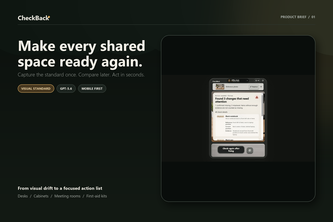
The description states that CheckBack is a mobile-first application that turns reference photos into reusable visual standards for shared workspaces such as desks, cabinets, and meeting rooms. It allows users to capture a reference image of an organized space and later compare it with a current image using GPT-5.6 to detect changes.
It supports:
- Multiple inspection modes: Desk/cabinet inventory checks, meeting room readiness verification.
- Structured AI output: Instead of generic scene descriptions, the system returns focused findings based on mode-specific instructions.
- Visual reasoning via GPT-5.6: The AI compares images and generates actionable results in English or Chinese.
- Local history tracking: Users can revisit past inspections.
- Self-hosted deployment: Built with Docker and Nginx; API keys are kept server-side.
The system is described as intentionally uncertainty-aware, avoiding confident claims when visual evidence is ambiguous.
Inference: The product appears to be a proof-of-concept or early-stage MVP, not yet validated in production environments. It lacks any mention of customer data, revenue, or adoption metrics.
Positioning & Claim Evolution
The author positions CheckBack as a solution to the problem of small but repeated failures in shared spaces, such as cluttered desks or missing supplies. The core claim is that traditional written checklists are slow and ignored, whereas visual standards can be more effective.
Key claims:
- “Show the system what ‘ready’ looks like once, then let it help people restore that state later.”
- “CheckBack is a complete, runnable product rather than a one-off vision demo.”
The evolution of the positioning seems to have moved from idea to implementation, with the author emphasizing:
- A camera-first workflow.
- Modular inspection modes tailored to different types of spaces.
- Privacy-conscious design: No third-party geolocation services, server-side API handling.
Inference: The positioning reflects a developer-driven approach focused on solving an internal pain point rather than targeting a broader market or customer base. There is no indication of how the idea evolved beyond personal use or whether it was shaped by external feedback.
Target Customer & ICP
The description does not explicitly define target customers or personas. However, it implies:
- Internal teams managing shared workspaces (e.g., office managers, facilities staff).
- Users who need quick visual confirmation of space readiness.
- Organizations with multiple shared areas that require consistent standards.
The product is described as supporting both English and Chinese, suggesting a potential global or multilingual audience.
Inference: While the author suggests a use case for shared workspaces, there is no evidence of specific customer segments, user interviews, or market research. The ICP remains undefined beyond the author’s own experience.
Business Model & Pricing Evidence
There is no evidence in the description of:
- A pricing model.
- Revenue streams.
- Monetization strategy.
- Customer acquisition plans.
- Subscription tiers or usage-based billing.
The product is described as a self-hosted solution, implying that users may be responsible for deployment and maintenance. There is no mention of SaaS, licensing, or marketplace integrations.
Inference: The business model remains unclear. It appears to be a personal project with no commercial traction or monetization strategy evident in the description.
Technical & Delivery Signals
The author reports:
- Built using TypeScript, React, Node.js, Next.js, and Docker/Nginx.
- Uses GPT-5.6 for visual reasoning.
- Implements structured outputs validated before UI display.
- Supports local history, bilingual interface, and privacy-conscious fallbacks (e.g., GeoIP lookups).
- Employs image guards, rate limits, and concurrency controls.
- Uses Codex extensively for development, including UI design, testing, and deployment.
The system is described as:
- Mobile-first.
- Server-side AI boundary.
- Self-hosted with production-ready configuration.
Inference: The technical stack and architecture suggest a developer-centric MVP. There is no evidence of enterprise-grade scalability or integration capabilities beyond self-hosting.
Traction & Maturity Signals
The description states:
- The project was submitted to the OpenAI 2026 hackathon.
- It is a complete, runnable product.
- It includes local history, bilingual behavior, and production deployment configuration.
- It has regression tests, synthetic evaluation cases, and uncertainty safeguards.
However:
- There is no evidence of customer adoption, usage metrics, or revenue.
- No mention of user feedback, beta testing, or product-market fit.
- The project is described as a personal development effort, not a commercial venture.
Inference: The maturity level reflects an early-stage MVP with strong technical execution but no demonstrated traction or market validation.
Competitive Context
The description does not reference any existing competitors. It focuses on the author’s own solution to a problem they identified, without comparing it to other tools in the shared workspace management or visual inspection space.
Inference: There is no evidence of competitive analysis or awareness of similar products. The project appears to be an independent innovation with no known market context.
Open Questions & Risks
- No commercial traction or revenue data: The product is described as a personal hackathon submission, not a commercial offering.
- Unclear business model: No pricing, monetization, or go-to-market strategy.
- Single-person team: Only one developer (ZHANG WENQING) is listed, raising questions about scalability and long-term maintenance.
- No customer feedback or real-world testing: The product is described as a personal tool with no external validation.
- AI dependency risks: Reliance on GPT-5.6 for visual reasoning introduces uncertainty around accuracy, consistency, and cost.
Inference: The project lacks commercial viability indicators and may not be ready for market entry without further development or validation.
Questions the description leaves open
- What is the actual problem you're solving, and how did you identify it?
- Have you tested this with real users or teams in shared workspaces?
- How do you plan to monetize or scale this product beyond a personal hackathon project?
- Are there any known limitations or edge cases where the AI fails to provide useful feedback?
- What are your plans for expanding beyond the current inspection modes (desks, cabinets, etc.)?
- Do you have any data on how often users return to inspect spaces after setting up a reference image?
Overall Assessment
The description indicates that CheckBack is a personal hackathon project with strong technical execution and a clear use case for shared workspace management. However, there is no evidence of commercial traction, customer feedback, or monetization strategy.
It is not yet ready for investment or partnership unless:
- The founder plans to build out a product-market fit.
- There is evidence of early user adoption or pilot testing.
- A clear business model and go-to-market plan are developed.
Confidence level: Low. This is a self-reported, unverified project with no third-party validation or commercial data.
User Stories BotA demo video on every pull request
Get a demo video on every new feature
GitHub App that watches your pull requests and records a narrated, captioned demo.
Save time on demo prep and make informed decisions faster with a video walkthrough of every new feature.
Source
Submitted to the OpenAI 2026 hackathon on Devpost. Project home on Devpost. Back to the full gallery on Devpost.
This competitive analysis was produced by top-founders.com (opens in a new tab)
Generated by a language model from this project's public Devpost page — its tagline, the author's own write-up and any built-with tags listed there — as captured in August 2026. Short quotations are the author's words. It is an opinion on the idea as a business, not on the people behind it, and it reflects the description as published then. If the project has moved on, request a correction below. The analysis is not independent research and contains no verified traction, revenue or customer data.
An independent guide by KFG International LLC — not affiliated with, endorsed by, or connected to Devpost or OpenAI.