

Archive position — measured, not model output
0 likes on Devpost
2,263 of the 7,850 archived projects have more likes, and 5,587 share exactly 0 — so this project's #3,213 place in the like-ranked listing is a tie-break inside that group, not a ranking.
Projects (log scale)
Likes on Devpost. ▲ marks this project's group.
Show the figures
| Likes | Projects | Share of archive |
|---|---|---|
| 0 | 5,587 | 71.2% |
| 1 | 1,758 | 22.4% |
| 2 | 284 | 3.6% |
| 3–4 | 132 | 1.7% |
| 5–9 | 75 | 1.0% |
| 10+ | 14 | 0.2% |
 User Stories BotA demo video on every pull request
Get a demo video on every new feature
GitHub App that watches your pull requests and records a narrated, captioned demo.
Save time on demo prep and make informed decisions faster with a video walkthrough of every new feature.
Executive Summary
What the company appears to be
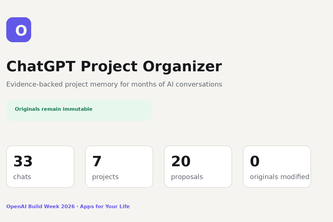
The project described by the author is a tool called ChatGPT Project Organizer, which claims to process exported ChatGPT conversations into organized, reviewable projects using AI and deterministic logic. It is presented as a self-contained, safe, and reversible system that preserves original data while reconstructing semantic project memory.
What changed
The description indicates this was built for the OpenAI 2026 hackathon, suggesting it is an early-stage prototype or proof-of-concept with no commercial traction or product-market fit validated beyond its own authorship.
Single most important open question
Is there any evidence of actual usage, adoption or revenue generation from this tool? The description states nothing about customers, users, or monetization — only a self-reported technical implementation and demonstration.
What The Product Actually Is
The description states that ChatGPT Project Organizer is a system that:
- Imports JSON, CSV, and TXT conversation exports.
- Preserves protected source copies.
- Normalizes chats and messages.
- Uses GPT-5.6 to reconstruct projects and operational memory.
- Identifies current/obsolete versions, decisions, tasks, duplicates, and ambiguous memberships.
- Generates one global proposal for organization.
- Allows batch approval of safe operations with mandatory previews.
- Applies only to a derived workspace; original conversations are never modified.
- Provides exact Undo through audit trails and SHA-256 state hashes.
It is described as a tool that turns informal AI conversation workspaces into structured, auditable project states.
Evidence strength Self-reported. No external validation or product data provided.
Positioning & Claim Evolution
The author claims the tool addresses a problem: people use ChatGPT conversations informally over time, leading to disorganized and mixed content. Existing chat lists show chronology but not operational state.
It positions itself as:
- An AI workspace for organizing ChatGPT conversations.
- A system that detects duplicates, outdated versions, and unclassified chats without altering originals.
- A safe, deterministic, and reversible process for project reconstruction.
The claim evolution shows a shift from informal use of AI to structured, auditable project management — with emphasis on preserving human control and safety.
Evidence strength Self-reported. No evidence of market positioning or customer feedback.
Target Customer & ICP
Not evidenced.
The description does not identify any specific customer segment or ideal customer profile (ICP). It only describes the tool’s function, not who uses it or why.
Business Model & Pricing Evidence
Not evidenced.
There is no mention of pricing, monetization strategy, or business model in the self-reported description. No indication of whether this is a freemium, SaaS, or one-time product.
Technical & Delivery Signals
The system is built with:
- Frontend: React, TypeScript, Vite
- Backend: FastAPI, Pydantic, SQLAlchemy, SQLite
- AI integration: GPT-5.6 via OpenAI API
- Data handling: JSON, CSV, TXT imports
- Deterministic safety features: immutable source, evidence engine, simulated apply, audit trail, Undo
Key technical claims:
- Uses structured outputs from GPT-5.6.
- Separates layers of processing for safety (immutable source, deterministic findings, semantic memory).
- Supports both precomputed and live modes.
- Includes automated tests (63 backend, 4 frontend, 50 acceptance cases).
- Zero npm vulnerabilities.
Evidence strength Self-reported. No independent verification or deployment data.
Traction & Maturity Signals
Not evidenced.
The description does not include any evidence of:
- Users, customers, or adoption.
- Revenue or monetization.
- Product-market fit.
- Iteration history or production usage.
- Any form of traction beyond the hackathon submission.
Competitive Context
Not evidenced.
No mention of competitors, market size, or competitive positioning. The description does not reference similar tools or platforms in the AI workspace or conversation management space.
Open Questions & Risks
- Unproven commercial viability: No evidence of revenue, customers, or product-market fit.
- Limited scope: Built for a hackathon; no indication of scalability or long-term development plans.
- AI dependency: Relies on GPT-5.6 and OpenAI API — subject to external service availability and cost.
- Self-contained nature: No mention of integrations, platform support, or extensibility beyond its own architecture.
- No user feedback loop: The tool is described as a prototype with no evidence of real-world usage or iteration.
Questions the description leaves open
- What is the actual use case for this tool? Who would benefit from it?
- How does the tool handle edge cases or ambiguous inputs?
- Has there been any user testing or feedback beyond the hackathon?
- Are there plans to monetize or scale this beyond a prototype?
- What are the risks of relying on GPT-5.6 for semantic interpretation?
- Is there a plan for integrating with other AI platforms or APIs?
- How does the tool ensure data privacy and security for users?
Overall Assessment
Not evidenced.
There is no evidence of any investment, partnership, or commercial interest in this project beyond its submission to a hackathon. No funding rounds, valuations, or strategic partnerships are mentioned.
The description presents a technical prototype with strong engineering execution but lacks any indication of traction, market demand, or business viability. It is not clear whether this represents a viable product or just an idea.
User Stories BotA demo video on every pull request
Get a demo video on every new feature
GitHub App that watches your pull requests and records a narrated, captioned demo.
Save time on demo prep and make informed decisions faster with a video walkthrough of every new feature.
Source
Submitted to the OpenAI 2026 hackathon on Devpost. Project home on Devpost. Back to the full gallery on Devpost.
This competitive analysis was produced by top-founders.com (opens in a new tab)
Generated by a language model from this project's public Devpost page — its tagline, the author's own write-up and any built-with tags listed there — as captured in August 2026. Short quotations are the author's words. It is an opinion on the idea as a business, not on the people behind it, and it reflects the description as published then. If the project has moved on, request a correction below. The analysis is not independent research and contains no verified traction, revenue or customer data.
An independent guide by KFG International LLC — not affiliated with, endorsed by, or connected to Devpost or OpenAI.