

Archive position — measured, not model output
0 likes on Devpost
2,263 of the 7,850 archived projects have more likes, and 5,587 share exactly 0 — so this project's #5,176 place in the like-ranked listing is a tie-break inside that group, not a ranking.
Projects (log scale)
Likes on Devpost. ▲ marks this project's group.
Show the figures
| Likes | Projects | Share of archive |
|---|---|---|
| 0 | 5,587 | 71.2% |
| 1 | 1,758 | 22.4% |
| 2 | 284 | 3.6% |
| 3–4 | 132 | 1.7% |
| 5–9 | 75 | 1.0% |
| 10+ | 14 | 0.2% |
 User Stories BotA demo video on every pull request
Get a demo video on every new feature
GitHub App that watches your pull requests and records a narrated, captioned demo.
Save time on demo prep and make informed decisions faster with a video walkthrough of every new feature.
Executive Summary
What the company appears to be
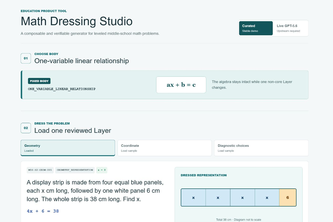
Math Dressing Studio is a self-reported educational tool for middle-school math problem generation, built as a one-page Next.js application with React, TypeScript, and Tailwind CSS. It separates math problems into a "Body" (mathematical content) and a "Layer" (presentation or diagnostic support), allowing for verifiable composition and repair of problems without silently altering the underlying mathematics.
What changed
The project was submitted as part of an OpenAI 2026 hackathon, with no prior public traction or commercial activity evidenced. It is described as a Build Week MVP with three curated samples and limited live functionality.
Single most important open question
Is there evidence of any real-world adoption, educator feedback, or product-market fit beyond the author’s own demonstration?
What The Product Actually Is
The description states that Math Dressing Studio is a composable and verifiable generator for leveled middle-school math problems, built as a one-page application using React, TypeScript, and Tailwind CSS. It uses a schema-driven approach to define:
- A Body containing the mathematical relationship, unknown, domain, answer, and target skill.
- A Layer that changes presentation or diagnostic support.
The system supports:
- Loading and verifying samples
- Removing or restoring Layers
- Exposing intentional Layer failures
- Applying bounded repairs
- Revalidating results
It is described as a curated demo, with no API requirement, and includes three original reviewed samples: geometry bar model, coordinate representation, and diagnostic-choice problem.
Evidence
- The author states it is a one-page Next.js/React app built with TypeScript and Tailwind.
- It uses Zod for strict schemas and Vitest for testing.
- It separates math problems into Body and Layer components.
- It includes deterministic validation for correctness, mapping, and integrity.
- It supports failure inspection and bounded repair.
Inference The system is designed to ensure that changes in presentation do not silently alter the mathematical content being assessed — a claim of verifiability.
Positioning & Claim Evolution
The author states that Math Dressing Studio began with the question: “Can we change how a math problem is presented without silently changing what it measures?”
It positions itself as:
- A tool for verifiable math problem generation.
- A system that separates creative presentation from mathematical integrity.
- A platform to expose diagnostic failures and repair them explicitly, rather than relying on aggregate scores.
The project is described as a Build Week MVP, suggesting it was not intended for production use but as a proof-of-concept or prototype.
Evidence
- The tagline: “A composable and verifiable generator for leveled middle-school math problems.”
- The author’s own write-up frames the tool as an experiment in separating math content from presentation.
- It is explicitly described as a curated demo, not a live product.
Inference The positioning reflects a focus on educational integrity and transparency, but there is no evidence of market positioning or competitive differentiation beyond its self-described features.
Target Customer & ICP
The description states that the tool is designed for:
- Middle-school math educators
- Curriculum authors
- Educational content creators
It is described as targeting a "leveled middle-school math problem" context, with a focus on:
- Diagnostic support
- Representation variety (geometry, coordinate)
- Answer uniqueness and shortcut risk control
There is no mention of:
- Specific customer segments beyond educators
- End-users (students)
- Institutional adoption or licensing models
Evidence
- The tool is built for middle-school math problems.
- It includes diagnostic-choice layers to support assessment.
- It is intended for curriculum authors and educators.
Inference The ICP appears to be educators and curriculum developers, but no evidence of specific customer personas, usage patterns, or feedback exists.
Business Model & Pricing Evidence
There is no evidence in the description of:
- Revenue streams
- Pricing models
- Monetization strategy
- Customer acquisition plans
- Subscription or licensing structures
The project is described as a Build Week MVP, with no indication of commercial intent or product-market fit.
Evidence
- The tool is presented as a demo, not a product.
- No pricing or business model is mentioned.
- It is built for demonstration and educational use only.
Inference There is no evidence of a business model beyond the author’s own prototype work.
Technical & Delivery Signals
The project is built using:
- Next.js
- React
- TypeScript
- Tailwind CSS
- Zod for schema validation
- Vitest for testing
- OpenAI GPT-5.6 (server-side only, in optional repair route)
- Codex for development support
It includes:
- A Git history for inspectability
- Deterministic validation logic
- Strict schemas for all components
- Bounded repair mechanisms
- Failure inspection and revalidation
The system is described as:
- Stable in curated mode
- Not requiring an API for the demo
- Using a server-side route with strict schema validation before model use
Evidence
- The tool uses React, Next.js, TypeScript, Tailwind, Zod, Vitest.
- It includes a Git history and test suite (23/23 tests passing).
- It uses GPT-5.6 only in an optional server-side route with deterministic validation.
Inference The technical stack suggests a lightweight, schema-driven prototype, not a full-scale SaaS product.
Traction & Maturity Signals
There is no evidence of:
- Revenue
- Customers or users
- Product-market fit
- Adoption metrics
- Growth data
- Live usage or production deployment beyond the demo
The project is described as:
- A Build Week MVP
- A curated demo with no student data
- Stable and independently testable
- Not yet live in a production environment
Evidence
- The tool is a demo, not a product.
- It includes no live API or user data.
- It is presented as a prototype for an OpenAI hackathon.
Inference The project is at a very early stage, with no evidence of traction or maturity beyond the author’s own work.
Competitive Context
There is no evidence in the description of:
- Competitors
- Market positioning
- Product differentiation
- Existing tools in the math problem generation space
The tool is described as a self-contained prototype, not part of an existing marketplace or product ecosystem.
Evidence
- No mention of competitors.
- No reference to similar tools or platforms.
- The project is presented as novel and experimental.
Inference There is no evidence of competitive context, market positioning, or differentiation from other tools.
Open Questions & Risks
Key risks and open questions include:
- No commercial traction or adoption — the tool is a demo with no evidence of real-world use.
- Limited scope — only three samples, one Body type, and one team member.
- No API or live functionality — the system is not yet production-ready.
- Unproven model integration — GPT-5.6 is used in an optional route but not proven to work in practice.
- No pricing or monetization strategy — no indication of how it would be sold or funded.
- Single founder — the team size is listed as one, which may limit scalability.
Evidence
- The project is a demo, not a product.
- It has no API or live functionality.
- No revenue, customers, or monetization strategy are mentioned.
Inference The tool is in an early prototype phase, with no evidence of viability or commercial readiness.
Questions the description leaves open
- What specific feedback have you received from educators or curriculum developers?
- How do you plan to expand beyond the current three samples and one Body type?
- Are there any plans for live API integration, or is it intended to remain a demo?
- What are your long-term goals for monetization or product-market fit?
- How do you intend to scale from a single developer to a production-ready system?
- Have you tested the bounded repair functionality with real-world educators?
Overall Assessment
Not evidenced.
The project is described as a Build Week MVP, with no evidence of:
- Revenue
- Customers
- Product-market fit
- Commercial viability
- Scalability or growth potential
It is presented as an experimental tool, not a product ready for investment or partnership.
Confidence Very low — this is a self-reported prototype with no external validation or traction.
User Stories BotA demo video on every pull request
Get a demo video on every new feature
GitHub App that watches your pull requests and records a narrated, captioned demo.
Save time on demo prep and make informed decisions faster with a video walkthrough of every new feature.
Source
Submitted to the OpenAI 2026 hackathon on Devpost. Project home on Devpost. Back to the full gallery on Devpost.
This competitive analysis was produced by top-founders.com (opens in a new tab)
Generated by a language model from this project's public Devpost page — its tagline, the author's own write-up and any built-with tags listed there — as captured in August 2026. Short quotations are the author's words. It is an opinion on the idea as a business, not on the people behind it, and it reflects the description as published then. If the project has moved on, request a correction below. The analysis is not independent research and contains no verified traction, revenue or customer data.
An independent guide by KFG International LLC — not affiliated with, endorsed by, or connected to Devpost or OpenAI.