

Archive position — measured, not model output
1 like on Devpost
505 of the 7,850 archived projects have more likes, and 1,758 share exactly 1 — so this project's #776 place in the like-ranked listing is a tie-break inside that group, not a ranking.
Projects (log scale)
Likes on Devpost. ▲ marks this project's group.
Show the figures
| Likes | Projects | Share of archive |
|---|---|---|
| 0 | 5,587 | 71.2% |
| 1 | 1,758 | 22.4% |
| 2 | 284 | 3.6% |
| 3–4 | 132 | 1.7% |
| 5–9 | 75 | 1.0% |
| 10+ | 14 | 0.2% |
 User Stories BotA demo video on every pull request
Get a demo video on every new feature
GitHub App that watches your pull requests and records a narrated, captioned demo.
Save time on demo prep and make informed decisions faster with a video walkthrough of every new feature.
Executive Summary
What the company appears to be
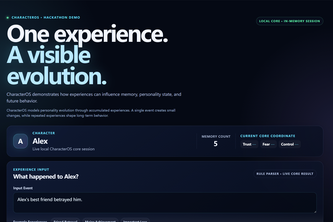
CharacterOS is an event-driven AI character engine that enables AI characters to evolve through experience. The description states it is a prototype built for the OpenAI 2026 hackathon, with no evidence of revenue, customers or traction.
What changed
The project is self-described as a proof-of-concept for persistent AI personalities that remember and learn from experiences, moving beyond static prompt-based responses.
Single most important open question
Is there any evidence of actual user adoption, commercial viability or technical scalability beyond the hackathon prototype?
The description is entirely self-reported and unverified. No revenue, customer data, or traction evidence is provided. The project appears to be a technical demonstration with no commercial evidence.
What The Product Actually Is
The description states CharacterOS is:
- An event-driven AI character engine
- Designed to create persistent and adaptive AI personalities
- Built around an event-driven architecture
- A prototype for the OpenAI 2026 hackathon
It includes components such as:
- Memory System that converts experiences into structured memories
- Personality Evolution System that allows traits to change gradually based on experiences
- Belief and Behavior Modeling that connects past experiences with future decision-making
The author states this is a working prototype that can create structured memories, analyze event impact, update internal personality states, and generate different behavioral tendencies.
Evidence strength Self-reported only. No independent verification or technical documentation provided beyond the author's own account.
Positioning & Claim Evolution
The description states:
- Current AI characters lack true memory and personal growth
- They usually reset between interactions and behave consistently regardless of past experiences
- CharacterOS explores how AI characters can remember, learn, and evolve like living beings
- It moves AI characters from static prompt-based responses toward experience-driven intelligence
The positioning appears to be:
- A technical demonstration of persistent AI personalities
- An exploration of AI character evolution through experience
- A prototype for developers to create persistent AI characters
Evidence strength Self-reported claims about positioning and intent. No evidence of market traction or customer validation.
Target Customer & ICP
The description states:
- Tools for developers to create persistent AI characters (in future development)
- The goal is to move AI characters from static prompt-based responses toward experience-driven intelligence
- Future development will explore multi-character relationships, long-term life simulation, and complex emotional systems
No specific customer segments or target accounts are identified. The description mentions developer tools as a future direction but does not indicate current customers.
Evidence strength Not evidenced. No indication of actual target customers or ICP.
Business Model & Pricing Evidence
The description states:
- CharacterOS is built around an event-driven AI architecture
- It's a prototype for the OpenAI 2026 hackathon
- Future development will explore tools for developers to create persistent AI characters
No business model, pricing structure, or monetization strategy is described. The project appears to be a technical demonstration with no commercial evidence.
Evidence strength Not evidenced. No indication of revenue streams or pricing.
Technical & Delivery Signals
The description states:
- Built with: agent, ai, api, architecture, event-driven, language, large, models, node.js, openai, typescript
- Core components include Memory System, Personality Evolution System, Belief and Behavior Modeling
- The core pipeline is: Event → Experience Processing → Memory Formation → Impact Analysis → Personality Evolution → Behavior Adaptation
- The goal is to move AI characters from static prompt-based responses toward experience-driven intelligence
The technical stack includes:
- Node.js
- TypeScript
- OpenAI
- Large language models
- Event-driven architecture
Evidence strength Self-reported technical details, but no independent verification or delivery evidence.
Traction & Maturity Signals
The description states:
- This is a working prototype
- Accomplishments include: creating structured memories from experiences, analyzing event impact, updating internal personality states, generating different behavioral tendencies based on past experiences
- Built for the OpenAI 2026 hackathon
- Future development will explore multi-character relationships, long-term life simulation, more complex emotional systems
No evidence of:
- Revenue or customers
- Product-market fit
- User adoption
- Market traction
- Commercial deployment
Evidence strength Not evidenced. The project is described as a prototype with no commercial evidence.
Competitive Context
The description states:
- Current AI characters can generate impressive conversations but lack true memory and personal growth
- They usually reset between interactions and behave consistently regardless of past experiences
- CharacterOS explores how AI characters can remember, learn, and evolve like living beings
No specific competitors or competitive positioning is mentioned. The description focuses on the technical innovation rather than market context.
Evidence strength Not evidenced. No competitive analysis or market positioning provided.
Open Questions & Risks
Inferences based on self-reported information:
- Prototype-only status with no commercial evidence
- Single founder (allll gaoyang) suggests limited team capacity
- No revenue, customers or traction data
- Technical complexity of memory systems and personality evolution may be challenging to implement at scale
- Unclear path from hackathon prototype to commercial product
- Limited evidence of market demand for persistent AI characters
Evidence strength Inferred from lack of evidence. The project appears to be a technical demonstration with no commercial viability shown.
Questions the description leaves open
- What specific use cases or markets do you see for persistent AI characters?
- How do you plan to transition from the hackathon prototype to a scalable product?
- What are your plans for monetization and customer acquisition?
- How do you address the technical challenges of balancing stability and adaptation in personality evolution?
- What is your roadmap for developing multi-character relationships and complex emotional systems?
- How do you plan to validate market demand for this technology?
- What are the key technical challenges you've encountered in implementing memory systems?
- How do you plan to scale beyond a single developer prototype?
Overall Assessment
Assessment Not evidenced.
The description is entirely self-reported and unverified. No evidence of:
- Revenue or customers
- Product-market fit
- Commercial traction
- Market validation
- Technical scalability
- Team capacity for execution
This appears to be a technical demonstration with no commercial evidence. The single founder, prototype-only status, and lack of any commercial metrics make it difficult to assess investment potential.
Confidence level Very low. The project description provides no evidence of traction, revenue, customers or market validation beyond the author's own claims.
User Stories BotA demo video on every pull request
Get a demo video on every new feature
GitHub App that watches your pull requests and records a narrated, captioned demo.
Save time on demo prep and make informed decisions faster with a video walkthrough of every new feature.
Source
Submitted to the OpenAI 2026 hackathon on Devpost. Project home on Devpost. Back to the full gallery on Devpost.
This competitive analysis was produced by top-founders.com (opens in a new tab)
Generated by a language model from this project's public Devpost page — its tagline, the author's own write-up and any built-with tags listed there — as captured in August 2026. Short quotations are the author's words. It is an opinion on the idea as a business, not on the people behind it, and it reflects the description as published then. If the project has moved on, request a correction below. The analysis is not independent research and contains no verified traction, revenue or customer data.
An independent guide by KFG International LLC — not affiliated with, endorsed by, or connected to Devpost or OpenAI.