

Archive position — measured, not model output
0 likes on Devpost
2,263 of the 7,850 archived projects have more likes, and 5,587 share exactly 0 — so this project's #4,702 place in the like-ranked listing is a tie-break inside that group, not a ranking.
Projects (log scale)
Likes on Devpost. ▲ marks this project's group.
Show the figures
| Likes | Projects | Share of archive |
|---|---|---|
| 0 | 5,587 | 71.2% |
| 1 | 1,758 | 22.4% |
| 2 | 284 | 3.6% |
| 3–4 | 132 | 1.7% |
| 5–9 | 75 | 1.0% |
| 10+ | 14 | 0.2% |
 User Stories BotA demo video on every pull request
Get a demo video on every new feature
GitHub App that watches your pull requests and records a narrated, captioned demo.
Save time on demo prep and make informed decisions faster with a video walkthrough of every new feature.
Executive Summary
What the company appears to be
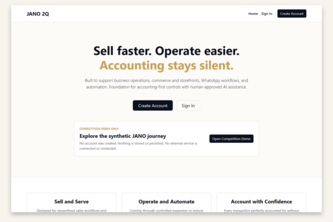
JANO 2Q is described as an "accounting-safe commerce operating system" for small merchants. The author states it is built around a principle that AI can assist business operations but must never silently control financial ledgers. It uses synthetic data and a demo environment to illustrate how an AI assistant would propose actions, which are then reviewed by a human through an "Accounting Firewall" before any ledger changes occur.
What changed
The project evolved from an early Laravel foundation into a more complete demonstration during OpenAI Build Week. The author used AI tools (Codex and GPT-5.6) to extend functionality across seven phases, including synthetic accounting proposals, human decision receipts, and a demo flow that simulates a business journey without persisting data or connecting external services.
The single most important open question — the commercial due-diligence read
Is there evidence of real traction, revenue, or customer adoption beyond the self-reported demo? The description provides no indication of actual users, paid customers, or financial performance. The product remains unproven in live use and is entirely synthetic.
What The Product Actually Is
The description states that JANO 2Q is an "accounting-safe commerce operating system for small merchants." It includes:
- A synthetic business journey with:
- Landing and registration
- Dashboard preview
- Customer/supplier previews
- Invoice previews
- Financial snapshot
- Animated AI assistant (Jano Octopus)
- Accounting Firewall review
- Human approval/rejection process
All actions in the demo are synthetic, meaning no real data or ledger entries are created. The system is described as advisory-only and does not post anything to a ledger unless explicitly approved by a human.
The product uses:
- Laravel 13
- PHP 8.4
- Blade
- Bootstrap 5.3
- Vite
- PHPUnit
- Playwright
- Git/GitHub
- Codex powered by GPT-5.6
It is not evidenced that the system has been deployed in production or integrated with real financial systems.
Positioning & Claim Evolution
The author positions JANO 2Q as a solution for small merchants who currently use separate tools for sales, customers, suppliers, invoices, and accounting — leading to duplication and risk. The core claim is:
AI proposes → Accounting Firewall verifies → Human decides → Ledger stays protected.
This positioning emphasizes safety over automation, framing the product as a control mechanism rather than an autonomous system.
The evolution of this claim appears to be:
- Start with a principle: AI can help but must not silently control ledgers.
- Demonstrate that principle through a synthetic demo.
- Outline future development toward a production-ready platform with multi-tenancy, audit trails, and secure AI integration.
There is no evidence of prior market positioning or product-market fit beyond the author’s own description.
Target Customer & ICP
The target customer is described as small merchants who use multiple systems for different aspects of their business (sales, customers, suppliers, invoices, accounting), resulting in inefficiencies and risks.
The ICP (Ideal Customer Profile) inferred from the description includes:
- Small businesses with basic commerce needs
- Merchants who are concerned about financial accuracy and control
- Users who may be hesitant to trust AI fully with financial decisions
No specific customer segments or personas are named. No evidence of market research, user interviews, or feedback loops is provided.
Business Model & Pricing Evidence
There is no evidence in the description of a business model or pricing structure. The author does not state whether the product will be sold as SaaS, freemium, or another model. Nor does it describe any monetization strategy beyond future development plans.
The description implies that the system will eventually support:
- Tenant isolation
- Human-controlled posting services
- Immutable posted records
- Reversal-only corrections
- Audit trails
But no details are given about how these features would be priced or delivered commercially.
Technical & Delivery Signals
The project is built using:
- Laravel 13
- PHP 8.4
- Blade
- Bootstrap 5.3
- Vite
- PHPUnit
- Playwright
- Git/GitHub
- Codex powered by GPT-5.6
Key technical signals include:
- Use of AI tools (Codex, GPT-5.6) for development and testing
- Emphasis on controlled implementation with human oversight
- Focus on security boundaries like session middleware, CSRF behavior, and stateless routes
- Testing framework includes 10 focused tests with 171 assertions and 53 full-suite tests with 558 assertions
However, the demo does not connect to external services or persist data. It is entirely synthetic.
Traction & Maturity Signals
There is no evidence of traction, revenue, or customer adoption beyond the author’s own account. The project exists as a demo and synthetic environment with no real-world usage or live integration.
The maturity level appears to be:
- Early-stage prototype
- Demo-ready version
- Not yet production-ready
No metrics, user feedback, or performance data are provided.
Competitive Context
The description does not mention competitors. It also does not provide any information on how JANO 2Q compares to existing solutions in the marketplace for small business accounting and commerce platforms.
There is no evidence of competitive analysis or differentiation strategy beyond its stated safety principle.
Open Questions & Risks
- No real-world validation: The entire system is synthetic. No actual customers, data, or financial transactions exist.
- Unproven commercial viability: No revenue, pricing, or business model are described.
- Limited team size: Only one founder is mentioned, raising questions about execution capacity.
- AI dependency without clarity on long-term AI strategy: While Codex and GPT-5.6 were used for development, there’s no indication of how AI will be integrated into the product post-demo.
- Lack of traction or market feedback: No evidence of early adopters, pilot programs, or user testing.
Questions the description leaves open
- What specific problems do you observe in current small merchant workflows that JANO 2Q addresses?
- How will the transition from a synthetic demo to a production-ready system be managed?
- Are there any real users or pilots currently testing this concept?
- What is your plan for monetization and scaling beyond the current demo?
- How do you intend to integrate with existing accounting software or platforms?
- What are the key technical challenges expected in moving from synthetic to live data handling?
Overall Assessment
Not evidenced.
The description provides no information about financials, traction, or commercial readiness. It is a self-reported demo of an early-stage concept that has not yet been validated in the market. There is no evidence of revenue, customers, or product-market fit.
This project is at a very early stage and lacks any measurable commercial signal. Any investment or partnership decision would require further validation through real-world usage, customer feedback, and proof of concept beyond the synthetic demo.
User Stories BotA demo video on every pull request
Get a demo video on every new feature
GitHub App that watches your pull requests and records a narrated, captioned demo.
Save time on demo prep and make informed decisions faster with a video walkthrough of every new feature.
Source
Submitted to the OpenAI 2026 hackathon on Devpost. Project home on Devpost. Back to the full gallery on Devpost.
This competitive analysis was produced by top-founders.com (opens in a new tab)
Generated by a language model from this project's public Devpost page — its tagline, the author's own write-up and any built-with tags listed there — as captured in August 2026. Short quotations are the author's words. It is an opinion on the idea as a business, not on the people behind it, and it reflects the description as published then. If the project has moved on, request a correction below. The analysis is not independent research and contains no verified traction, revenue or customer data.
An independent guide by KFG International LLC — not affiliated with, endorsed by, or connected to Devpost or OpenAI.