

Archive position — measured, not model output
0 likes on Devpost
2,263 of the 7,850 archived projects have more likes, and 5,587 share exactly 0 — so this project's #2,739 place in the like-ranked listing is a tie-break inside that group, not a ranking.
Projects (log scale)
Likes on Devpost. ▲ marks this project's group.
Show the figures
| Likes | Projects | Share of archive |
|---|---|---|
| 0 | 5,587 | 71.2% |
| 1 | 1,758 | 22.4% |
| 2 | 284 | 3.6% |
| 3–4 | 132 | 1.7% |
| 5–9 | 75 | 1.0% |
| 10+ | 14 | 0.2% |
 User Stories BotA demo video on every pull request
Get a demo video on every new feature
GitHub App that watches your pull requests and records a narrated, captioned demo.
Save time on demo prep and make informed decisions faster with a video walkthrough of every new feature.
Executive Summary
What the company appears to be
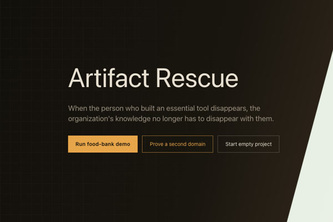
Artifact Rescue is a self-reported tool that restores legacy spreadsheet workbooks into modern applications, with an emphasis on proving recovered rules before migrating real data. It uses AI (GPT-5.6) for clarification and rule proposal but does not rely on it as the trust boundary; instead, it enforces schema validation, deterministic fallbacks, and human approval.
What changed
The project was submitted to the OpenAI 2026 hackathon by a single founder, Arya RH. It is described as a prototype built in a short timeframe using Next.js, Supabase, ExcelJS, Playwright, and GPT-5.6. No prior version or product history is evident.
The single most important open question
Is there evidence of real-world usage or demand for this type of spreadsheet-to-application migration, or is the project purely a proof-of-concept?
What The Product Actually Is
The description states that Artifact Rescue is a tool that inspects Excel workbooks (.xlsx), extracts formulas, comments, and behavior, and generates a Recovery Compatibility Report and Rule Ledger. It uses GPT-5.6 to clarify ambiguous rules but does not treat AI output as the final authority.
It builds a modern application from recovered rules, including fields, role-gated data entry, calculations, reports, and CSV export. The process includes:
- A Proof Room that tests legacy and restored behavior side-by-side
- Transactional migration into Supabase tables with checksum reconciliation and rollback support
- A final package including the rebuilt app, migrated records, operating guide, and certificates
The tool is described as a restoration studio for dying software, focused on institutional knowledge preservation.
Evidence Self-reported. No external validation or product screenshots provided.
Positioning & Claim Evolution
The author positions Artifact Rescue as a solution to the problem of institutional knowledge loss when employees leave organizations that depend on spreadsheets or desktop tools.
Key claims:
- It restores abandoned spreadsheets into modern applications.
- It proves every recovered rule before migration.
- It avoids “convincing but untrustworthy” demos by using deterministic checks and human review.
- AI is used for clarification, not as the trust boundary.
- The core value proposition is proof, not generation.
The positioning evolved from a hackathon prototype to an idea of a restoration studio that can be applied across domains (e.g., food banks, animal shelters, clinics).
Evidence Self-reported. No prior version or market positioning history provided.
Target Customer & ICP
The description states that the tool is intended for small organizations that depend on spreadsheets or desktop tools built by one person or volunteer. These are typically non-profits or small teams where knowledge is not codified and can be lost when people leave.
It also implies a use case in domains with legacy workflows, such as:
- Food banks
- Animal shelters
- Clinic scheduling
The ICP appears to be:
- Small, non-technical teams
- Organizations with institutional knowledge embedded in spreadsheets
- Users who want to migrate data and behavior without losing trust or accuracy
Evidence Self-reported. No customer data, personas, or segmentation provided.
Business Model & Pricing Evidence
No business model or pricing information is provided in the description.
The author states that the tool is a prototype, built for a hackathon, with no mention of monetization, subscriptions, or licensing.
Evidence Not evidenced.
Technical & Delivery Signals
The product is described as:
- Built using Next.js and deployed on Vercel
- Backed by Supabase Postgres
- Uses ExcelJS to parse workbooks
- Employs GPT-5.6 via OpenRouter for clarification, with Zod for validation
- Uses Playwright for browser testing and GitHub Actions for CI/CD
- Includes a generic formula interpreter that supports arithmetic, comparisons, IF logic, aggregates, and constrained VLOOKUP/XLOOKUP
- Has a Proof Room, regression suite, and rollback support
The system is described as:
- Deterministic where possible
- Reversible
- Schema-validated
- Designed to avoid “inventing” uncertainty or silent guessing
Evidence Self-reported. No performance data, scalability claims, or delivery metrics.
Traction & Maturity Signals
No traction or maturity signals are evident in the description:
- No customers
- No revenue
- No product usage metrics
- No prior versions or iterations
- No public deployment beyond a hackathon submission
The project is described as a single-person hackathon effort, with no indication of ongoing development, user feedback, or adoption.
Evidence Not evidenced.
Competitive Context
No competitive landscape is described. The author does not reference existing tools for spreadsheet migration or knowledge preservation.
The product appears to be unique in its focus on:
- Proving recovered rules
- Using AI as a clarification tool, not a trust boundary
- Supporting transactional migration and rollback
Evidence Not evidenced.
Open Questions & Risks
- Unproven demand: The project is described as a hackathon prototype with no evidence of real-world adoption or customer need.
- Single-founder build: Only one person built the product, which raises questions about scalability and long-term maintenance.
- AI dependency without clear trust model: While GPT-5.6 is used for clarification, it is not the trust boundary — but this may still be a point of risk if AI output is misused or misunderstood.
- No monetization strategy: No indication of how the product would generate revenue.
- Limited scope: The author notes that the tool supports a “useful subset” of Excel functions and does not cover all edge cases.
Evidence Inferred from self-reported description.
Questions the description leaves open
- What is the real-world problem you are solving, and how did you identify it?
- Have you tested this with any actual users or organizations?
- How do you plan to scale beyond a single-person prototype?
- What is your path to monetization?
- How do you intend to expand beyond the current Excel function support?
- What are the key assumptions in your approach, and how might they fail?
Overall Assessment
The project is described as a hackathon prototype with no evidence of traction, revenue, or customer usage. It is self-described as a tool for restoring legacy spreadsheets into modern applications, with an emphasis on proof and deterministic behavior.
It is not evident whether this represents a viable product or a proof-of-concept. The author has not provided any data to suggest demand, adoption, or scalability.
Confidence Low. The description is self-reported and unverified. No evidence of commercial viability, market traction, or business model.
Assessment Not ready for investment or partnership. Requires further validation of real-world use cases, customer feedback, and product-market fit before any serious consideration.
User Stories BotA demo video on every pull request
Get a demo video on every new feature
GitHub App that watches your pull requests and records a narrated, captioned demo.
Save time on demo prep and make informed decisions faster with a video walkthrough of every new feature.
Source
Submitted to the OpenAI 2026 hackathon on Devpost. Project home on Devpost. Back to the full gallery on Devpost.
This competitive analysis was produced by top-founders.com (opens in a new tab)
Generated by a language model from this project's public Devpost page — its tagline, the author's own write-up and any built-with tags listed there — as captured in August 2026. Short quotations are the author's words. It is an opinion on the idea as a business, not on the people behind it, and it reflects the description as published then. If the project has moved on, request a correction below. The analysis is not independent research and contains no verified traction, revenue or customer data.
An independent guide by KFG International LLC — not affiliated with, endorsed by, or connected to Devpost or OpenAI.