

Archive position — measured, not model output
0 likes on Devpost
2,263 of the 7,850 archived projects have more likes, and 5,587 share exactly 0 — so this project's #2,740 place in the like-ranked listing is a tie-break inside that group, not a ranking.
Projects (log scale)
Likes on Devpost. ▲ marks this project's group.
Show the figures
| Likes | Projects | Share of archive |
|---|---|---|
| 0 | 5,587 | 71.2% |
| 1 | 1,758 | 22.4% |
| 2 | 284 | 3.6% |
| 3–4 | 132 | 1.7% |
| 5–9 | 75 | 1.0% |
| 10+ | 14 | 0.2% |
 User Stories BotA demo video on every pull request
Get a demo video on every new feature
GitHub App that watches your pull requests and records a narrated, captioned demo.
Save time on demo prep and make informed decisions faster with a video walkthrough of every new feature.
Executive Summary
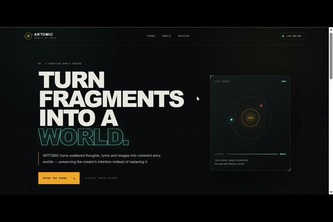
What the company appears to be: ARTOMIC: Rebels of Truth is a creative world engine built as a hackathon project. The author describes it as a tool that transforms unfinished creative fragments into structured story worlds using AI, while preserving the creator’s original voice and intention.
What changed: The project was developed during Build Week, with no prior product history or traction. It emerged from an idea about connecting fantasy with reality for non-technical creators who have scattered ideas but lack tools to structure them.
Single most important open question: Is there a viable market demand for this type of creative AI tool among non-technical users, and does the author’s vision align with what users actually want or need?
This analysis is based entirely on the self-reported description provided by the project author. No external verification, revenue data, customer feedback, or traction evidence is available.
What The Product Actually Is
The description states that ARTOMIC is a creative world engine. It allows creators to input an unfinished fragment and select:
- An emotional frequency (Rebellion, Mystery, Hope, Ancient Wisdom, Cosmic)
- An output form
- A balance between light and shadow
From these inputs, it generates:
- A title and central premise
- A world law
- A conflict
- A character gift
- A three-scene storyboard
- A soundtrack direction
The tool also supports archiving, copying, and exporting created worlds in the browser.
It is described as a responsive React and TypeScript application, built using Codex with GPT-5.6, Next.js, OpenAI, and other technologies declared by the author.
This is a self-reported product description; no independent validation or demonstration of functionality beyond the author's account exists.
Positioning & Claim Evolution
The author positions ARTOMIC as:
- A tool for non-technical creators who have fragmented ideas but lack tools to develop them.
- A way to preserve the creator’s voice while structuring ideas into coherent stories.
- A collaboration between human intention and AI execution, where the creator remains in control of meaning.
The project evolved from a philosophical concept rooted in "creative universe, themes, and early fragments" that existed before Build Week. During Build Week, it was designed and built as a functional prototype.
The positioning is based on the author’s own claims and does not reflect any market testing or user validation.
Target Customer & ICP
The description states that ARTOMIC targets non-technical creators who have:
- Unfinished ideas
- Fragments (e.g., lyrics, images, contradictions, memories, questions)
- No structured tools to turn those into stories
It is implied that the tool is aimed at people who are not programmers but want to explore creative worlds without losing their original voice.
The ICP is inferred from the author’s description. No explicit segmentation or customer data is provided.
Business Model & Pricing Evidence
No business model or pricing information is stated in the project description.
Not evidenced.
Technical & Delivery Signals
The tool was built using:
- Codex with GPT-5.6
- Next.js, React, TypeScript
- OpenAI APIs
It includes features such as:
- A deterministic world-forging engine
- Browser-based archiving and export capabilities
- Keyboard-accessible controls
- Visual system tailored for ARTOMIC
The author notes that the interface was designed specifically for this purpose.
These are self-reported technical details. No evidence of scalability, performance, or production deployment is provided.
Traction & Maturity Signals
There is no evidence of:
- Revenue
- Customers
- Users
- Adoption metrics
- Product usage data
- Prior versions or iterations
The project was built during a single hackathon event (Build Week), and the author mentions it as a “working, public product with a live application, source repository, and complete demonstration.”
Not evidenced.
Competitive Context
No mention is made of existing competitors or similar tools in the market. The author does not reference any comparable products or platforms that offer similar functionality.
Not evidenced.
Open Questions & Risks
- Lack of traction: No evidence of users, customers, or revenue.
- Unproven demand: The described use case is speculative and lacks validation.
- Single-person team: Only one member (Fotis Di) is listed; no indication of additional support or scalability.
- Limited scope: The tool appears to be a prototype built for a hackathon with no clear path to product-market fit or commercialization.
- Unclear monetization strategy: No business model or pricing structure is described.
These are inferences drawn from the lack of evidence, not confirmed facts.
Questions the description leaves open
- What specific types of creative fragments do users provide? How many different kinds have been tested?
- Have you conducted any user interviews or usability tests with non-technical creators?
- What is your long-term vision for monetization, and how does it align with current functionality?
- Can you describe the process of generating a world in more detail? Is there variability in outputs based on inputs?
- How do you plan to scale beyond a single-person development model?
- Are there any plans to integrate with existing creative tools or platforms?
Overall Assessment
At this stage, ARTOMIC is a conceptual prototype built during a hackathon. It has no demonstrated traction, revenue, or customer base.
The author’s claims about preserving the creator's voice and enabling collaboration between human intention and AI are compelling in theory but unvalidated in practice.
There is no evidence of market demand, no business model, and no indication of scalability beyond a single developer.
This is a very early-stage idea with limited commercial viability at present. Further validation, user testing, and product development would be required before any investment or partnership consideration.
User Stories BotA demo video on every pull request
Get a demo video on every new feature
GitHub App that watches your pull requests and records a narrated, captioned demo.
Save time on demo prep and make informed decisions faster with a video walkthrough of every new feature.
Source
Submitted to the OpenAI 2026 hackathon on Devpost. Project home on Devpost. Back to the full gallery on Devpost.
This competitive analysis was produced by top-founders.com (opens in a new tab)
Generated by a language model from this project's public Devpost page — its tagline, the author's own write-up and any built-with tags listed there — as captured in August 2026. Short quotations are the author's words. It is an opinion on the idea as a business, not on the people behind it, and it reflects the description as published then. If the project has moved on, request a correction below. The analysis is not independent research and contains no verified traction, revenue or customer data.
An independent guide by KFG International LLC — not affiliated with, endorsed by, or connected to Devpost or OpenAI.