

Archive position — measured, not model output
1 like on Devpost
505 of the 7,850 archived projects have more likes, and 1,758 share exactly 1 — so this project's #771 place in the like-ranked listing is a tie-break inside that group, not a ranking.
Projects (log scale)
Likes on Devpost. ▲ marks this project's group.
Show the figures
| Likes | Projects | Share of archive |
|---|---|---|
| 0 | 5,587 | 71.2% |
| 1 | 1,758 | 22.4% |
| 2 | 284 | 3.6% |
| 3–4 | 132 | 1.7% |
| 5–9 | 75 | 1.0% |
| 10+ | 14 | 0.2% |
 User Stories BotA demo video on every pull request
Get a demo video on every new feature
GitHub App that watches your pull requests and records a narrated, captioned demo.
Save time on demo prep and make informed decisions faster with a video walkthrough of every new feature.
Executive Summary
What the company appears to be
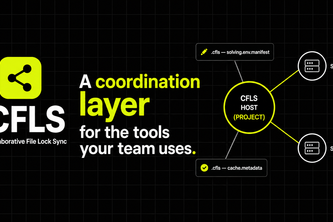
CFLS: Collaborative File Lock Sync is a self-reported developer tool that aims to reduce merge conflicts in shared Git repositories by enabling real-time coordination between developers and AI coding agents. It provides visibility into file activity and intent, without replacing Git or uploading code.
What changed
The project was submitted as part of the OpenAI 2026 hackathon. The authors describe it as a proof-of-concept built in a short timeframe using TypeScript, Node.js, and various AI tools like GPT-5.6 and Codex. It includes a VS Code extension, local agent, coordination host, CLI, and playground for testing.
Single most important open question
Is there evidence of any real-world usage or adoption beyond the hackathon prototype?
What The Product Actually Is
The description states that CFLS is a real-time coordination layer for developers and AI coding agents working in Git repositories. It provides:
- Live editing presence
- Soft file locks
- Declared intent
- Planned file creation
It operates as a local agent on each teammate’s computer, communicating with a shared Host over WSS/TLS. The Host validates devices, stores metadata in SQLite, and broadcasts shared state to connected users.
It does not upload source code or replace Git; instead, it helps teams avoid conflicts before they occur by sharing metadata only.
Evidence
- “CFLS, or Collaborative File Lock Sync, is a real-time coordination layer for developers and AI coding agents working in the same Git repository.”
- “The editor extension talks only to the local Agent. That Agent sends signed, repository-relative coordination metadata to a shared Host over WSS/TLS.”
- “Git still owns the code, commits, branches, pull requests, reviews, and final merge resolution.”
Inference CFLS is not a Git replacement but a complementary tool for visibility and coordination.
Positioning & Claim Evolution
The authors claim that CFLS addresses a common frustration in shared repositories: two people working on the same part of code without awareness of each other’s activity, especially when AI agents are involved.
They frame it as a solution to merge conflicts that could be prevented by early coordination. The tool is positioned as a lightweight, non-blocking system, not an operating-system-level file lock.
It also emphasizes privacy and clarity, noting that while metadata is shared, it does not include source code.
Evidence
- “We kept running into the same frustrating moment in shared repositories: two people would start changing the same part of the code without knowing the other person was already there.”
- “CFLS does not replace Git. It does not upload source code through its Host, and it does not try to become another code-hosting platform.”
Inference The positioning is that CFLS is a developer productivity tool, not a core infrastructure or enterprise-grade system.
Target Customer & ICP
The description states that CFLS targets developers and AI coding agents working in the same Git repository. It is designed for teams using shared codebases where coordination can be difficult.
It does not specify a particular industry, but it implies use cases in software development environments with multiple contributors.
Evidence
- “CFLS is a real-time coordination layer for developers and AI coding agents working in the same Git repository.”
- “Teams can adopt stricter policies for sensitive paths, but CFLS does not pretend to be an operating-system file lock.”
Inference The ICP likely includes small to mid-sized development teams, especially those using Git-based workflows and possibly integrating AI tools.
Business Model & Pricing Evidence
There is no evidence of a business model or pricing structure in the description. The project is presented as a hackathon submission with no mention of monetization, licensing, or customer acquisition plans.
Evidence
- No mention of revenue, pricing tiers, subscriptions, or sales channels.
- “The core boundary will stay the same: CFLS coordinates metadata, while Git remains responsible for source code and final merges.”
Inference It is unclear whether this project intends to become a commercial product or remain a prototype.
Technical & Delivery Signals
CFLS was built as a TypeScript pnpm monorepo, with:
- A local CFLS Agent
- A shared Coordination Host
- Editor extensions for VS Code and Kiro
- CLI, dashboard, and playground components
It uses technologies like:
- WebSockets (WSS/TLS)
- SQLite for metadata storage
- TypeScript, Node.js, Vitest, fast-check, OpenAI Codex, GPT-5.6
The system is described as awareness-first, not blocking by default, and designed to avoid creating a second source of truth.
Evidence
- “We built CFLS as a TypeScript pnpm monorepo with a shared Coordination Host and a local CFLS Agent on every teammate’s computer.”
- “The editor extension talks only to the local Agent. That Agent sends signed, repository-relative coordination metadata to a shared Host over WSS/TLS.”
Inference It is a lightweight, developer-focused tool, likely intended for early adopters or internal use.
Traction & Maturity Signals
There is no evidence of traction, customers, or adoption beyond the hackathon submission. The project is described as a prototype built in a short time frame and not yet deployed in production environments.
Evidence
- “This project was submitted to the OpenAI 2026 hackathon on Devpost.”
- “The product decisions, validation, and final checks remained human-led.”
Inference No evidence of real-world usage, user feedback, or market traction. The tool is at a pre-product stage.
Competitive Context
There is no mention of existing tools in the description. The authors do not reference competitors or similar systems.
Evidence
- No comparison to other Git coordination tools or developer productivity platforms.
- “We had to be careful about what gets shared, how competing claims are ordered, and what happens when someone is offline.”
Inference It is unclear whether this tool addresses a known gap in the market or introduces a novel concept. The competitive landscape is not described.
Open Questions & Risks
- No evidence of real-world usage or adoption: The project is presented as a hackathon prototype with no traction.
- Unproven scalability: The MVP uses SQLite for metadata storage, which may not scale well.
- Unclear commercial viability: No pricing, monetization or go-to-market strategy is described.
- Limited team size: Only two team members are listed, raising questions about execution capacity.
- No third-party validation: All evidence is self-reported and unverified.
Evidence
- “Team size: 2”
- “This project was submitted to the OpenAI 2026 hackathon on Devpost.”
- “The core boundary will stay the same: CFLS coordinates metadata, while Git remains responsible for source code and final merges.”
Questions the description leaves open
- What is the expected user journey from installation to daily use?
- How does CFLS handle offline scenarios or stale state?
- Are there any plans to integrate with existing CI/CD pipelines or platforms like GitHub, GitLab, etc.?
- Has the tool been tested in real development workflows beyond the hackathon playground?
- What are the long-term goals for the product—will it be open-source, commercial, or internal-only?
Overall Assessment
Not evidenced.
The description provides no evidence of revenue, customers, traction, or a clear path to monetization. It is a self-reported hackathon prototype with no indication of market readiness or commercial viability.
This project appears to be an early-stage idea or proof-of-concept, not a product ready for investment or partnership. Any further diligence would require access to more detailed data on usage, adoption, or development progress beyond the initial submission.
User Stories BotA demo video on every pull request
Get a demo video on every new feature
GitHub App that watches your pull requests and records a narrated, captioned demo.
Save time on demo prep and make informed decisions faster with a video walkthrough of every new feature.
Source
Submitted to the OpenAI 2026 hackathon on Devpost. Project home on Devpost. Back to the full gallery on Devpost.
This competitive analysis was produced by top-founders.com (opens in a new tab)
Generated by a language model from this project's public Devpost page — its tagline, the author's own write-up and any built-with tags listed there — as captured in August 2026. Short quotations are the author's words. It is an opinion on the idea as a business, not on the people behind it, and it reflects the description as published then. If the project has moved on, request a correction below. The analysis is not independent research and contains no verified traction, revenue or customer data.
An independent guide by KFG International LLC — not affiliated with, endorsed by, or connected to Devpost or OpenAI.