

Archive position — measured, not model output
1 like on Devpost
505 of the 7,850 archived projects have more likes, and 1,758 share exactly 1 — so this project's #773 place in the like-ranked listing is a tie-break inside that group, not a ranking.
Projects (log scale)
Likes on Devpost. ▲ marks this project's group.
Show the figures
| Likes | Projects | Share of archive |
|---|---|---|
| 0 | 5,587 | 71.2% |
| 1 | 1,758 | 22.4% |
| 2 | 284 | 3.6% |
| 3–4 | 132 | 1.7% |
| 5–9 | 75 | 1.0% |
| 10+ | 14 | 0.2% |
 User Stories BotA demo video on every pull request
Get a demo video on every new feature
GitHub App that watches your pull requests and records a narrated, captioned demo.
Save time on demo prep and make informed decisions faster with a video walkthrough of every new feature.
Executive Summary
What the company appears to be
ChainLens is a self-reported paper-only options decision-auditing system built on NIFTY option-chain data. The author states it uses GPT-5.6 and Codex for analytical reasoning and codebase interaction, respectively, and includes historical replay and comparison features.
What changed
This is a hackathon submission (Devpost entry) from 2026. No evidence of product development beyond the single-person build, no commercial traction, or customer adoption.
Single most important open question
Is there any evidence of revenue, customers, or real-world usage beyond the author’s own demonstration?
Note
This analysis is based solely on the self-reported project description provided by the caller. No external verification, archived data, or third-party sources are available. All claims are attributed to the author's own account and are unverified.
What The Product Actually Is
The description states that ChainLens is an "explainable options decision-auditing system" built on a "NIFTY Live Option Forward Engine V1". It processes chronological option-chain snapshots and evaluates market structure using combinations of:
- CE and PE open interest
- OI percentage and OI changes
- Volume
- Implied volatility
- Delta, Gamma, Theta, Vega
- India VIX
- Spot price and ATM context
- Forward strikes
- Call and put walls
- Pin-risk and target-path obstruction
It produces interpretable states (e.g., bullish structure, bearish structure, pinning, no-chase conditions) instead of relying on a single indicator.
The system also includes historical replay capabilities for comparing how option-chain structures evolve across different market regimes.
Evidence The author describes the product’s functionality and components in detail. However, there is no evidence of actual deployment, usage, or integration with live trading systems beyond paper-trading mode.
Positioning & Claim Evolution
The author states that ChainLens was built around the idea of analyzing how multiple option-chain signals evolve together across strikes and time, rather than relying on isolated indicators.
It aims to "separate early pre-break warnings from confirmed momentum" using verified NIFTY replay data.
The system is described as a decision-auditing layer that helps avoid acting on misleading directional signals when broader evidence remains conflicted.
Inference The positioning appears to be that of a research and analytical tool for traders or analysts working in options markets, focused on improving signal reliability through multi-dimensional analysis.
Claim vs Fact
These are claims made by the author about intent and design. No evidence exists regarding adoption, feedback, or impact from users.
Target Customer & ICP
The description does not explicitly state who the target customer is. However, based on the product’s focus on NIFTY option-chain data and its use of financial metrics like Greeks, volatility, and OI changes, it seems aimed at:
- Traders or analysts in Indian equity options markets
- Researchers studying market structure and behavior
- Developers or engineers working with financial data pipelines
Inference The ICP likely includes individuals or teams interested in advanced options analysis, backtesting, and understanding complex market dynamics.
Not evidenced No explicit customer list, user base, or buyer persona is provided.
Business Model & Pricing Evidence
The description does not contain any information about pricing, monetization, or business model.
It explicitly states that the system is "paper-only", with real order execution disabled ("real_orders_allowed: false", etc.).
Not evidenced No evidence of revenue streams, subscription plans, licensing, or commercial use cases beyond personal research and demo purposes.
Technical & Delivery Signals
The author reports:
- Built using Python on Ubuntu
- Uses GPT-5.6 for analytical reasoning
- Uses Codex CLI for codebase-level interaction
- Includes components for data processing, forward-strike analysis, decision layers, historical replay, validation, and paper trading
- Repository contains sanitized engine architecture
The system is described as a "NIFTY Live Option Forward Engine V1" with support for chronological snapshots and multi-variable signal evaluation.
Not evidenced No evidence of scalability, infrastructure, or delivery mechanisms beyond the single developer’s environment.
Traction & Maturity Signals
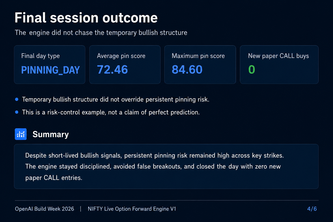
There is no evidence of traction, adoption, or user engagement. The project was submitted as a hackathon entry (OpenAI 2026 hackathon) and is described as experimental research and paper-trading.
The author mentions one recorded session with 69,564 rows and 748 snapshots but does not provide metrics on usage frequency, number of sessions, or user feedback.
Not evidenced No data on active users, recurring usage, or product maturity beyond the initial build.
Competitive Context
The description does not mention competitors or existing tools in the options analysis space. It is unclear whether ChainLens competes with other financial analytics platforms or trading tools.
Not evidenced No competitive landscape, market positioning, or differentiation from similar offerings.
Open Questions & Risks
- Single-person development: The team size is listed as 1, indicating a solo project with no organizational support.
- Paper-only mode: Real execution is disabled; this limits commercial viability unless the system transitions to live trading.
- No revenue or traction: No evidence of monetization, customer base, or product usage beyond the author’s own demo.
- Unverified technology claims: Use of GPT-5.6 and Codex is self-reported without validation or demonstration of integration.
- Hackathon origin: The project was submitted to a hackathon, suggesting it may be experimental or exploratory in nature.
Questions the description leaves open
- What is the actual utility of ChainLens beyond personal research? Has there been any feedback from traders or analysts?
- How does ChainLens handle data privacy and compliance for financial datasets?
- Are there plans to enable real trading or integrate with live brokers?
- What are the technical limitations of the current system, especially around scalability and performance?
- Is there a roadmap for product development beyond the current demo version?
Overall Assessment
Not evidenced No evidence of commercial viability, revenue potential, or strategic fit for investment or partnership.
The project is described as an experimental tool built by one person during a hackathon. It lacks any signs of traction, monetization, or real-world application beyond the author’s own use case.
Confidence Level Low — based entirely on self-reported information with no external validation or evidence of product-market fit or commercial success.
User Stories BotA demo video on every pull request
Get a demo video on every new feature
GitHub App that watches your pull requests and records a narrated, captioned demo.
Save time on demo prep and make informed decisions faster with a video walkthrough of every new feature.
Source
Submitted to the OpenAI 2026 hackathon on Devpost. Project home on Devpost. Back to the full gallery on Devpost.
This competitive analysis was produced by top-founders.com (opens in a new tab)
Generated by a language model from this project's public Devpost page — its tagline, the author's own write-up and any built-with tags listed there — as captured in August 2026. Short quotations are the author's words. It is an opinion on the idea as a business, not on the people behind it, and it reflects the description as published then. If the project has moved on, request a correction below. The analysis is not independent research and contains no verified traction, revenue or customer data.
An independent guide by KFG International LLC — not affiliated with, endorsed by, or connected to Devpost or OpenAI.