

Archive position — measured, not model output
1 like on Devpost
505 of the 7,850 archived projects have more likes, and 1,758 share exactly 1 — so this project's #774 place in the like-ranked listing is a tie-break inside that group, not a ranking.
Projects (log scale)
Likes on Devpost. ▲ marks this project's group.
Show the figures
| Likes | Projects | Share of archive |
|---|---|---|
| 0 | 5,587 | 71.2% |
| 1 | 1,758 | 22.4% |
| 2 | 284 | 3.6% |
| 3–4 | 132 | 1.7% |
| 5–9 | 75 | 1.0% |
| 10+ | 14 | 0.2% |
 User Stories BotA demo video on every pull request
Get a demo video on every new feature
GitHub App that watches your pull requests and records a narrated, captioned demo.
Save time on demo prep and make informed decisions faster with a video walkthrough of every new feature.
Executive Summary
What the company appears to be
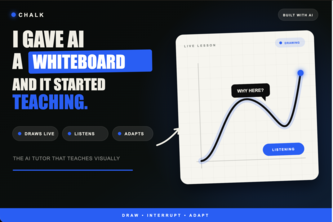
The author describes CHALK as an AI tutor that teaches visually on a live whiteboard—drawing explanations, handling interruptions, asking questions, and adapting each lesson in real time. It is presented as a tool for teaching math and physics using voice and visual interaction.
What changed
This project was built during the OpenAI 2026 hackathon. The author states that it uses GPT 5.6 Luna to create structured lessons and GPT Realtime 2.1 for live interaction, with a custom-built "drawer" intermediary orchestrating between models and the whiteboard surface.
Single most important open question
Is there evidence of any commercial traction or product-market fit beyond this hackathon prototype? The description does not indicate any revenue, users, or adoption beyond the author’s own development efforts.
What The Product Actually Is
The description states that CHALK is a live voice tutor for maths and physics that teaches on a whiteboard. It generates structured lessons, narrates them aloud, and draws supporting equations, graphs, and diagrams as it explains. Students can interrupt with space bar or clicking the voice orb, ask questions about the board, and resume without losing lesson state.
It uses GPT 5.6 Luna for creating structured lesson plans and GPT Realtime 2.1 for live interaction. A custom-built "drawer" acts as an orchestrator between models and the whiteboard surface. The system is built with React/TypeScript frontend and FastAPI backend, and uses a constrained lesson DSL for safe rendering.
Evidence
- Author states: “CHALK is a live voice tutor for maths and physics that teaches on an whiteboard.”
- Author states: “GPT 5.6 Luna creates the structured lesson plan while GPT Realtime 2.1 handles the live interaction between the interface and the student.”
- Author states: “My custom built 'drawer' intermediary acts as an orchestrator between both the models and the whiteboard surface.”
Inference The system is designed to simulate a teacher’s visual and verbal instruction in real time, with interruption handling and adaptive lesson flow.
Positioning & Claim Evolution
The author positions CHALK as an AI tutor that brings traditional classroom whiteboard teaching into an AI-powered format. The inspiration comes from the idea of using familiar tools like the whiteboard to enhance learning through AI.
Evidence
- Author states: “I love learning. AI has greatly accelerated this project for myself and many students worldwide regardless of their background.”
- Author states: “A whiteboard is the bread and butter of classroom teaching. I wondered why not bring that to AI?”
Inference The positioning is rooted in familiarity and pedagogical preference, aiming to make AI tutoring feel more like a human instructor.
Target Customer & ICP
Not evidenced. The description does not identify specific customer segments or personas beyond general student use cases.
Evidence
- Author states: “I wonder why not bring that to AI?”
- No mention of specific user types, age groups, educational levels, or institutions.
Business Model & Pricing Evidence
Not evidenced. There is no indication of pricing strategy, monetization model, or revenue streams beyond the author’s own development efforts.
Evidence
- No mention of any pricing, subscriptions, licensing, or sales channels.
- No evidence of customer acquisition or retention strategies.
Technical & Delivery Signals
The system uses a React/TypeScript frontend and FastAPI backend. It integrates with OpenAI APIs (GPT 5.6 Luna and GPT Realtime 2.1). The whiteboard rendering is constrained through a DSL, validated for safety and determinism, and includes mechanisms to handle interruptions and synchronization.
Evidence
- Author states: “We built CHALK with a React/TypeScript frontend and a FastAPI backend.”
- Author states: “Rather than allowing a model to emit arbitrary drawing code, CHALK uses a constrained lesson DSL for text, equations, curves, arrows, constructions, and diagrams.”
- Author states: “Every generated step is schema-validated, checked for safe mathematical expressions and references, laid out deterministically, and rendered only after it passes those checks.”
Inference The architecture suggests a focus on reliability and safety in AI-generated content delivery.
Traction & Maturity Signals
Not evidenced. There is no mention of users, customers, revenue, or product adoption beyond the author’s own development.
Evidence
- No data on usage, retention, or feedback.
- No indication of any live deployment or user base.
- The project was built for a hackathon and has no stated commercial rollout.
Competitive Context
Not evidenced. There is no mention of competitors or market positioning beyond the author’s own claims.
Evidence
- No reference to existing AI tutoring platforms, whiteboard tools, or educational tech products.
- No indication of competitive advantage or differentiation from other solutions.
Open Questions & Risks
- No commercial traction: The project is a hackathon prototype with no evidence of real-world use or adoption.
- Unverified model versions: Claims about GPT 5.6 Luna and GPT Realtime 2.1 are self-reported and not independently verifiable.
- Single-person team: The entire project was built by one person, raising questions about scalability and long-term maintenance.
- No monetization strategy: No evidence of how the product would be sold or funded beyond personal development.
Evidence
- Author states: “Team size: 1”
- Author states: “This project was submitted to the OpenAI 2026 hackathon on Devpost.”
- No mention of any revenue, users, or commercial viability.
Questions the description leaves open
- What is the current status of the product beyond this hackathon prototype?
- Have you tested the system with real students or educators? If so, what feedback did you receive?
- How do you plan to monetize this tool if it were to move beyond a prototype?
- Are there any technical limitations that would prevent scaling this solution for broader use?
- What are your plans for expanding the visual vocabulary and interactivity features?
Overall Assessment
Not evidenced. There is no evidence of any investment interest, partnership discussions, or commercial viability beyond the author’s own development.
Evidence
- No mention of funding rounds, investors, or partnerships.
- No indication of any business plan or go-to-market strategy.
- The project remains a personal prototype with no stated intent for commercialization.
User Stories BotA demo video on every pull request
Get a demo video on every new feature
GitHub App that watches your pull requests and records a narrated, captioned demo.
Save time on demo prep and make informed decisions faster with a video walkthrough of every new feature.
Source
Submitted to the OpenAI 2026 hackathon on Devpost. Project home on Devpost. Back to the full gallery on Devpost.
This competitive analysis was produced by top-founders.com (opens in a new tab)
Generated by a language model from this project's public Devpost page — its tagline, the author's own write-up and any built-with tags listed there — as captured in August 2026. Short quotations are the author's words. It is an opinion on the idea as a business, not on the people behind it, and it reflects the description as published then. If the project has moved on, request a correction below. The analysis is not independent research and contains no verified traction, revenue or customer data.
An independent guide by KFG International LLC — not affiliated with, endorsed by, or connected to Devpost or OpenAI.