

Archive position — measured, not model output
0 likes on Devpost
2,263 of the 7,850 archived projects have more likes, and 5,587 share exactly 0 — so this project's #2,736 place in the like-ranked listing is a tie-break inside that group, not a ranking.
Projects (log scale)
Likes on Devpost. ▲ marks this project's group.
Show the figures
| Likes | Projects | Share of archive |
|---|---|---|
| 0 | 5,587 | 71.2% |
| 1 | 1,758 | 22.4% |
| 2 | 284 | 3.6% |
| 3–4 | 132 | 1.7% |
| 5–9 | 75 | 1.0% |
| 10+ | 14 | 0.2% |
 User Stories BotA demo video on every pull request
Get a demo video on every new feature
GitHub App that watches your pull requests and records a narrated, captioned demo.
Save time on demo prep and make informed decisions faster with a video walkthrough of every new feature.
Executive Summary
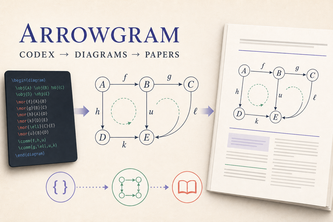
Arrowgram is a self-reported tool for editing typed files (diagrams, papers, books, slide decks) that are legible to AI coding agents like Codex, while also being editable by humans visually. The system uses a file-first approach with a single source of truth in JSON and Markdown files, which can be edited both programmatically and through a browser-based visual editor. It supports local workflows via an open-source plugin and hosted workflows via a proprietary "GetPaidX" service that provides cloud workspaces and publishing capabilities.
The project is presented as a solution to the fragmentation between AI authoring tools and human visual editing, aiming to unify them within a shared artifact model. The authors claim it works with Codex and GPT-5.6 for research-authoring tasks and has been tested on a substantial formal-mathematics project (Emdash). However, no revenue, customer data, or traction metrics are provided.
The single most important open question
Is there evidence that Arrowgram's file-based artifact model is actually adopted or used by developers or researchers beyond the authors' own development environment?
What The Product Actually Is
The description states that Arrowgram is a visual editor and typed authoring system for commutative diagrams, research papers, books, and slide decks. It uses a file-first approach, with a single source of truth in ordinary files:
arrowgram.workspace.jsondescribes the workspace;diagram.jsonstores a standalone diagram using a strict schema;paper.mdstores a paper, book section, or Reveal.js deck;paper.csscontrols publication styling.
Codex can edit these files directly. Arrowgram validates them and opens the same content in a visual editor. Changes made visually persist back to the workspace files.
Arrowgram also supports two complementary Codex integration paths:
- The Arrowgram plugin: local and file-first, open-source.
- The GetPaidX plugin: hosted and publishable, proprietary.
The system is built as an npm-workspace monorepo with three main public packages:
@hotdocx/arrowgram(Zod schema, geometry engine, React SVG renderer);@hotdocx/arrowgram-web(visual workspace, paper editor, preview, browser persistence);@hotdocx/arrowgram-agent(file watcher, bridge API, validation, diff/snapshot behavior, static builds).
It uses technologies including React, TypeScript, Vite, Zustand, IndexedDB, KaTeX, Mermaid, Vega-Lite, Paged.js, and Reveal.js.
Inference: The product appears to be a hybrid system combining file-based editing with visual UI for human interaction, designed to support AI authoring workflows while maintaining compatibility with Git and local development practices.
Positioning & Claim Evolution
The description states that Arrowgram was built because research diagrams rarely live alone, but instead belong inside proofs, papers, lectures, or books. The usual workflow splits the work across multiple tools (drawing tool, source files, local dev environment, publishing system), which is awkward for AI coding agents.
Arrowgram aims to solve this by making the diagram and paper themselves legible to Codex, editable by people, runnable in a browser, and publishable from a hosted AI workspace — without bolting a chat panel onto a canvas.
The authors claim that Arrowgram:
- Enables both human visual editing and Codex-editable artifact formats;
- Shares the same source model between local CLI and hosted workflows;
- Supports end-to-end workflows involving creation, drafting, diffing, building, snapshotting, and publishing;
- Is used in a real-world project (Emdash) involving formal mathematics and book production.
Inference: The positioning evolved from a general-purpose tool for AI-authoring to a specialized solution for research documents that require both machine-editability and human readability.
Target Customer & ICP
The description does not explicitly state the target customer or ideal customer profile (ICP). However, based on the content and use case described:
- Primary users appear to be researchers, mathematicians, or developers working in formal-mathematics contexts.
- These users likely work with typed files, diagrams, and research papers that need both AI assistance and human review.
- The system supports local workflows (via open-source plugin) and hosted workflows (via GetPaidX), suggesting a dual audience:
- Developers or researchers who prefer local control;
- Users who want cloud-hosted environments with persistent workspaces.
There is no mention of enterprise customers, non-academic users, or general-purpose developers beyond the context of research authoring.
Inference: The ICP likely includes researchers and developers in formal-mathematics domains, particularly those using AI coding agents for complex document authoring.
Business Model & Pricing Evidence
The description does not provide any information about business model or pricing. It mentions two paths:
- An open-source Arrowgram plugin;
- A proprietary GetPaidX plugin with hosted services.
It says that the GetPaidX plugin connects users' Codex CLI/app to a cloud-hosted API (https://getpaidx.com/api/mcp) via OAuth and offers curated tools for managing Arrowgram workspaces.
However, there is no evidence of:
- Revenue streams;
- Pricing tiers or plans;
- Customer acquisition costs;
- Monetization strategy;
- Subscription models or usage-based billing.
Inference: The business model remains unclear. It may be based on a freemium model (open-source plugin + paid hosted service), but this is not stated.
Technical & Delivery Signals
Arrowgram is built as an npm-workspace monorepo with:
- Three main public packages:
@hotdocx/arrowgram,@hotdocx/arrowgram-web, and@hotdocx/arrowgram-agent. - Core technologies include React, TypeScript, Vite, Zustand, IndexedDB, KaTeX, Mermaid, Vega-Lite, Paged.js, and Reveal.js.
- Tests are written using Vitest (unit/integration) and Playwright (browser flows).
- The system supports:
- File-based editing;
- Bidirectional synchronization between visual editor and source files;
- Static builds to SVG, PNG, TikZ-CD, HTML/PDF, Reveal.js presentations.
- It integrates with Codex through two plugins:
- Local:
@hotdocx/arrowgram-agent; - Hosted: via GetPaidX MCP tools.
- Local:
Inference: The technical architecture is modular and supports both local and cloud-based workflows. The system is designed for reproducible builds, version control integration, and AI-assisted editing.
Traction & Maturity Signals
The description states that Arrowgram was built as part of a Devpost submission to the OpenAI 2026 hackathon. It includes a case study involving Emdash — an experimental Lambdapi specification for functorial type theory and a future proof assistant.
Emdash is described as:
- A 192-page tagged PDF assembled from 32 ordered Markdown sources;
- A project that tests the full Arrowgram stack on a substantial formal-mathematics and book-production task;
- Used to validate artifact contracts, pagination, typography, accessibility, and deterministic output.
However, there is no evidence of:
- Revenue or monetization;
- Customer adoption or usage beyond the authors’ own development;
- Product-market fit or market traction;
- Any form of user feedback or product iteration history.
Inference: The system has been tested in a real-world academic context but lacks measurable traction or commercial validation.
Competitive Context
The description does not mention specific competitors. However, it implies that Arrowgram addresses a gap in the current ecosystem where:
- AI coding agents like Codex struggle to work with fragmented workflows;
- Visual editors do not support programmatic editing;
- There is no unified model for combining human visual editing and machine-readable artifacts.
It positions itself as an alternative to traditional tools like:
- Drawing apps (e.g., draw.io);
- LaTeX-based systems (e.g., Overleaf, TeXstudio);
- Note-taking platforms (e.g., Obsidian, Notion).
Inference: Arrowgram operates in a niche space where AI authoring meets structured document editing. It competes with tools that support either AI authoring or visual editing, but not both simultaneously.
Open Questions & Risks
Several key risks and open questions are present:
- No traction or revenue data: The project is described as a hackathon submission with no evidence of adoption or monetization.
- Unclear business model: No pricing, monetization strategy, or customer base are mentioned.
- Limited external validation: The only real-world test case is Emdash, which may not reflect broader usage patterns.
- Proprietary vs open-source tension: While the local plugin is open-source, the hosted GetPaidX service is proprietary — this could create friction for users seeking full control.
- Dependency on Codex/GPT-5.6: The system’s value depends heavily on AI coding agent availability and performance, which may not be stable or scalable.
Inference: Without external validation or commercial traction, Arrowgram risks being a proof-of-concept rather than a viable product for widespread use.
Questions the description leaves open
- What is the actual adoption rate of Arrowgram among researchers or developers? Is there any data on how many people are using it?
- How does Arrowgram plan to monetize its hosted service (GetPaidX)? Are there any pricing tiers or plans?
- Can you provide examples of real-world projects where Arrowgram has been used beyond Emdash?
- What is the roadmap for expanding support for other types of documents or formats beyond diagrams and papers?
- How does Arrowgram handle security concerns around file access in hosted environments, especially with allowlists and OAuth?
- Are there any plans to integrate with existing platforms like GitHub, Overleaf, or Jupyter?
- What are the long-term goals for the open-source plugin versus the proprietary service?
Overall Assessment
Arrowgram is presented as a proof-of-concept tool designed to bridge AI authoring and visual editing in research contexts. It shows technical capability through its modular architecture, integration with Codex, and real-world application in Emdash.
However, there is no evidence of traction, revenue, or customer adoption beyond the authors’ own development environment. The business model remains unclear, and the product appears to be in early-stage development.
Assessment: Not ready for investment or partnership at this time. It requires further validation through real-world usage, commercial traction, and a clear monetization strategy before it can be considered a viable opportunity.
User Stories BotA demo video on every pull request
Get a demo video on every new feature
GitHub App that watches your pull requests and records a narrated, captioned demo.
Save time on demo prep and make informed decisions faster with a video walkthrough of every new feature.
Source
Submitted to the OpenAI 2026 hackathon on Devpost. Project home on Devpost. Back to the full gallery on Devpost.
This competitive analysis was produced by top-founders.com (opens in a new tab)
Generated by a language model from this project's public Devpost page — its tagline, the author's own write-up and any built-with tags listed there — as captured in August 2026. Short quotations are the author's words. It is an opinion on the idea as a business, not on the people behind it, and it reflects the description as published then. If the project has moved on, request a correction below. The analysis is not independent research and contains no verified traction, revenue or customer data.
An independent guide by KFG International LLC — not affiliated with, endorsed by, or connected to Devpost or OpenAI.