

Archive position — measured, not model output
1 like on Devpost
505 of the 7,850 archived projects have more likes, and 1,758 share exactly 1 — so this project's #772 place in the like-ranked listing is a tie-break inside that group, not a ranking.
Projects (log scale)
Likes on Devpost. ▲ marks this project's group.
Show the figures
| Likes | Projects | Share of archive |
|---|---|---|
| 0 | 5,587 | 71.2% |
| 1 | 1,758 | 22.4% |
| 2 | 284 | 3.6% |
| 3–4 | 132 | 1.7% |
| 5–9 | 75 | 1.0% |
| 10+ | 14 | 0.2% |
 User Stories BotA demo video on every pull request
Get a demo video on every new feature
GitHub App that watches your pull requests and records a narrated, captioned demo.
Save time on demo prep and make informed decisions faster with a video walkthrough of every new feature.
Executive Summary
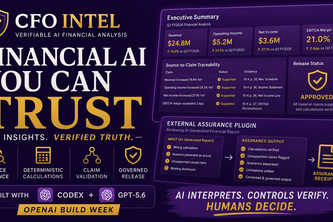
CFO Intel is a self-reported financial intelligence platform built as a hackathon project by one person (Bukie Faforiji). The product claims to automate financial analysis from raw data into board-ready outputs with an "evidence paper trail." It integrates AI tools like GPT-5.6 and Codex, supports Excel uploads, and offers narrative generation, evidence tracking, and export capabilities.
The author states that CFO Intel is designed for finance leaders who want to reduce manual effort while maintaining accuracy and auditability in financial reporting. The platform uses deterministic processing for data interpretation and AI for executive narratives within governed boundaries.
Key commercial due-diligence read
There is no evidence of revenue, customers, or product-market fit beyond the author's own description. The project has not been independently verified or deployed beyond a hackathon prototype. The single most important open question is whether this platform can scale from a proof-of-concept into a viable B2B SaaS offering with real enterprise adoption.
What The Product Actually Is
The description states that CFO Intel is:
- A financial decision platform that turns raw financial data into board-ready intelligence
- An evidence-led financial intelligence platform for finance leaders
- Capable of accepting original financial workbooks and supporting files, then answering CFO-level questions
- Producing outputs including:
- Executive board readout and management actions
- Source review and evidence-backed claim ledger
- Variance, trend, plan, month-over-month, and year-over-year analysis where data supports it
- Follow-up analysis for different periods or questions
- Downloadable Excel audit trail, board-ready PDF, and PowerPoint deck
- A portable CFO Intel Plugin for checking financial outputs created outside the platform
The product is built using technologies such as:
- AI tools (agents, Codex, GPT-5.6)
- Frameworks (Flask, React, Vite)
- File formats (CSV, Excel, PDF, PowerPoint)
- Infrastructure (Docker, Railway, GitHub)
Inference The platform appears to be a hybrid of deterministic financial processing and AI-enhanced narrative generation, aimed at reducing manual effort in finance while preserving traceability.
Positioning & Claim Evolution
The author claims that CFO Intel:
- Was built to automate “grunt work” in finance
- Addresses the need for clinical precision and low error margins in financial analysis
- Helps avoid sharing inaccurate insights by providing an evidence paper trail
- Delivers faster, more efficient CFO-grade intelligence
- Makes finance "sexy" through automation
The positioning evolves from:
- A personal solution to a problem faced by the founder (manual, time-consuming finance tasks)
- To a tool for finance leaders seeking accuracy and speed
- To a platform that supports governance, traceability, and assurance in financial decision-making
Inference The evolution suggests a shift from individual productivity to enterprise-level financial intelligence with built-in auditability.
Target Customer & ICP
The description states that CFO Intel is intended for:
- Finance leaders
- Users who require “CFO-level” questions to be answered
- Organizations needing board-ready financial intelligence
It also mentions:
- A need for “clinical-precision-level attention to detail”
- A desire to avoid errors in high-stakes environments
Inference The target customer likely includes finance teams within mid-to-large enterprises, particularly those involved in FP&A, strategic planning, or board reporting.
Business Model & Pricing Evidence
There is no evidence provided about:
- Revenue streams
- Pricing models
- Monetization strategy
- Customer acquisition plans
- Subscription tiers or usage-based pricing
Not evidenced.
Technical & Delivery Signals
The platform uses:
- AI tools: agents, Codex, GPT-5.6
- Frameworks: Flask, React, Vite
- File handling: CSV, Excel, PDF, PowerPoint
- Infrastructure: Docker, Railway, GitHub
- Deployment methods: Cloudflare worker route (mentioned as problematic but used for judge access)
The system:
- Preserves source sheets and mappings
- Uses deterministic processing for interpretation and calculations
- Applies AI only for executive narrative and follow-up reasoning within governed boundaries
- Supports secure deployment with email one-time-code access
Inference The technical stack suggests a modern, cloud-native approach with AI integration. However, the use of GPT-5.6 implies reliance on external APIs rather than in-house models.
Traction & Maturity Signals
The description states:
- This is a hackathon project
- Built by one person (Bukie Faforiji)
- No mention of revenue, customers, or product adoption
- The judge-access deployment was protected via email one-time-code access
- The team size is listed as 1
Not evidenced.
Competitive Context
No information is provided about:
- Direct competitors
- Market size or segment
- Existing solutions in the financial intelligence or FP&A space
- Competitive advantages or differentiation
Not evidenced.
Open Questions & Risks
Key risks and open questions based on the description:
- Single-person team: No evidence of scaling beyond a hackathon prototype.
- Unverified claims: All features, functionality, and performance are self-reported without external validation.
- AI dependency: Reliance on GPT-5.6 raises concerns about consistency, control, and cost.
- Limited maturity: The product is described as a proof-of-concept with unresolved issues (e.g., broken dashboard tabs, formatting problems).
- No commercial traction: No evidence of revenue, customers, or market validation.
- Security concerns: Mentioned Cloudflare worker override indicates potential deployment instability.
Questions the description leaves open
- What specific financial workbooks or datasets were used during testing? How representative are they of real-world enterprise data?
- Has the platform been tested with actual finance teams or stakeholders beyond the founder?
- Are there any plans to integrate directly with ERP, CRM, or other enterprise systems?
- What is the current architecture for handling large-scale financial data ingestion and processing?
- How does the platform ensure consistency and accuracy when using AI-generated narratives?
- What are the key assumptions underlying the business model, and how do you plan to validate them?
- Are there any known limitations or edge cases in the current implementation that could affect enterprise adoption?
Overall Assessment
There is no evidence of:
- Revenue
- Customers
- Product-market fit
- Scalable business model
- Commercial traction beyond a hackathon submission
The project is described as a proof-of-concept, built by one person, with no indication of commercial viability or market readiness.
Assessment Not ready for investment or partnership at this stage. The idea shows promise in addressing a real pain point in finance, but lacks any demonstrated traction or product maturity. Further validation through pilot testing, customer feedback, and technical refinement would be required before considering deeper engagement.
User Stories BotA demo video on every pull request
Get a demo video on every new feature
GitHub App that watches your pull requests and records a narrated, captioned demo.
Save time on demo prep and make informed decisions faster with a video walkthrough of every new feature.
Source
Submitted to the OpenAI 2026 hackathon on Devpost. Project home on Devpost. Back to the full gallery on Devpost.
This competitive analysis was produced by top-founders.com (opens in a new tab)
Generated by a language model from this project's public Devpost page — its tagline, the author's own write-up and any built-with tags listed there — as captured in August 2026. Short quotations are the author's words. It is an opinion on the idea as a business, not on the people behind it, and it reflects the description as published then. If the project has moved on, request a correction below. The analysis is not independent research and contains no verified traction, revenue or customer data.
An independent guide by KFG International LLC — not affiliated with, endorsed by, or connected to Devpost or OpenAI.