

Archive position — measured, not model output
0 likes on Devpost
2,263 of the 7,850 archived projects have more likes, and 5,587 share exactly 0 — so this project's #4,697 place in the like-ranked listing is a tie-break inside that group, not a ranking.
Projects (log scale)
Likes on Devpost. ▲ marks this project's group.
Show the figures
| Likes | Projects | Share of archive |
|---|---|---|
| 0 | 5,587 | 71.2% |
| 1 | 1,758 | 22.4% |
| 2 | 284 | 3.6% |
| 3–4 | 132 | 1.7% |
| 5–9 | 75 | 1.0% |
| 10+ | 14 | 0.2% |
 User Stories BotA demo video on every pull request
Get a demo video on every new feature
GitHub App that watches your pull requests and records a narrated, captioned demo.
Save time on demo prep and make informed decisions faster with a video walkthrough of every new feature.
Executive Summary
What the company appears to be
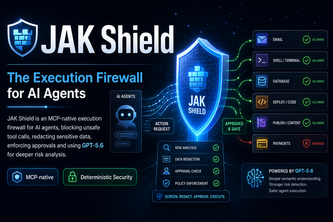
JAK Shield is described as an MCP-native execution firewall for AI agents. It is positioned as a local-first security layer that sits between an AI agent and its tools, evaluating tool calls before execution and making deterministic decisions (allow, redact, rewrite, requires_approval, block) based on a policy engine.
What changed
The project description indicates a shift from prompt-level safety to a hard execution boundary. It introduces a layered approach combining deterministic controls with optional semantic analysis via GPT-5.6 for risk assessment, while maintaining strict enforcement authority that cannot be overridden by AI decisions.
Single most important open question — the commercial due-diligence read
Is there any evidence of real-world usage or integration beyond early testing and hackathon submission? The description states the product is ready for "controlled early testing" but not production deployment, with no mention of customers, revenue, or adoption.
What The Product Actually Is
The description states that JAK Shield is a local-first, MCP-native execution firewall for AI agents. It operates between an AI agent and its tools, evaluating every protected tool call and returning one of five decisions: allow, redact, rewrite, requires_approval, or block.
It uses:
- A deterministic policy engine as the final enforcement authority.
- Optional integration with GPT-5.6 for semantic risk analysis (used only for advisory purposes).
- Taint tracking to monitor untrusted information across multiple tool calls.
- Role-based access control (RBAC) and exact-call, scoped, single-use authorisation tokens.
- A Floodgate emergency lockdown feature that closes all non-read-only execution paths.
- Cryptographically signed audit records.
It supports:
- MCP over STDIO and Streamable HTTP
- REST API
- Next.js dashboard
- Electron desktop app
The product is built as a TypeScript monorepo, with components including:
- Policy engine
- MCP server (STDIO & HTTP)
- Fastify REST API
- Human approval gateway
- PII/redaction layer
- Prompt-injection detection
- Signed audit infrastructure
- Protected connector operations
It integrates with Codex via an MCP configuration, routing external side effects through shield.proxy_tool_call and using shield.evaluate_tool_call for non-destructive evaluations.
Positioning & Claim Evolution
The description states that the project was inspired by the realization that prompt-level safety is insufficient when AI agents can perform real-world actions like sending emails, running terminal commands, accessing databases, deploying software, publishing content, and initiating payments.
It claims to address a fundamental security problem: the same model deciding what action to take should not be the final authority deciding whether that action is safe.
The positioning has evolved from:
- A general AI agent safety tool →
- A hard execution boundary between intention and real-world impact →
- A deterministic policy engine with optional semantic analysis, where AI is advisory, not authoritative
It also claims to be a universal execution-security layer for autonomous agents, aiming to give developers freedom without unchecked authority.
Target Customer & ICP
The description does not explicitly name target customers or define an Ideal Customer Profile (ICP). However, it implies that the primary users are:
- Developers building AI agents
- Teams integrating AI with real-world tools and systems
- Organizations using MCP-compatible AI frameworks such as Codex
It is positioned for developers who want to build powerful AI systems without giving those systems unchecked authority over real-world tools.
Business Model & Pricing Evidence
Not evidenced. The description does not contain any information about pricing, monetization strategy, or business model.
Technical & Delivery Signals
The project is built as a TypeScript monorepo using:
- Fastify
- Next.js
- Electron
- Docker
- PostgreSQL
- Prisma
- Prometheus
- Zod
- Vitest
- Turborepo
It uses:
- MCP (Model Control Protocol) over STDIO and Streamable HTTP
- REST API
- GPT-5.6 via OpenAI Responses API for optional semantic analysis
- Local pre-egress redaction before AI analysis
- Taint tracking across tool calls
- Signed audit trails
It includes:
- A verification flow that tests MCP startup, tool discovery, evaluation, proxying, and destructive SQL blocking.
- Reference integrations for additional agent frameworks.
Traction & Maturity Signals
Not evidenced. The description states:
- JAK Shield is ready for controlled early testing, not unrestricted production deployment.
- It was submitted to the OpenAI 2026 hackathon.
- It has undergone:
- Clean Windows virtual-machine acceptance
- Code signing (planned)
- Independent penetration test (planned)
- Multi-tenant hardening (planned)
No revenue, customers, or adoption data are provided.
Competitive Context
Not evidenced. The description does not mention competitors or the competitive landscape.
Open Questions & Risks
- No traction or commercial use: The product is described as ready for early testing but not production deployment.
- Unverified AI integration: GPT-5.6 is used only for advisory purposes, but its actual performance and reliability in real-world scenarios are unknown.
- Limited validation: No third-party penetration tests, no customer feedback, no live deployments.
- Self-reported maturity: The team states it’s not ready for production use, which raises questions about readiness for enterprise adoption.
- Single-founder team: Only one member listed (REETURAJ GOSWAMI), which may limit scalability or operational capacity.
Questions the description leaves open
- What specific real-world integrations or use cases have been tested beyond the hackathon?
- How is the deterministic policy engine validated and audited for correctness?
- Has the team conducted any internal or external security testing (e.g., penetration tests)?
- Are there any early adopters or pilot customers using this in a controlled environment?
- What are the plans for scaling beyond the current monorepo architecture?
- How does JAK Shield handle edge cases where the deterministic engine and GPT-5.6 disagree?
- What is the roadmap for enterprise features, multi-tenancy, and hosted deployment?
Overall Assessment
Not evidenced. The description does not provide any information on funding rounds, valuation, or investment history.
The project appears to be in an early-stage prototype or proof-of-concept phase, submitted to a hackathon. It shows technical depth and a clear understanding of AI agent security challenges but lacks evidence of traction, revenue, customers, or commercial viability.
Confidence level: Low — based entirely on self-reported claims with no external validation or data points.
User Stories BotA demo video on every pull request
Get a demo video on every new feature
GitHub App that watches your pull requests and records a narrated, captioned demo.
Save time on demo prep and make informed decisions faster with a video walkthrough of every new feature.
Source
Submitted to the OpenAI 2026 hackathon on Devpost. Project home on Devpost. Back to the full gallery on Devpost.
This competitive analysis was produced by top-founders.com (opens in a new tab)
Generated by a language model from this project's public Devpost page — its tagline, the author's own write-up and any built-with tags listed there — as captured in August 2026. Short quotations are the author's words. It is an opinion on the idea as a business, not on the people behind it, and it reflects the description as published then. If the project has moved on, request a correction below. The analysis is not independent research and contains no verified traction, revenue or customer data.
An independent guide by KFG International LLC — not affiliated with, endorsed by, or connected to Devpost or OpenAI.