

Archive position — measured, not model output
0 likes on Devpost
2,263 of the 7,850 archived projects have more likes, and 5,587 share exactly 0 — so this project's #3,092 place in the like-ranked listing is a tie-break inside that group, not a ranking.
Projects (log scale)
Likes on Devpost. ▲ marks this project's group.
Show the figures
| Likes | Projects | Share of archive |
|---|---|---|
| 0 | 5,587 | 71.2% |
| 1 | 1,758 | 22.4% |
| 2 | 284 | 3.6% |
| 3–4 | 132 | 1.7% |
| 5–9 | 75 | 1.0% |
| 10+ | 14 | 0.2% |
 User Stories BotA demo video on every pull request
Get a demo video on every new feature
GitHub App that watches your pull requests and records a narrated, captioned demo.
Save time on demo prep and make informed decisions faster with a video walkthrough of every new feature.
Executive Summary
What the company appears to be
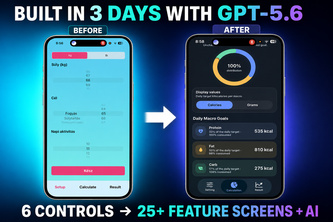
CalorieGraphTracker is an iOS nutrition tracking app built during OpenAI Build Week 2026. The author describes it as a tool for macro tracking that aims to simplify weight loss, maintenance, or gain by offering two modes—simple and advanced—and integrating AI to guide users through food logging, meal planning, and progress visualization.
What changed
The project evolved from a basic two-screen prototype into a feature-rich application with over 25 user-facing screens, an AI-assisted backend, subscription infrastructure, and TestFlight-ready structure—all developed in less than a week using an AI-first development process powered by Codex and GPT-5.6.
Single most important open question
Is there any evidence of real-world usage or product-market fit beyond the author’s own testing and iteration?
What The Product Actually Is
The description states that CalorieGraphTracker is a nutrition tracking app for iOS, built using Swift and UIKit, with a server-side AI backend implemented via Codex and GPT-5.6. It supports two user modes: simple and advanced. Features include:
- Personalized daily calorie and macro goal calculation
- Manual or AI-powered food logging
- Meal suggestions based on remaining targets
- Visual dashboards, food logs, calendar views
- Body measurement tracking
- Portion optimization
- Food preferences and exclusions
- Localization and privacy controls
- Swipe-based food preference basket
It also integrates with StoreKit for subscriptions, uses iOS Keychain for session tokens, and implements App Attest and DeviceCheck for security.
The app was built using an AI-assisted workflow where the author described desired behavior and tested results iteratively. The code was generated by Codex but guided by human decisions, testing, and feedback.
Evidence
- Author’s own write-up
- Technology stack listed (Swift, UIKit, Codex, GPT-5.6, etc.)
- Feature list provided in detail
Inference The app is designed to be usable by both beginners and experts, with a focus on reducing complexity and time spent on tracking.
Positioning & Claim Evolution
The author positions CalorieGraphTracker as an AI-guided tool that makes macro tracking easy for all users. The tagline compares macro tracking to using a remote control for TV — implying intuitive control over one’s nutrition goals.
Key claims:
- Macro tracking should be simple for beginners and fast for experts.
- AI helps explain what has been eaten and suggests what fits into the rest of the day.
- Users can avoid becoming nutrition experts while still achieving their goals.
- The app removes barriers to entry, especially around complexity and time spent planning meals.
Evidence
- Tagline
- Author’s narrative about personal struggle with macro tracking
- Description of two user modes (simple vs. advanced)
- Claims about AI assistance in food logging and meal suggestions
Inference The positioning suggests a shift from traditional, manual or expert-heavy tools toward an accessible, AI-enhanced experience.
Target Customer & ICP
The author describes the app as serving people working toward:
- Weight loss
- Weight maintenance
- Healthy weight gain
It targets users who:
- Have struggled with inconsistent results despite regular exercise
- Want to understand how calories and macronutrients affect their goals
- May lack experience in nutrition or time to plan meals manually
The app is positioned for those who want to avoid becoming “nutrition experts” but still need practical tools.
Evidence
- Author’s personal story of difficulty with weight management
- Description of two user modes (beginner-friendly and expert-level)
- Focus on reducing complexity and time investment
Inference The ICP likely includes individuals interested in health and fitness, particularly those seeking structured support for diet and macro tracking.
Business Model & Pricing Evidence
There is no explicit mention of pricing or monetization strategy in the project description. The app supports StoreKit subscription infrastructure, suggesting a potential paid model, but no details are given about:
- Subscription tiers
- Pricing structure
- Free vs. premium features
- Revenue streams beyond subscriptions
The author mentions “subscription infrastructure” and “StoreKit support,” but does not elaborate.
Evidence
- Mention of StoreKit integration
- Reference to subscription infrastructure
Inference If the app moves beyond prototype stage, it may adopt a freemium or subscription-based model, though this is speculative without further data.
Technical & Delivery Signals
The app was built using:
- Swift and UIKit for iOS development
- Codex (powered by GPT-5.6) to generate code
- Server-side AI backend
- GitHub for version control
- OpenAI API for AI functions
- App Attest and DeviceCheck for session security
- TestFlight for testing
Development was iterative, involving:
- Human-defined goals
- AI-generated implementation
- Real-world testing on device
- Feedback loops to refine behavior
The author notes that the process required patience due to AI delays and human validation of usability.
Evidence
- Technology stack listed
- Development methodology described
- Mention of security features (App Attest, DeviceCheck)
- Iterative development approach
Inference The use of AI for code generation indicates a novel or experimental approach to product development. However, the reliance on human oversight suggests that full autonomy is not yet achieved.
Traction & Maturity Signals
There is no evidence of real-world usage, customer acquisition, revenue, or user engagement beyond the author’s own testing and iteration during Build Week.
The app:
- Was submitted as a hackathon project
- Has not been released to the public (only TestFlight-ready)
- Contains no mention of beta users, early adopters, or feedback from real users
Evidence
- Submitted to OpenAI Build Week 2026
- Mentioned as “TestFlight-ready”
- No data on downloads, retention, or usage metrics
Inference The product is at a very early stage—likely pre-launch—and lacks any demonstrated traction or market validation.
Competitive Context
No mention of competitors or competitive landscape in the provided description. The author does not reference existing apps or platforms in the macro tracking or nutrition space.
Evidence
- No comparison to other tools
- No discussion of market positioning relative to others
Inference Without context, it is unclear whether this app addresses a gap in the market or competes with established players. This is an open question that requires deeper research.
Open Questions & Risks
- Unproven Market Fit: The app has no evidence of real-world usage or customer feedback.
- AI Dependency Risk: Heavy reliance on AI for development may lead to instability, lack of control, or scalability issues if the underlying models change.
- Limited Team Size: Only one team member is involved; this raises concerns about long-term sustainability and execution.
- No Revenue or Monetization Strategy: No indication of how the product will generate income.
- Prototype Stage: The app is described as a prototype, not yet launched to users.
Evidence
- Author’s own account of development
- Lack of user data or revenue metrics
- Single-person team
Inference The risk of failure increases significantly due to lack of traction, monetization clarity, and team capacity.
Questions the description leaves open
- What specific problems did you encounter during the AI-assisted development process that were not resolved?
- How do you plan to validate market demand beyond your own experience?
- Are there any plans for user testing or feedback collection before launch?
- What is the long-term vision for monetization and scaling?
- How will the app handle data privacy and compliance (especially with health-related information)?
- What are the key assumptions about user behavior that underpin the product design?
Overall Assessment
Not evidenced
There is insufficient evidence to assess whether this project warrants investment or partnership interest. The description indicates a promising concept, but lacks any demonstration of traction, revenue, or customer validation.
The author’s narrative suggests innovation in AI-assisted development and a clear user need, yet the absence of real-world usage, financials, or competitive analysis makes it difficult to evaluate commercial viability.
Confidence Level Low
Reasoning
Self-reported only; no third-party verification, no revenue, customers, or adoption data. The project is described as a prototype developed in a short timeframe under unique conditions (hackathon), which limits its readiness for investment or partnership evaluation.
User Stories BotA demo video on every pull request
Get a demo video on every new feature
GitHub App that watches your pull requests and records a narrated, captioned demo.
Save time on demo prep and make informed decisions faster with a video walkthrough of every new feature.
Source
Submitted to the OpenAI 2026 hackathon on Devpost. Project home on Devpost. Back to the full gallery on Devpost.
This competitive analysis was produced by top-founders.com (opens in a new tab)
Generated by a language model from this project's public Devpost page — its tagline, the author's own write-up and any built-with tags listed there — as captured in August 2026. Short quotations are the author's words. It is an opinion on the idea as a business, not on the people behind it, and it reflects the description as published then. If the project has moved on, request a correction below. The analysis is not independent research and contains no verified traction, revenue or customer data.
An independent guide by KFG International LLC — not affiliated with, endorsed by, or connected to Devpost or OpenAI.