

Archive position — measured, not model output
0 likes on Devpost
2,263 of the 7,850 archived projects have more likes, and 5,587 share exactly 0 — so this project's #3,093 place in the like-ranked listing is a tie-break inside that group, not a ranking.
Projects (log scale)
Likes on Devpost. ▲ marks this project's group.
Show the figures
| Likes | Projects | Share of archive |
|---|---|---|
| 0 | 5,587 | 71.2% |
| 1 | 1,758 | 22.4% |
| 2 | 284 | 3.6% |
| 3–4 | 132 | 1.7% |
| 5–9 | 75 | 1.0% |
| 10+ | 14 | 0.2% |
 User Stories BotA demo video on every pull request
Get a demo video on every new feature
GitHub App that watches your pull requests and records a narrated, captioned demo.
Save time on demo prep and make informed decisions faster with a video walkthrough of every new feature.
Executive Summary
What the company appears to be
Calqen is a self-reported AI wardrobe stylist tool that uses GPT-5.6 to generate three distinct, ranked outfit recommendations from a user’s existing wardrobe. It allows users to describe an occasion and constraints, then produces tailored looks with explanations and supports targeted refinements while preserving compatible components.
What changed
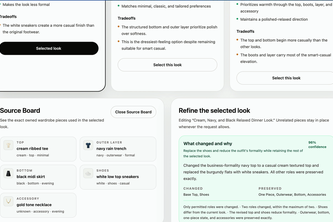
During Build Week, the author added a production-grade GPT-5.6 Decision Studio runtime to an already functional wardrobe foundation. This included structured output planning, natural-language refinement, role reporting, source board ownership proof, and strict validation of model outputs against user-owned items.
Single most important open question — the commercial due-diligence read
Is there a viable market need for this type of AI-powered wardrobe decision-making tool, or is it a personal project with limited commercial traction?
What The Product Actually Is
The description states that Calqen is an AI wardrobe stylist built around a GPT-5.6 Decision Studio. It generates exactly three complete looks from a user's authenticated owned wardrobe based on contextual inputs like occasion, weather, formality, and comfort needs.
It includes:
- Structured three-look planning.
- Natural-language refinement of outfits.
- Role reporting (which parts changed vs stayed).
- Source Board to verify final components map back to owned items.
- Strict output validation using server-side checks and request-scoped references.
- Deterministic fallback behavior when needed.
The system uses a combination of technologies including Next.js 14, TypeScript, React, Tailwind CSS, Turso/libSQL, Drizzle ORM, JWT authentication, Vercel Blob, and the OpenAI Responses API with gpt-5.6-sol.
Not evidenced:
- Whether the product is live or used by anyone beyond the author.
- Any revenue, customer base, or usage metrics.
- The actual performance of the AI in real-world scenarios outside of controlled testing.
Positioning & Claim Evolution
The description states that Calqen begins with a practical question: “what can I do with the clothes I already own?” rather than starting with inspiration or shopping. It positions itself as a decision tool, not an open-ended styling chatbot.
Key claims:
- It produces exactly three distinct, complete looks from an owned wardrobe.
- It explains context, constraints, and tradeoffs in plain language.
- It makes targeted changes while preserving compatible roles.
- It proves final ownership through the Source Board.
- It uses deterministic evaluation suites covering planning and refinement cases.
Inferences:
- The author sees value in grounding AI recommendations in existing personal inventory.
- There is an emphasis on control and transparency over AI-generated suggestions.
Not evidenced:
- How this compares to other wardrobe tools or apps.
- Whether these claims reflect actual user experience or just internal testing.
- Any competitive positioning beyond self-description.
Target Customer & ICP
The description implies that Calqen targets individuals who own a significant portion of their wardrobe but struggle to see how to combine pieces for specific situations — particularly those looking for quick, practical decisions without additional purchases.
It appears aimed at people who:
- Have an authenticated wardrobe.
- Want to make decisions quickly (e.g., “dinner in an hour”).
- Value clarity and control over AI suggestions.
- Prefer not to buy new clothes but want to maximize what they already own.
Not evidenced:
- Specific demographics or user segments.
- Market size or target audience segmentation.
- Any evidence of customer interviews, surveys, or feedback loops.
Business Model & Pricing Evidence
The description does not provide any information about pricing, monetization strategy, or business model. It only describes the technical functionality and runtime environment.
Not evidenced:
- Revenue streams.
- Subscription tiers or freemium models.
- Any commercial partnerships or sales channels.
- Customer acquisition costs or lifetime value estimates.
Technical & Delivery Signals
The system is built with:
- Next.js 14, TypeScript, React, Tailwind CSS
- Turso/libSQL, Drizzle ORM
- JWT and cookie authentication
- Vercel Blob for storage
- OpenAI Responses API with gpt-5.6-sol
Key technical features include:
- Structured output contracts.
- Request-scoped references to prevent hallucinations.
- Strict validation of model outputs against user-owned items.
- Bounded repair paths and fallback labeling.
- Deterministic evaluation suites covering 100 planning and 60 refinement cases.
Not evidenced:
- Scalability or infrastructure capacity.
- Long-term maintainability or deployment practices.
- Any production monitoring, error tracking, or logging systems beyond the demo.
Traction & Maturity Signals
The description mentions that Calqen was already a working wardrobe product before Build Week. It had:
- Authentication
- Wardrobe ingestion and tagging
- Profile and size memory
- Deterministic recommendation foundations
- Vercel deployment
During Build Week, it added:
- Production GPT-5.6 Decision Studio runtime
- Structured three-look planning
- Targeted natural-language refinement
- Source Board ownership proof
- Request-scoped references and server-side validation
- Quotas, timeouts, repair limits, and truthful fallback behavior
The author claims:
- 12 out of 12 bounded-live planning and refinement cases passed with zero fallback or hallucinated references.
- Desktop and mobile judge journeys completed without errors.
Not evidenced:
- Real-world usage data.
- Customer feedback or adoption metrics.
- Any evidence of growth, retention, or monetization.
- Whether the product has moved beyond prototype stage into a usable service.
Competitive Context
The description does not mention any competitors. It focuses solely on Calqen’s own functionality and claims.
Not evidenced:
- Direct or indirect competitors in the wardrobe or styling space.
- Market share or competitive positioning.
- Any differentiation strategy against existing tools.
Open Questions & Risks
Inferences:
- The project is highly experimental, built during a hackathon, and lacks real-world validation.
- There is no evidence of traction, revenue, or customer adoption.
- The focus on deterministic outputs and strict validation may limit scalability or flexibility.
- The lack of pricing or monetization strategy raises questions about long-term viability.
Open questions:
- No mention of user acquisition, retention, or monetization plans.
- Limited team size (only one member) suggests potential resource constraints.
- Heavy reliance on a single AI model with limited fallbacks could be risky.
- The product is described as a "personal project" without indication of broader commercial intent.
Not evidenced:
- Any risk mitigation strategies.
- Financial or operational sustainability beyond the author’s personal effort.
Questions the description leaves open
- What inspired you to build this tool? Was there a specific pain point in your own wardrobe that led to this solution?
- How do you plan to scale beyond one person building and testing it?
- Have you tested the product with real users outside of the judge journey?
- Are there any plans for monetization or commercial partnerships?
- What are the key assumptions behind the current approach, and how might they change in a larger market?
- How do you intend to handle privacy concerns related to storing personal wardrobe data?
- Is there any intention to expand beyond the current scope (e.g., exact try-on, shopping recommendations)?
- What would constitute success for this product in terms of user engagement or adoption?
Overall Assessment
The description indicates that Calqen is a self-reported personal project built during a hackathon. It shows technical capability and clear design intent but lacks evidence of traction, revenue, or customer validation.
This is not a commercial-grade product yet — it appears to be an experimental prototype with strong execution in the short term. The author has demonstrated ability to build a functional system using modern tools and AI frameworks, but there is no indication that this has evolved into a scalable business or product with real users.
Assessment Not ready for investment or partnership at this time. The project shows promise as a proof-of-concept, but further development, user testing, and commercial traction are required before any serious consideration of funding or collaboration.
User Stories BotA demo video on every pull request
Get a demo video on every new feature
GitHub App that watches your pull requests and records a narrated, captioned demo.
Save time on demo prep and make informed decisions faster with a video walkthrough of every new feature.
Source
Submitted to the OpenAI 2026 hackathon on Devpost. Project home on Devpost. Back to the full gallery on Devpost.
This competitive analysis was produced by top-founders.com (opens in a new tab)
Generated by a language model from this project's public Devpost page — its tagline, the author's own write-up and any built-with tags listed there — as captured in August 2026. Short quotations are the author's words. It is an opinion on the idea as a business, not on the people behind it, and it reflects the description as published then. If the project has moved on, request a correction below. The analysis is not independent research and contains no verified traction, revenue or customer data.
An independent guide by KFG International LLC — not affiliated with, endorsed by, or connected to Devpost or OpenAI.