

Archive position — measured, not model output
0 likes on Devpost
2,263 of the 7,850 archived projects have more likes, and 5,587 share exactly 0 — so this project's #3,037 place in the like-ranked listing is a tie-break inside that group, not a ranking.
Projects (log scale)
Likes on Devpost. ▲ marks this project's group.
Show the figures
| Likes | Projects | Share of archive |
|---|---|---|
| 0 | 5,587 | 71.2% |
| 1 | 1,758 | 22.4% |
| 2 | 284 | 3.6% |
| 3–4 | 132 | 1.7% |
| 5–9 | 75 | 1.0% |
| 10+ | 14 | 0.2% |
 User Stories BotA demo video on every pull request
Get a demo video on every new feature
GitHub App that watches your pull requests and records a narrated, captioned demo.
Save time on demo prep and make informed decisions faster with a video walkthrough of every new feature.
Executive Summary
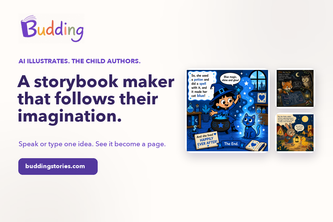
What the company appears to be: Budding is a self-reported child-led storybook-making tool that uses AI to support imaginative storytelling while preserving the child’s authorship. It integrates GPT-5.6 Terra and OpenAI image generation, with a focus on narrative continuity, safety, and child-first interaction.
What changed: The project evolved from an early-stage product skeleton into a self-serve, production-ready experience during a Build Week period. Key improvements included better image consistency, faster narration, structured AI prompts, and a native iPhone/iPad shell.
The single most important open question: Is there evidence of real-world usage or engagement by children and parents that supports the claim of educational impact?
Note: This analysis is based entirely on the self-reported project description provided. No external verification, traction data, revenue figures, or customer information are available.
What The Product Actually Is
The description states that Budding is a child-led storybook maker designed to teach storytelling through imagination and illustration. It allows children to speak the first part of a story, which then gets turned into an illustrated, narrated page using AI tools like GPT-5.6 Terra and OpenAI image generation.
Key features include:
- A choice of 22 illustration styles.
- Child-led narrative creation with optional prompts from Story Helper.
- Narration added to pages via TTS (Text-to-Speech).
- Private books by default, with opt-in sharing.
- Redo/change functionality through voice input.
- Support for both web and native iOS environments.
The product uses:
- React + TypeScript + Vite frontend
- Cloudflare Workers, D1, R2, Queues backend
- OpenAI Responses API (GPT-5.6 Terra)
- OpenAI image generation
- Capacitor 8 for iPhone/iPad shell
Inference: The author claims the product supports full idea-to-book loop and includes fixes for latency, continuity, and media delivery during Build Week.
Positioning & Claim Evolution
The project positions itself as a tool that empowers children to become authors while teaching narrative concepts in an age-appropriate way. It emphasizes:
- Child-led storytelling
- Creative skill development
- Use of AI to enhance rather than replace imagination
- Safe, private-by-default experience
It also claims to use AI not just for generating content but for offering "bounded creative pressure" — i.e., structured constraints that guide creativity without dictating outcomes.
Inference: The evolution from a “skeleton” to a production-ready product shows intent and progress toward commercial viability. However, no evidence of actual user feedback or adoption exists in the description.
Target Customer & ICP
The primary target is children aged 3–10, who are encouraged to lead story creation with adult support. The secondary audience includes parents or caregivers who facilitate the experience and manage privacy settings.
The product is designed for:
- Families seeking creative educational tools
- Parents wanting safe, child-first digital experiences
- Educators interested in narrative-based learning
Not evidenced: No specific demographic data, usage patterns, or customer segmentation beyond general age ranges.
Business Model & Pricing Evidence
There is no mention of pricing models, monetization strategies, or business model details in the description. The author does not describe how they plan to charge users or whether there are paid features.
Not evidenced: No indication of revenue streams, subscriptions, freemium tiers, or B2B vs B2C plans.
Technical & Delivery Signals
The product integrates several technologies:
- AI: GPT-5.6 Terra via OpenAI Responses API
- Image generation: OpenAI image APIs
- TTS (Narration): Gemini TTS
- Frontend: React + TypeScript + Vite
- Backend: Cloudflare Workers, D1, R2, Queues
- Mobile platform: Capacitor 8 for iOS
Key technical improvements noted during Build Week:
- Improved character consistency and story continuity
- Faster narration preparation
- Structured output validation from GPT-5.6 Terra
- Native iPhone/iPad shell with secure media handling
- Reduced latency and generation costs
Inference: The use of structured AI outputs, caching mechanisms, and device-specific optimizations suggests attention to performance and user experience.
Traction & Maturity Signals
The author reports:
- A working prototype before Build Week
- Extension into a production-ready version during Build Week
- Automated testing, dependency audits, and release gates
- Regression notes and durable documentation
However, there is no evidence of:
- Real-world usage or engagement metrics
- Customer acquisition or retention data
- Sales figures or user growth
- Public availability or distribution channels
Not evidenced: No signs of traction, adoption, or market validation beyond internal development progress.
Competitive Context
The description does not provide any information about competitors or the competitive landscape. It doesn’t mention similar products, pricing, or positioning in the broader edtech or creative storytelling space.
Not evidenced: No competitive analysis, benchmarking, or differentiation strategy described.
Open Questions & Risks
- Unverified claims: All assertions are self-reported and unverified.
- No traction data: No evidence of real-world usage, customer feedback, or adoption.
- Limited scope: The project is described as a single-person effort with no team or external support.
- Unclear monetization path: No indication of how the product will generate revenue.
- Privacy concerns: While privacy is emphasized, no details on data handling or compliance are given.
- AI dependency risk: Heavy reliance on GPT-5.6 Terra and OpenAI services may pose risks if those APIs change or become unavailable.
Inference: The lack of third-party validation, user testing, or business model clarity raises questions about scalability and commercial viability.
Questions the description leaves open
- What specific educational outcomes have you observed in children using the product?
- How do you plan to scale beyond a single developer’s effort?
- Are there any existing users or pilot programs with families or educators?
- What are your plans for monetization and pricing?
- How do you ensure long-term stability of AI integrations like GPT-5.6 Terra?
- Have you considered accessibility compliance (e.g., WCAG)?
- What is the timeline for Apple approval and app store release?
Overall Assessment
This project is presented as a child-focused storytelling tool with strong technical execution, particularly around AI integration, mobile delivery, and narrative continuity. However, due to its self-reported nature and lack of verified traction or business model, it cannot be evaluated for investment or partnership potential at this stage.
Confidence level: Low — based on thin evidence and unverified claims.
Next steps: If further development is pursued, focus should be on gathering real-world usage data, validating educational impact, and outlining a clear path to market and monetization.
User Stories BotA demo video on every pull request
Get a demo video on every new feature
GitHub App that watches your pull requests and records a narrated, captioned demo.
Save time on demo prep and make informed decisions faster with a video walkthrough of every new feature.
Source
Submitted to the OpenAI 2026 hackathon on Devpost. Project home on Devpost. Back to the full gallery on Devpost.
This competitive analysis was produced by top-founders.com (opens in a new tab)
Generated by a language model from this project's public Devpost page — its tagline, the author's own write-up and any built-with tags listed there — as captured in August 2026. Short quotations are the author's words. It is an opinion on the idea as a business, not on the people behind it, and it reflects the description as published then. If the project has moved on, request a correction below. The analysis is not independent research and contains no verified traction, revenue or customer data.
An independent guide by KFG International LLC — not affiliated with, endorsed by, or connected to Devpost or OpenAI.