

Archive position — measured, not model output
0 likes on Devpost
2,263 of the 7,850 archived projects have more likes, and 5,587 share exactly 0 — so this project's #3,038 place in the like-ranked listing is a tie-break inside that group, not a ranking.
Projects (log scale)
Likes on Devpost. ▲ marks this project's group.
Show the figures
| Likes | Projects | Share of archive |
|---|---|---|
| 0 | 5,587 | 71.2% |
| 1 | 1,758 | 22.4% |
| 2 | 284 | 3.6% |
| 3–4 | 132 | 1.7% |
| 5–9 | 75 | 1.0% |
| 10+ | 14 | 0.2% |
 User Stories BotA demo video on every pull request
Get a demo video on every new feature
GitHub App that watches your pull requests and records a narrated, captioned demo.
Save time on demo prep and make informed decisions faster with a video walkthrough of every new feature.
Executive Summary
Budget Compass – AI-Powered Travel Decision Assistant is a self-reported full-stack web application built as a hackathon project by one developer (Deepika Leelakumar). The product claims to help travelers make smarter transportation decisions using AI, evaluating factors like budget, travel time, comfort, safety, and walking preference. It uses a deterministic scoring engine for recommendations and OpenAI APIs for generating explanations.
The description states that the application is in early development, with no revenue, customers or traction evidenced. The author reports building it within a hackathon timeline using React, Spring Boot, and OpenAI APIs. There is no evidence of funding rounds, partnerships, or market validation beyond the self-reported write-up.
Most Important Open Question
Is there any evidence that Budget Compass has moved beyond a prototype or MVP to demonstrate real-world utility or user adoption?
What The Product Actually Is
The description states that Budget Compass is an AI-powered travel decision assistant designed to recommend transportation options based on user-defined criteria such as budget, travel time, comfort, safety, and walking preference. It uses:
- A deterministic scoring engine to evaluate multiple transport modes
- An AI component (OpenAI Responses API) to generate human-friendly explanations for recommendations
It is described as a full-stack web application, built with:
- Frontend: React, Vite, Tailwind CSS
- Backend: Spring Boot, Java
- AI: OpenAI API
- Version control: Git & GitHub
The author reports that it was developed within a hackathon timeframe and currently functions as an MVP.
Inference The product is not evidenced to be live or used beyond the developer's own testing or demonstration.
Positioning & Claim Evolution
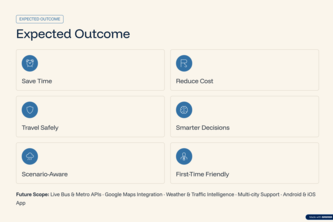
The description states that Budget Compass aims to help travelers make smarter, safer, and budget-friendly transportation decisions with AI, addressing a challenge faced by students, newcomers, tourists, and daily commuters in unfamiliar places.
It positions itself as an alternative to navigation apps that only show directions, instead answering the question:
“Which travel option is the best for me based on my budget, travel time, comfort, and safety?”
The author also notes that it supports dynamic scenarios like heavy rain or missed buses, which influence recommendations. Future plans include integrating Google Maps, live transport APIs, and multi-city support.
Claim
The product is positioned as a decision-making tool rather than a navigation or booking app.
Inference The positioning reflects an attempt to differentiate from existing tools by focusing on user-specific criteria and AI-generated reasoning.
Target Customer & ICP
The description states that Budget Compass targets:
- Students
- Newcomers
- Tourists
- Daily commuters
These users are said to face the challenge of choosing the best travel option in unfamiliar places, especially when balancing budget, time, comfort, safety, and walking preferences.
Claim
The target audience is individuals who struggle with transportation decisions in new or complex environments.
Inference No evidence exists regarding specific customer segments, personas, or user acquisition strategies beyond the author’s personal experience.
Business Model & Pricing Evidence
The description does not provide any information about:
- Revenue streams
- Pricing models
- Monetization strategy
- Customer acquisition costs
- Subscription plans or transaction fees
Not evidenced.
Technical & Delivery Signals
The project is described as a full-stack web application, built with:
- Frontend: React, Vite, Tailwind CSS
- Backend: Spring Boot, Java
- AI: OpenAI API
- Version control: Git & GitHub
It uses:
- A deterministic scoring engine for recommendations
- OpenAI Responses API to generate explanations
- REST APIs for communication between frontend and backend
Challenges mentioned include:
- Integrating frontend with backend
- Resolving CORS issues
- Configuring deployment and environment variables
- Building a realistic dataset without live APIs
Inference The technical stack suggests a basic MVP, but no evidence of scalability or production-grade infrastructure.
Traction & Maturity Signals
The description states that this is a hackathon project, built within a short timeline. No evidence of:
- Users or customers
- Revenue or monetization
- Product-market fit
- Market traction or adoption
- Live deployment or usage metrics
Not evidenced.
Competitive Context
The description does not mention any competitors or existing solutions in the travel decision-making space.
Not evidenced.
Open Questions & Risks
- Single Developer: The project was built by one person, raising questions about scalability and long-term maintenance.
- Prototype Status: No evidence of live deployment or user feedback beyond the author’s experience.
- Limited Data Sources: The application reportedly uses a synthetic dataset for Chennai, not real-time transport data.
- No Revenue or Traction: There is no indication that the product has moved beyond an MVP or generated any revenue.
- Unverified Claims: All claims are self-reported and unverified.
Inference The lack of traction, funding, or market validation raises concerns about commercial viability.
Questions the description leaves open
- What is the current status of the product? Is it deployed or still in prototype form?
- Have you conducted any user testing or gathered feedback from target users?
- How do you plan to monetize this product, if at all?
- Are there any partnerships or integrations with public transport systems or travel platforms?
- What are your plans for scaling beyond Chennai and supporting other cities?
- How do you intend to handle real-time data integration (e.g., live bus/metro APIs)?
- What is the long-term vision for Budget Compass, and how does it differ from existing tools?
Overall Assessment
The description states that this is a hackathon project built by one developer with no evidence of traction, revenue, or market validation.
Assessment Not ready for investment or partnership at this stage. The product appears to be an early-stage MVP with no demonstrated commercial viability or user adoption.
Confidence Level Low — based entirely on self-reported information and no external corroboration.
User Stories BotA demo video on every pull request
Get a demo video on every new feature
GitHub App that watches your pull requests and records a narrated, captioned demo.
Save time on demo prep and make informed decisions faster with a video walkthrough of every new feature.
Source
Submitted to the OpenAI 2026 hackathon on Devpost. Project home on Devpost. Back to the full gallery on Devpost.
This competitive analysis was produced by top-founders.com (opens in a new tab)
Generated by a language model from this project's public Devpost page — its tagline, the author's own write-up and any built-with tags listed there — as captured in August 2026. Short quotations are the author's words. It is an opinion on the idea as a business, not on the people behind it, and it reflects the description as published then. If the project has moved on, request a correction below. The analysis is not independent research and contains no verified traction, revenue or customer data.
An independent guide by KFG International LLC — not affiliated with, endorsed by, or connected to Devpost or OpenAI.