

Archive position — measured, not model output
0 likes on Devpost
2,263 of the 7,850 archived projects have more likes, and 5,587 share exactly 0 — so this project's #3,039 place in the like-ranked listing is a tie-break inside that group, not a ranking.
Projects (log scale)
Likes on Devpost. ▲ marks this project's group.
Show the figures
| Likes | Projects | Share of archive |
|---|---|---|
| 0 | 5,587 | 71.2% |
| 1 | 1,758 | 22.4% |
| 2 | 284 | 3.6% |
| 3–4 | 132 | 1.7% |
| 5–9 | 75 | 1.0% |
| 10+ | 14 | 0.2% |
 User Stories BotA demo video on every pull request
Get a demo video on every new feature
GitHub App that watches your pull requests and records a narrated, captioned demo.
Save time on demo prep and make informed decisions faster with a video walkthrough of every new feature.
Executive Summary
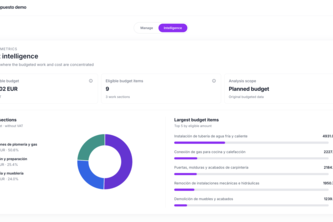
The description states that "Budget Intelligence for Construction" is a collaborative budget management solution built as a hackathon project by one person (rando128 SH). The author claims it uses AI-assisted capabilities to interpret construction budgets, aiming to improve communication and transparency among homeowners, architects, constructors, and supervisors. It includes a chatGPT plugin and features for importing PDF budgets with AI-driven explanations. The product is described as attempting to simplify budgets into more understandable terms using natural language processing.
The single most important open question is: What evidence exists that this solution has traction or proven utility in real-world construction projects? The description contains no data on revenue, customers, usage, or adoption beyond the author's self-reported experience and project scope.
This analysis is based entirely on the self-reported, unverified account provided by the author. It does not reflect any independent verification of claims, performance metrics, or market validation.
What The Product Actually Is
The description states that the product is a "collaborative budget management solution" for construction projects. It includes:
- A chatGPT plugin
- AI-assisted capabilities for importing PDF budgets
- Budget intelligence features to explain what work is being performed, why it costs money, and what remains unclear
- Tools to simplify budgets into more understandable terms using natural language processing
The author describes building the platform "entirely vibe-coded during over 52 weekends" with deep research and PRD discussions involving ChatGPT. For this hackathon, they used GPT-5.6-sol to implement AI-assisted budget intelligence.
Not evidenced: The actual functionality or interface of the product beyond these claims is not described.
Positioning & Claim Evolution
The author states that the project was inspired by their own experience as a first-time homeowner managing a 2-year construction project involving multiple parties. They claim the sector lacks a process and tool to ease communication and provide budget transparency across all involved parties.
The positioning appears to be:
- A solution for improving collaboration in construction projects
- A tool that makes budgets more understandable through AI interpretation
- A way to reduce disputes and miscommunication between homeowners and contractors
The claim evolution shows the author moving from personal frustration with the current state of construction budgeting to proposing a technical solution using AI tools. The project is described as attempting to "gather multiple parties towards executing construction projects with least friction possible."
Not evidenced: No evidence of prior positioning or how this differs from existing solutions.
Target Customer & ICP
The description states that the target customers are:
- Homeowners
- Architects
- Constructors
- Supervisors
These are described as being involved in construction projects where budget management is challenging due to communication issues and unclear budgets. The author notes that budgets are often cryptic for homeowners, underspecified by architects, or misinterpreted by constructors.
Not evidenced: No evidence of specific customer segments, personas, or market size.
Business Model & Pricing Evidence
The description does not provide any information about:
- Revenue model
- Pricing structure
- Monetization approach
- Customer acquisition strategy
Not evidenced: The business model is entirely absent from the self-reported description.
Technical & Delivery Signals
The author states that the platform was built using:
- Django (backend framework)
- OpenAI APIs
- Procrastinate (likely task queue or scheduling tool)
- Svelte (frontend framework)
For this hackathon, they used GPT-5.6-sol to implement AI-assisted budget intelligence features.
Not evidenced: No information on technical architecture, scalability, or delivery mechanisms beyond the stack mentioned.
Traction & Maturity Signals
The description states that:
- This is a hackathon project built over 52 weekends
- The author has been working on it for a long time ("vibe-coded")
- The feature is "now in place" and needs evaluation to measure and improve LLM interpretation quality
There is no evidence of:
- Revenue generation
- Customer base
- Usage metrics
- Product maturity beyond the hackathon stage
- Any form of market validation or adoption
Not evidenced: No traction or maturity indicators are provided.
Competitive Context
The description does not mention any competitors or existing solutions in the construction budgeting space. The author frames their solution as addressing a gap they personally experienced, but provides no information about:
- Existing tools or platforms
- Market landscape
- Competitive advantages or disadvantages
Not evidenced: No competitive analysis or positioning relative to others.
Open Questions & Risks
The description indicates several potential risks and open questions:
- Single-person development: The team size is listed as 1, suggesting limited resources for scaling or maintenance.
- Hackathon origin: The project was built in a hackathon context, which may indicate early-stage development without full market testing.
- AI implementation challenges: The author notes that "evals, as always in AI, are the hard last mile in LLM pipelines," suggesting potential technical limitations or unproven effectiveness of AI features.
- No commercial evidence: There is no evidence of revenue, customers, or product-market fit beyond the author's personal experience.
Inference: The lack of any traction or commercial validation raises concerns about whether this solution addresses a real market need or if it remains an experimental idea.
Questions the description leaves open
- What specific problems in construction budgeting have you observed that your solution directly addresses?
- How do you plan to validate the accuracy and usefulness of the AI-assisted budget interpretation features?
- Have you conducted any user research or interviews with homeowners, architects, or contractors?
- What is your go-to-market strategy for reaching potential customers in the construction industry?
- How do you intend to scale beyond a single developer's effort?
- What are the key performance indicators (KPIs) you would use to measure success?
- Are there any existing tools or platforms that you're aware of that attempt to solve similar problems?
Overall Assessment
The description provides no evidence of:
- Revenue
- Customers
- Product-market fit
- Traction
- Market validation
The project is described as a hackathon effort by one person, with no indication of commercial viability or market readiness. The author states that the AI features are "now in place" but need evaluation to improve quality.
Inference: Given the lack of any evidence of traction, revenue, or customer adoption, and the fact that this appears to be an experimental project rather than a developed product, there is insufficient basis for investment or partnership consideration at this stage. The solution remains unproven in real-world application.
The author's own account indicates they are still in the early stages of development and evaluation ("I need to go through proper evals to measure and improve the LLM interpretation quality"). This suggests that while the idea may be conceptually sound, there is no demonstrated commercial potential or market validation yet.
User Stories BotA demo video on every pull request
Get a demo video on every new feature
GitHub App that watches your pull requests and records a narrated, captioned demo.
Save time on demo prep and make informed decisions faster with a video walkthrough of every new feature.
Source
Submitted to the OpenAI 2026 hackathon on Devpost. Project home on Devpost. Back to the full gallery on Devpost.
This competitive analysis was produced by top-founders.com (opens in a new tab)
Generated by a language model from this project's public Devpost page — its tagline, the author's own write-up and any built-with tags listed there — as captured in August 2026. Short quotations are the author's words. It is an opinion on the idea as a business, not on the people behind it, and it reflects the description as published then. If the project has moved on, request a correction below. The analysis is not independent research and contains no verified traction, revenue or customer data.
An independent guide by KFG International LLC — not affiliated with, endorsed by, or connected to Devpost or OpenAI.