

Archive position — measured, not model output
0 likes on Devpost
2,263 of the 7,850 archived projects have more likes, and 5,587 share exactly 0 — so this project's #3,041 place in the like-ranked listing is a tie-break inside that group, not a ranking.
Projects (log scale)
Likes on Devpost. ▲ marks this project's group.
Show the figures
| Likes | Projects | Share of archive |
|---|---|---|
| 0 | 5,587 | 71.2% |
| 1 | 1,758 | 22.4% |
| 2 | 284 | 3.6% |
| 3–4 | 132 | 1.7% |
| 5–9 | 75 | 1.0% |
| 10+ | 14 | 0.2% |
 User Stories BotA demo video on every pull request
Get a demo video on every new feature
GitHub App that watches your pull requests and records a narrated, captioned demo.
Save time on demo prep and make informed decisions faster with a video walkthrough of every new feature.
Executive Summary
What the company appears to be
BudgetPro – Smart Financial Forecast is a multilingual personal finance app built by a single non-technical founder using AI tools like Codex and GPT-5.6. It started as a functional Android application published on Google Play, with an extension added during OpenAI Build Week 2026: a privacy-first smart financial forecast feature.
What changed
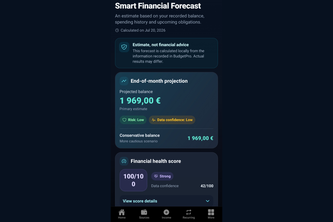
The app was extended to include a local, deterministic financial forecasting engine that estimates end-of-month balances and provides financial health scores without sending data to external AI services. The new feature integrates into the existing UI and supports eight languages.
Single most important open question
Is there any evidence of user adoption or revenue generation beyond the author’s own testing and publishing?
Note: This analysis is based entirely on self-reported, unverified information from the project description provided by the caller. No third-party verification, archived data, or traction metrics are available.
What The Product Actually Is
The description states that BudgetPro is a multilingual personal finance app built with React Native and Expo for Android. It includes features such as:
- Income and expense tracking;
- Customizable financial jars;
- Savings and subscription management;
- Credits and installments;
- Projects, investments, revenue, expenses, and profit tracking;
- Local backup and restore;
- Multiple currencies;
- Account-specific data.
The new Smart Financial Forecast feature uses local data to project end-of-month balances. It displays:
- Projected balance (primary and conservative);
- Current balance, income, and expenses;
- Comparison with previous month;
- Discretionary spending estimates;
- Upcoming payments and credits;
- Future recurring income;
- Seven-day safety buffer;
- Estimated saving capacity;
- Financial health score;
- Risk and confidence levels;
- Recommendations and data-quality warnings.
The forecast engine runs locally on the device, does not call external APIs, and reuses existing user data without duplicating it. The UI is responsive and supports eight languages.
Claim: The app was built using Codex and GPT-5.6.
Evidence: The author states this in the write-up.
Inference: The feature is deterministic and rule-based, not AI-driven in runtime.
Evidence: The description explicitly says all calculations run locally and do not use external AI services.
Positioning & Claim Evolution
The app positions itself as a personal finance tool that helps users understand where their money goes and what will remain at the end of the month. It emphasizes:
- A multilingual interface;
- Privacy-first design (no data sent to AI services);
- Deterministic forecasting;
- Local processing;
- No financial advice, only estimates.
The author notes that BudgetPro was already a functional app before Build Week 2026 and that the new feature was added without destabilizing the existing product. The evolution appears to be an incremental enhancement rather than a repositioning.
Claim: The app is built from zero by a non-technical creator.
Evidence: The author states this in the write-up.
Inference: The app is not a commercial product with revenue or customers yet.
Evidence: No mention of monetization, users, or sales.
Target Customer & ICP
The description does not identify specific customer segments or personas. It implies that BudgetPro targets individuals managing personal finances, particularly those who want to track income and expenses and gain insight into future financial positions.
It is described as a personal finance app, but there is no indication of whether it targets specific demographics (e.g., millennials, freelancers, families) or use cases beyond general budgeting.
Claim: The app is for individuals managing personal finances.
Evidence: The author describes the inspiration and functionality in terms of personal money tracking.
Inference: The app may appeal to users who value privacy and local data handling.
Evidence: Emphasis on no external API calls, deterministic engine, and local processing.
Business Model & Pricing Evidence
There is no evidence of a business model or pricing strategy in the description. The author does not mention:
- Revenue streams;
- Subscription plans;
- Freemium tiers;
- Paid features;
- Monetization methods.
The app is described as a personal finance tool, but there is no indication that it is monetized or sold to users.
Claim: No pricing or business model mentioned.
Evidence: The description does not include any commercial details.
Inference: The app may be free-to-use with no paid features.
Evidence: Not stated; this is an assumption based on lack of evidence.
Technical & Delivery Signals
The app was built using:
- React Native and Expo;
- TypeScript;
- AsyncStorage for local data;
- react-i18next for translations;
- Codex and GPT-5.6 for development assistance;
- Android and Google Play deployment.
Key technical elements include:
- Local processing of forecasts;
- Deterministic engine with no external API dependencies;
- Responsive UI layouts (single-column on narrow screens, two-column on wider);
- Support for eight languages;
- Accessibility improvements;
- Validation via ESLint and TypeScript;
- Testing on real Android devices;
- Git-based version control with branches for comparison.
Claim: The app uses Codex and GPT-5.6.
Evidence: Stated in the write-up.
Inference: The app is a mobile-first, single-developer project.
Evidence: Team size is listed as 1; no mention of backend or cloud infrastructure.
Traction & Maturity Signals
The description states that BudgetPro was already published on Google Play before Build Week 2026. It includes:
- A production release version 1.0.37;
- Integration of a new feature without breaking existing workflows;
- Successful testing on real devices;
- TypeScript and ESLint validation with zero errors;
- Repository tags and branches for comparison.
However, there is no evidence of:
- User adoption or retention;
- Revenue or monetization;
- Customer acquisition or marketing;
- App store ratings or reviews;
- Active user base.
Claim: The app was published on Google Play.
Evidence: Stated in the write-up.
Inference: The app is mature enough to support feature additions without breaking core functionality.
Evidence: The author notes that the new feature was added without destabilizing the product.
Competitive Context
The description does not provide any information about competitors or market positioning. It does not mention:
- Direct competitors;
- Market size or segment;
- Differentiation from other budgeting apps;
- Pricing or feature comparisons.
Claim: No competitive context provided.
Evidence: The description lacks any reference to the broader marketplace.
Open Questions & Risks
Key risks and open questions include:
- Single-founder development model (no team, no scalability);
- No evidence of revenue, users, or monetization;
- App is not verified as having traction or adoption;
- No mention of data security or compliance measures beyond local processing;
- The app is described as a personal project, not a commercial venture.
Inference: The lack of any commercial metrics suggests the project may be in early stages.
Evidence: No revenue, customers, or monetization mentioned.
Questions the description leaves open
- What is your plan for monetizing the app?
- Have you received any user feedback or reviews from Google Play?
- How do you intend to scale beyond a single developer?
- Are there plans to expand beyond Android or add iOS support?
- What are your long-term goals for the product and business model?
- How do you plan to validate forecast accuracy over time?
Overall Assessment
There is no evidence of commercial traction, revenue, or user adoption. The project is described as a personal finance app built by one person using AI tools, with a new feature added during a hackathon. It has not been independently verified.
Claim: No commercial viability or investment-ready signals.
Evidence: No revenue, customers, or monetization data provided.
Inference: The project may be in early development and lacks commercial maturity.
Evidence: Self-reported as a personal tool with no evidence of market traction.
User Stories BotA demo video on every pull request
Get a demo video on every new feature
GitHub App that watches your pull requests and records a narrated, captioned demo.
Save time on demo prep and make informed decisions faster with a video walkthrough of every new feature.
Source
Submitted to the OpenAI 2026 hackathon on Devpost. Project home on Devpost. Back to the full gallery on Devpost.
This competitive analysis was produced by top-founders.com (opens in a new tab)
Generated by a language model from this project's public Devpost page — its tagline, the author's own write-up and any built-with tags listed there — as captured in August 2026. Short quotations are the author's words. It is an opinion on the idea as a business, not on the people behind it, and it reflects the description as published then. If the project has moved on, request a correction below. The analysis is not independent research and contains no verified traction, revenue or customer data.
An independent guide by KFG International LLC — not affiliated with, endorsed by, or connected to Devpost or OpenAI.