

Archive position — measured, not model output
0 likes on Devpost
2,263 of the 7,850 archived projects have more likes, and 5,587 share exactly 0 — so this project's #5,004 place in the like-ranked listing is a tie-break inside that group, not a ranking.
Projects (log scale)
Likes on Devpost. ▲ marks this project's group.
Show the figures
| Likes | Projects | Share of archive |
|---|---|---|
| 0 | 5,587 | 71.2% |
| 1 | 1,758 | 22.4% |
| 2 | 284 | 3.6% |
| 3–4 | 132 | 1.7% |
| 5–9 | 75 | 1.0% |
| 10+ | 14 | 0.2% |
 User Stories BotA demo video on every pull request
Get a demo video on every new feature
GitHub App that watches your pull requests and records a narrated, captioned demo.
Save time on demo prep and make informed decisions faster with a video walkthrough of every new feature.
Executive Summary
What the company appears to be
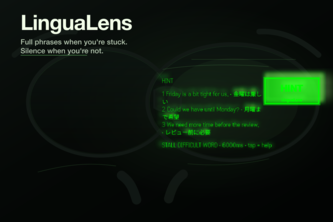
LinguaLens is a self-reported project built for the OpenAI 2026 hackathon. It claims to be an English language coach that runs on smart glasses (specifically Even Realities G2), offering coaching cards in real time during conversation — only when needed, and silently.
What changed
The author states they built this tool to address a personal frustration: losing the moment of linguistic hesitation during conversation practice with GPT-Live or others. The project was designed around constraints like bandwidth and audio detection, and evolved through iterative fixes in role attribution, timing, and intent inference.
Single most important open question
Is there any evidence that this product has been tested beyond the hackathon environment? What is the actual user adoption or feedback from real-world use?
Note: This analysis is based entirely on the self-reported project description provided by the author. No external verification, revenue data, customer names, or traction metrics are available.
What The Product Actually Is
The description states that LinguaLens is a language coaching tool for English learners that runs on Even Realities G2 smart glasses. It listens to speech via the glasses’ microphone and displays visual coaching cards on the HUD only when intervention is needed.
It offers four types of interventions:
- HINT: Shows 3 ready-to-say phrases with glosses in native language, when user stalls.
- WORD: Displays a gloss or example sentence for difficult words used by others.
- RECAP: Reviews a phrase the learner couldn’t say, shown again at next session.
- Tap to ask: A single tap requests help on demand.
The system uses GPT models (GPT-5.6, GPT-5.6-Luna) and Codex for development, with ASR handled by gpt-4o-mini-transcribe and role attribution managed by the model rather than local detection.
Inference: The product is described as a real-time assistant that operates silently, using visual cues only, to avoid interrupting conversation flow. It is not a standalone app or web tool but a glasses-based experience.
Positioning & Claim Evolution
The author positions LinguaLens as a quiet coach — one that intervenes only when needed and otherwise remains silent. The core value proposition is the balance between “intervention” and “silence,” which they describe as a key design principle.
They claim:
- It helps users recover from linguistic hesitation without breaking conversation.
- It works with GPT-Live or real people, not just AI.
- It avoids reliance on phone-based tools that disrupt flow.
- The system is built to operate within strict bandwidth and hardware constraints of smart glasses.
Claim vs Fact: These are self-reported claims about intent and functionality. There is no evidence of actual deployment, user testing, or feedback beyond the hackathon context.
Target Customer & ICP
The description implies that LinguaLens targets:
- English learners practicing with others (including GPT-Live).
- Users who struggle with fluency in real-time conversation.
- People using smart glasses for language learning.
It does not specify a defined persona or segment beyond "English learner." The product is built for a specific use case: “mid-sentence stall” during conversation.
Inference: Likely users are individuals practicing English, particularly those who find themselves stuck mid-sentence and want to maintain conversation flow. No evidence of segmentation or targeting beyond this.
Business Model & Pricing Evidence
There is no mention of pricing, monetization, or business model in the description. The project was built for a hackathon and does not reference any commercial offering, subscription plans, or revenue streams.
Not evidenced: No indication of how the product would be sold or who pays for it.
Technical & Delivery Signals
The system is built using:
- Codex CLI sessions
- GPT-5.6 (sol) for RECAP phrases
- GPT-5.6-Luna for intervention decisions and role attribution
- gpt-4o-mini-transcribe for ASR
- TypeScript
Key technical constraints include:
- Bandwidth limited to ~48 kbps sustained
- BLE link supports 10–30 KB/s, limiting animation
- Text-first cards with single hero image under 200×100 px
- Simulated timing via heartbeat (250 ms interval)
- On-device telemetry for session logs
Inference: The product is designed around hardware and bandwidth limitations, suggesting a focus on minimalism and efficiency. It uses AI models in a constrained environment.
Traction & Maturity Signals
There is no evidence of traction or maturity beyond the hackathon submission:
- No customer data
- No revenue or ARR
- No headcount or team size beyond one person (K T)
- No product launch, usage metrics, or user feedback
- No mention of follow-up development or commercialization plans
Not evidenced: No signs of real-world adoption, performance tracking, or scaling efforts.
Competitive Context
The description does not reference competitors. It is unclear whether similar tools exist in the market for language learning with smart glasses or real-time coaching.
Not evidenced: No competitive landscape or differentiation analysis provided.
Open Questions & Risks
- Unproven concept: The product exists only as a hackathon prototype.
- Limited scope: It works only on one specific hardware platform (Even Realities G2).
- No commercial viability: No pricing, monetization or business model described.
- Single developer: Team size is listed as 1, suggesting limited development capacity.
- Self-reported only: All claims are unverified and lack independent corroboration.
Inference: The project appears to be a proof-of-concept rather than a scalable product. It lacks commercial readiness or traction indicators.
Questions the description leaves open
- Has the system been tested beyond the hackathon environment?
- What is the actual user feedback from those who tried it?
- Are there plans to expand beyond GPT-Live or specific hardware platforms?
- How does the product handle edge cases like multiple speakers or noisy environments?
- Is there any plan for monetization or commercial deployment?
Overall Assessment
The project is a hackathon prototype with no evidence of traction, revenue, or real-world adoption. It is not demonstrated to be a viable business or scalable product.
Assessment: Not ready for investment or partnership consideration at this stage. The project lacks commercial viability and maturity indicators. Any future value would depend on significant development beyond the current prototype.
User Stories BotA demo video on every pull request
Get a demo video on every new feature
GitHub App that watches your pull requests and records a narrated, captioned demo.
Save time on demo prep and make informed decisions faster with a video walkthrough of every new feature.
Source
Submitted to the OpenAI 2026 hackathon on Devpost. Project home on Devpost. Back to the full gallery on Devpost.
This competitive analysis was produced by top-founders.com (opens in a new tab)
Generated by a language model from this project's public Devpost page — its tagline, the author's own write-up and any built-with tags listed there — as captured in August 2026. Short quotations are the author's words. It is an opinion on the idea as a business, not on the people behind it, and it reflects the description as published then. If the project has moved on, request a correction below. The analysis is not independent research and contains no verified traction, revenue or customer data.
An independent guide by KFG International LLC — not affiliated with, endorsed by, or connected to Devpost or OpenAI.