

Archive position — measured, not model output
0 likes on Devpost
2,263 of the 7,850 archived projects have more likes, and 5,587 share exactly 0 — so this project's #2,960 place in the like-ranked listing is a tie-break inside that group, not a ranking.
Projects (log scale)
Likes on Devpost. ▲ marks this project's group.
Show the figures
| Likes | Projects | Share of archive |
|---|---|---|
| 0 | 5,587 | 71.2% |
| 1 | 1,758 | 22.4% |
| 2 | 284 | 3.6% |
| 3–4 | 132 | 1.7% |
| 5–9 | 75 | 1.0% |
| 10+ | 14 | 0.2% |
 User Stories BotA demo video on every pull request
Get a demo video on every new feature
GitHub App that watches your pull requests and records a narrated, captioned demo.
Save time on demo prep and make informed decisions faster with a video walkthrough of every new feature.
Executive Summary
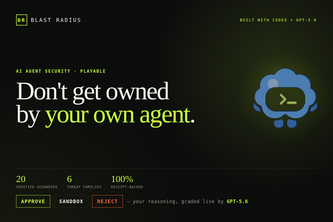
Blast Radius is a self-reported gamified learning tool for AI coding agents, designed to teach users how to evaluate and respond to agent-generated actions in order to avoid security risks like prompt injection and remote code execution. The author states that it uses GPT-5.6 (in roles named Sol and Luna) to grade user decisions live, with a correctness gate ensuring all scenarios are grounded in verified facts. It is presented as both an educational game and a set of developer tools (CLI, GitHub Action, Codex plugin), built using Codex and OpenAI APIs.
The product is described as a single-person project built over several weeks, with no evidence of revenue, customers or traction beyond the author’s own claims. The description includes technical details about how it was built but lacks any verification or independent corroboration.
Key open question
Is there sufficient evidence that the tool actually works as described, or whether the author's self-reported implementation reflects a functional product?
What The Product Actually Is
The description states that Blast Radius is:
- A gamified learning platform where users make decisions about AI agent actions (approve, sandbox, reject).
- Designed to teach users how to identify risks such as prompt injection and remote code execution.
- Built using Codex and OpenAI APIs, including GPT-5.6 in two named roles: Sol (for reasoning grading) and Luna (for reskinning scenarios).
- Available in both a hosted web version and developer tools (CLI, GitHub Action, Codex plugin).
- Uses a correctness gate to ensure all scenarios are backed by verified facts.
- Includes pre- and post-tests to adapt the learning path based on user competency.
It is not evidenced whether:
- The tool actually functions as described.
- The correctness gate is effective in practice.
- The live grading works reliably or has been tested with real users.
Positioning & Claim Evolution
The author positions Blast Radius as:
- An educational tool for developers to learn how to handle AI coding agents responsibly.
- A way to teach reflexive decision-making around agent actions, especially in light of OWASP's #1 LLM risk (prompt injection).
- A product that bridges the gap between "magic" and "responsibility" in AI tools like Codex.
It is claimed that:
- The tool teaches users how to detect malicious or risky agent behavior.
- It uses a deterministic grading system with ground truth, not hallucinations.
- It can be used both as a game and as a practical developer tool.
There is no evidence of prior positioning or evolution in the description — this appears to be the first public statement of its kind.
Target Customer & ICP
The author states that Blast Radius targets:
- Developers using AI coding agents (e.g., Codex).
- IT-security enthusiasts.
- A new generation of developers who need to understand risks from AI tools.
It is claimed that the tool is designed for users who are "both an IT-security enthusiast and an AI enthusiast", suggesting a niche audience with dual interests in both domains.
There is no evidence of:
- Specific customer segments or personas.
- Market research or user interviews.
- Any actual customer base or feedback.
Business Model & Pricing Evidence
The description does not mention any business model, pricing, monetization strategy, or revenue streams.
It is claimed that the tool is available as a CLI, GitHub Action, and Codex plugin — but no information is given about:
- Whether these are free or paid.
- How they might be monetized.
- Any commercial use cases beyond personal development.
Technical & Delivery Signals
The author reports that Blast Radius was built with:
- Codex (for brainstorming, planning, and implementation).
- OpenAI APIs (specifically GPT-5.6 in roles Sol and Luna).
- Python 3.11 and 3.13.
- CI/CD pipeline with ruff and pytest.
- GitHub Action and Codex plugin published to marketplace.
It is claimed that:
- The tool uses a correctness gate to validate scenarios before showing them.
- A deterministic grader falls back in case of model failure.
- The system includes adversarial regression tests against its own engine.
However, there is no evidence of:
- Actual deployment or performance data.
- Scalability or reliability metrics.
- Independent technical review or validation.
Traction & Maturity Signals
The author states that the tool:
- Was built in one primary thread over several weeks.
- Is currently hosted on a VPS with access token protection.
- Has been tested with adversarial inputs (e.g., "curl | bash" detection).
- Includes persistent/non-persistent users, session tracking, and leaderboard features.
There is no evidence of:
- Any real-world usage or adoption.
- Customer feedback or engagement metrics.
- Revenue or monetization activity.
- Product maturity beyond initial prototype.
Competitive Context
The description does not provide any information about:
- Competitors in the AI agent education or security space.
- Market size or competitive landscape.
- How this product differentiates from existing tools.
No mention is made of similar products, platforms, or educational offerings that may already exist.
Open Questions & Risks
Key risks and open questions based on the self-reported description:
- The tool is described as a single-person project with no evidence of team size beyond one developer.
- No independent verification of claims about functionality, correctness gate, or live grading.
- The author admits to having a "nastiest bug" that silently failed without throwing an error — raising concerns about reliability.
- The use of GPT-5.6 (which does not exist) introduces uncertainty and potential misrepresentation.
- No evidence of user testing, feedback loops, or real-world validation.
Questions the description leaves open
- Can you demonstrate the correctness gate in action? How is it validated?
- What are the actual performance and reliability metrics for the live grading system?
- How many scenarios have been tested, and what percentage of them pass the correctness gate?
- Is there any evidence of user engagement or feedback from those who have used the tool?
- What is the current status of the CLI, GitHub Action, and Codex plugin? Are they publicly available?
- How does the system handle edge cases or unexpected inputs in real-world usage?
Overall Assessment
There is no evidence that Blast Radius has achieved any meaningful traction, revenue, or customer adoption.
The description is entirely self-reported and unverified — it contains no data on:
- Revenue
- Customers
- Usage metrics
- Product-market fit
- Market validation
While the concept appears novel and potentially valuable in the context of AI agent security, there is insufficient evidence to assess whether the tool functions as described or has commercial viability.
Confidence: Low.
The project is presented as a prototype or proof-of-concept with no independent corroboration. It remains unclear whether it is ready for investment or partnership consideration at this stage.
User Stories BotA demo video on every pull request
Get a demo video on every new feature
GitHub App that watches your pull requests and records a narrated, captioned demo.
Save time on demo prep and make informed decisions faster with a video walkthrough of every new feature.
Source
Submitted to the OpenAI 2026 hackathon on Devpost. Project home on Devpost. Back to the full gallery on Devpost.
This competitive analysis was produced by top-founders.com (opens in a new tab)
Generated by a language model from this project's public Devpost page — its tagline, the author's own write-up and any built-with tags listed there — as captured in August 2026. Short quotations are the author's words. It is an opinion on the idea as a business, not on the people behind it, and it reflects the description as published then. If the project has moved on, request a correction below. The analysis is not independent research and contains no verified traction, revenue or customer data.
An independent guide by KFG International LLC — not affiliated with, endorsed by, or connected to Devpost or OpenAI.