

Archive position — measured, not model output
0 likes on Devpost
2,263 of the 7,850 archived projects have more likes, and 5,587 share exactly 0 — so this project's #2,961 place in the like-ranked listing is a tie-break inside that group, not a ranking.
Projects (log scale)
Likes on Devpost. ▲ marks this project's group.
Show the figures
| Likes | Projects | Share of archive |
|---|---|---|
| 0 | 5,587 | 71.2% |
| 1 | 1,758 | 22.4% |
| 2 | 284 | 3.6% |
| 3–4 | 132 | 1.7% |
| 5–9 | 75 | 1.0% |
| 10+ | 14 | 0.2% |
 User Stories BotA demo video on every pull request
Get a demo video on every new feature
GitHub App that watches your pull requests and records a narrated, captioned demo.
Save time on demo prep and make informed decisions faster with a video walkthrough of every new feature.
Executive Summary
The description states that Blender AI Agent is a Blender extension that allows an external AI agent to interact with Blender through a bounded, loopback-only HTTP API. The author claims it enables visible, sequential operations within Blender, preventing arbitrary code execution and maintaining transparency in agent workflows.
Key points:
- It is presented as a proof-of-concept project submitted for the OpenAI 2026 hackathon.
- The extension supports mesh creation/editing, Boolean operations, text addition, modifiers, print readiness checks, and STL export.
- Safety features include sequential execution on Blender’s main thread, loopback-only access, and exclusion of arbitrary Python or remote network access.
- The project was built using GPT-5.6 and Codex tools during a Build Week event.
- A beta release has been published with checksum verification.
The single most important open question
Is there any evidence that this extension is being used beyond the hackathon context, or whether it has moved past experimental status into real-world adoption?
What The Product Actually Is
The description states:
- Blender AI Agent is an installable Blender extension.
- It provides a bounded, loopback-only HTTP API for external AI agents to interact with Blender.
- Agents can perform operations such as inspecting objects, creating/editing meshes, adding text/modifiers, Boolean operations, checking print readiness, and exporting STL files.
- All mutations run sequentially on Blender’s main thread.
- The extension deliberately excludes:
- Arbitrary Python execution
- Unrestricted Blender properties
- Hidden macros
- Remote-network access
Inference: The product is a Blender add-on that acts as a controlled interface between an AI agent and the Blender environment, designed to maintain visibility and control over agent actions.
Positioning & Claim Evolution
The description states:
- The project was inspired by a desire for transparent AI-assisted creative workflows, where users can observe every meaningful operation.
- It positions itself as a safe, visible bridge between AI agents and Blender.
- The authors claim that “AI-assisted creative work is more trustworthy when the application remains the visible workspace.”
Inference: The positioning evolved from a hackathon prototype to a conceptual framework for safe automation in creative software, emphasizing transparency and control.
Target Customer & ICP
The description states:
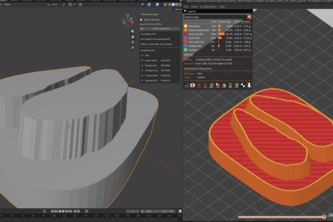
- The initial use case was for creating twenty animal-track stamps for a summer-camp activity.
- Future plans include using the tool with educators, makers, and agent developers.
Inference: The target customer segments appear to be:
- Educators (for teaching children about animal tracks)
- Makers (who may want to automate parts of their design process)
- Agent developers (who might integrate this into larger AI workflows)
Not evidenced: No explicit identification of a specific ICP beyond these broad categories.
Business Model & Pricing Evidence
The description states:
- A beta release has been published and is downloadable with checksum verification.
- No pricing or monetization strategy is mentioned.
Inference: The business model is not evident. It appears to be an open-source or early-stage prototype, possibly intended for educational or developer use.
Technical & Delivery Signals
The description states:
- Built using GPT-5.6 and Codex during Build Week.
- The extension supports:
- Mesh, text, modifier, Boolean, print-check, recovery, and STL-export operations
- A machine-readable
/helpendpoint for agent discovery of capabilities - Sequential execution on Blender’s main thread
- Loopback-only access
- Isolated development harness to prevent interference with other Blender instances
Inference: The technical architecture is designed around safety, transparency, and bounded interaction. It uses a main-thread dispatcher, loopback-only API, and isolated profiles.
Traction & Maturity Signals
The description states:
- Produced twenty real, physically printed animal-track stamps.
- Published a downloadable, checksum-verified beta release.
- Tested installation and lifecycle behavior in a clean Blender profile.
- Recorded a complete workflow from installation to sliced artifact.
- The project was submitted as part of the OpenAI 2026 hackathon.
Inference: The product is at an early stage — a proof-of-concept prototype, not yet mature for commercial use. No evidence of revenue, customers, or adoption beyond the hackathon context.
Competitive Context
The description does not mention any competitors or similar tools.
Not evidenced: No information on existing solutions in the space of AI-assisted 3D modeling or Blender automation.
Open Questions & Risks
- The project is described as a hackathon submission, suggesting it has not yet progressed beyond experimental phase.
- There is no evidence of:
- Revenue
- Customers
- Adoption
- Product-market fit
- The team size is listed as 1 (Scotty Nordstrom), which may limit scalability or development velocity.
- No mention of ongoing funding, partnerships, or long-term roadmap beyond the beta release.
Inference: The project lacks commercial traction and maturity. It is likely in a pre-product-market-fit stage, with no clear path to monetization or large-scale adoption.
Questions the description leaves open
- What is the current status of the product beyond the hackathon? Is it being used by anyone outside of the development team?
- How does the extension handle conflicts when multiple agents attempt to modify the same scene?
- Are there any plans for monetization or commercial licensing?
- Has the team considered integrating with other 3D modeling tools or platforms beyond Blender?
- What are the key limitations of the current API that would need to be addressed before broader adoption?
Overall Assessment
The description states:
- The project is a Blender extension built during a hackathon.
- It has produced a beta release, but no evidence of traction, revenue, or customer base.
Inference: At this stage, the project appears to be a pre-product-market-fit prototype with limited commercial viability. It may have potential for future development, but there is no evidence of current market demand or product maturity.
Not evidenced: No data on valuation, funding rounds, or strategic partnerships. The project does not yet demonstrate a clear path to profitability or scalability.
User Stories BotA demo video on every pull request
Get a demo video on every new feature
GitHub App that watches your pull requests and records a narrated, captioned demo.
Save time on demo prep and make informed decisions faster with a video walkthrough of every new feature.
Source
Submitted to the OpenAI 2026 hackathon on Devpost. Project home on Devpost. Back to the full gallery on Devpost.
This competitive analysis was produced by top-founders.com (opens in a new tab)
Generated by a language model from this project's public Devpost page — its tagline, the author's own write-up and any built-with tags listed there — as captured in August 2026. Short quotations are the author's words. It is an opinion on the idea as a business, not on the people behind it, and it reflects the description as published then. If the project has moved on, request a correction below. The analysis is not independent research and contains no verified traction, revenue or customer data.
An independent guide by KFG International LLC — not affiliated with, endorsed by, or connected to Devpost or OpenAI.