

Archive position — measured, not model output
1 like on Devpost
505 of the 7,850 archived projects have more likes, and 1,758 share exactly 1 — so this project's #695 place in the like-ranked listing is a tie-break inside that group, not a ranking.
Projects (log scale)
Likes on Devpost. ▲ marks this project's group.
Show the figures
| Likes | Projects | Share of archive |
|---|---|---|
| 0 | 5,587 | 71.2% |
| 1 | 1,758 | 22.4% |
| 2 | 284 | 3.6% |
| 3–4 | 132 | 1.7% |
| 5–9 | 75 | 1.0% |
| 10+ | 14 | 0.2% |
 User Stories BotA demo video on every pull request
Get a demo video on every new feature
GitHub App that watches your pull requests and records a narrated, captioned demo.
Save time on demo prep and make informed decisions faster with a video walkthrough of every new feature.
Executive Summary
What the company appears to be
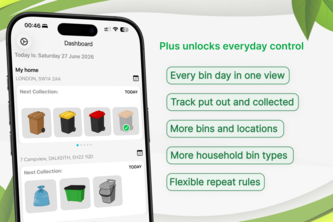
Bin Collection Reminder is an iOS app that helps users manage household waste collection schedules by finding, creating, and tracking bin collection days. It allows users to search for their schedule by address, customize bins, set reminders, and receive notifications. The app supports multiple bins, recurrence rules, local reminders, and premium features like remote notifications and subscription handling.
What changed
The project was submitted as a hackathon entry (Devpost, OpenAI 2026) with no evidence of prior traction or commercial activity. It is described as a working prototype built in a short timeframe using Swift, SwiftUI, Node.js, Firebase, Kubernetes, and RevenueCat.
Single most important open question
Is there any evidence that the app has been released to users beyond the hackathon, or whether it has begun generating revenue or user engagement?
What The Product Actually Is
The description states:
- Bin Collection Reminder is an iOS app.
- It helps users find, create, and manage household bin collection schedules.
- Users can search by country, postcode, and address.
- It supports multiple bins, recurrence rules, collection badges, local reminders, and remote notifications for premium users.
- It includes manual fallback for countries without address lookup providers.
- The backend is built with Node.js on Kubernetes, using Firebase Firestore, Redis, and RevenueCat for subscriptions.
Inference The app appears to be a consumer-facing mobile tool designed to solve a common household problem — remembering when bins are collected. It integrates with real-world data sources (council schedules) and offers both free and paid features.
Confidence Highly dependent on self-reporting; no independent verification of functionality or performance.
Positioning & Claim Evolution
The description states:
- The app was inspired by the annoyance of remembering bin collection days.
- It aims to simplify access to waste collection schedules for households.
- It supports customization, reminders, and integration with real-world data.
- It includes subscription-based premium features such as remote notifications.
Inference Positioning is centered around solving a mundane but recurring household task through digital convenience. The app positions itself as a utility that makes scheduling easier, not necessarily a disruptive innovation or platform.
Confidence Low — the description does not indicate any market positioning strategy beyond its own self-perception.
Target Customer & ICP
The description states:
- The target audience is households trying to remember bin collection days.
- It supports multiple bins and recurrence rules, suggesting it targets users with complex or multi-bin setups.
- It includes manual fallback for countries where address lookup isn’t available, implying a global or multi-country approach.
Inference The ICP likely includes tech-savvy individuals living in areas with inconsistent or hard-to-find collection schedules. Users may be in urban or suburban settings where local councils provide varied and non-intuitive data.
Confidence Very low — no evidence of actual user segmentation, personas, or feedback from target users beyond the author’s own account.
Business Model & Pricing Evidence
The description states:
- The app supports subscription-aware limits.
- Premium features include remote notifications.
- RevenueCat is used for subscriptions.
- Frontend/backend configuration is shared to align plan limits and feature gates.
Inference There is a freemium model with premium features (e.g., remote notifications) available via subscription. However, there is no mention of pricing tiers, monetization strategy, or revenue generation beyond the use of RevenueCat.
Confidence Low — no evidence of actual pricing, conversion rates, or monetization metrics.
Technical & Delivery Signals
The description states:
- Built with Swift and SwiftUI for iOS.
- Backend uses Node.js API on Kubernetes.
- Firebase Firestore for data storage, Redis for caching.
- Push notifications handled via Firebase/APNs.
- Address lookup is done through a separate AnyLookup service to avoid exposing provider tokens.
- RevenueCat handles subscriptions.
- Configuration is shared between frontend and backend.
Inference The technical stack suggests a modern, scalable architecture with clear separation of concerns. The use of Kubernetes, Firebase, and RevenueCat indicates an attempt at building a robust, production-ready system even in a short timeframe.
Confidence Moderate — the description implies good engineering practices but lacks evidence of deployment or performance data.
Traction & Maturity Signals
The description states:
- This is a hackathon project submitted to Devpost.
- It includes accomplishments such as working iOS app, configuration system, and fallback flows.
- The team size is one person (David Sadowski).
- No mention of public release, user base, or adoption metrics.
Inference There is no evidence of traction, revenue, or customer engagement beyond the hackathon submission. The project appears to be a prototype with limited real-world usage.
Confidence Very low — no data on users, retention, or monetization.
Competitive Context
The description does not provide any information about competitors or market positioning relative to existing solutions.
Inference There is no evidence of competitive analysis or awareness of similar tools. The app may be addressing a niche gap in the market, but this cannot be confirmed without external data.
Confidence Very low — no mention of competition or market landscape.
Open Questions & Risks
- Single-founder team: Only one person is listed as part of the team.
- No commercial traction: No evidence of users, revenue, or product-market fit beyond a hackathon submission.
- Unproven monetization model: Subscription-based features are mentioned but not validated.
- High technical complexity for a small team: Managing real-world data, offline use, and notifications is complex.
- No public release or feedback loop: No evidence of an App Store presence or user testing.
Inference The project is in early development with no clear path to commercial viability. Risks include lack of scalability, limited market validation, and potential technical debt from a hackathon prototype.
Confidence High — based on the absence of any traction or commercial signals.
Questions the description leaves open
- Has the app been publicly released (e.g., on the App Store)?
- What is the current user base, if any?
- How many users are subscribed to premium features?
- Are there plans for monetization beyond subscriptions?
- Have you tested the app with real users or conducted usability studies?
- What is your strategy for expanding address lookup coverage and integrating with council data?
- How do you plan to scale the team and product development?
Overall Assessment
Assessment Not evidenced.
The project is described as a hackathon submission with no evidence of commercial traction, revenue, or user engagement. It is unclear whether it has moved beyond prototype stage or if any users are actively using it. The business model appears to be subscription-based but unproven.
Confidence Very low — the description provides no data to support investment or partnership decisions. Any potential value lies in future development, not current performance or market readiness.
User Stories BotA demo video on every pull request
Get a demo video on every new feature
GitHub App that watches your pull requests and records a narrated, captioned demo.
Save time on demo prep and make informed decisions faster with a video walkthrough of every new feature.
Source
Submitted to the OpenAI 2026 hackathon on Devpost. Project home on Devpost. Back to the full gallery on Devpost.
This competitive analysis was produced by top-founders.com (opens in a new tab)
Generated by a language model from this project's public Devpost page — its tagline, the author's own write-up and any built-with tags listed there — as captured in August 2026. Short quotations are the author's words. It is an opinion on the idea as a business, not on the people behind it, and it reflects the description as published then. If the project has moved on, request a correction below. The analysis is not independent research and contains no verified traction, revenue or customer data.
An independent guide by KFG International LLC — not affiliated with, endorsed by, or connected to Devpost or OpenAI.