

Archive position — measured, not model output
0 likes on Devpost
2,263 of the 7,850 archived projects have more likes, and 5,587 share exactly 0 — so this project's #4,621 place in the like-ranked listing is a tie-break inside that group, not a ranking.
Projects (log scale)
Likes on Devpost. ▲ marks this project's group.
Show the figures
| Likes | Projects | Share of archive |
|---|---|---|
| 0 | 5,587 | 71.2% |
| 1 | 1,758 | 22.4% |
| 2 | 284 | 3.6% |
| 3–4 | 132 | 1.7% |
| 5–9 | 75 | 1.0% |
| 10+ | 14 | 0.2% |
 User Stories BotA demo video on every pull request
Get a demo video on every new feature
GitHub App that watches your pull requests and records a narrated, captioned demo.
Save time on demo prep and make informed decisions faster with a video walkthrough of every new feature.
Executive Summary
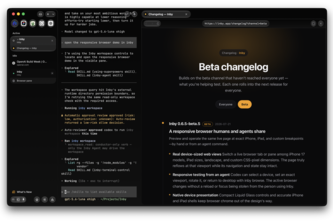
The company appears to be a solo project named Inby, developed by Craig Wattrus, submitted to the OpenAI 2026 hackathon. The author describes it as a terminal workspace for collaborating on software with agents, integrating tools like Codex and GPT into a native macOS environment. It includes features such as an agent-native web browser, docs/code viewer, diagram system, and fast web server.
What changed: The project is described as a hackathon iteration that builds upon prior work with Codex, aiming to improve usability and workflow for agent-assisted software creation. It represents an experiment in how coding agents might be better integrated into developer environments.
The single most important open question: Is there evidence of real user traction or feedback beyond the 50-person waiting list? The description states no revenue, customers, or adoption data are available — only self-reported claims about product utility and future plans.
What The Product Actually Is
- The description states that Inby is a terminal workspace.
- It includes:
- A terminal
- An agent-native web browser
- A docs and code viewer
- A diagram system and renderer
- A lightning fast web server
- Settings and controls for configuring agents like Claude, Codex, and Open Code
- It is built using:
- Codex
- GPT
- macOS
- Swift
- WebKit
- Xcode
Inference: The product appears to be a developer tool, possibly aimed at improving workflows with AI agents, especially in environments where visual and interactive design is needed.
Positioning & Claim Evolution
- The author states that Inby is:
- “A terminal workspace for getting into flow with your agents”
- “Not an IDE or conductor, a place to cowork on real software”
- It aims to bridge the gap between:
- Tools built for software engineers (which don’t resonate with the author)
- Web-based tools like Lovable Cloud Code and Claude Design (which feel underpowered)
- The product is positioned as:
- A workspace for coworking on real software
- A place where agents can be used in a more elegant, iterative way
- It is described as an evolution from earlier work with Codex during the hackathon.
Inference: Inby is being positioned as a hybrid tool, combining terminal-based workflows with agent-native UI features. The author claims it improves upon existing tools by offering a more enjoyable and efficient experience for working with AI agents in software development.
Target Customer & ICP
- The description states that the author:
- “Works every day with coding agents”
- Is a builder who doesn’t resonate with current tools
- It is implied that Inby targets:
- Developers or builders who work with AI agents
- People looking for a more enjoyable and efficient way to collaborate with agents
- The author mentions a waiting list of 50 people, suggesting early interest from users.
Inference: The target customer appears to be technical professionals working with AI agents, especially those who find existing tools frustrating or underpowered. However, no explicit segmentation or persona data is provided.
Business Model & Pricing Evidence
- No pricing information, revenue model, or monetization strategy is stated.
- The author mentions:
- “I have a waiting list of 50 people”
- “I intend to get as much feedback as possible from real users and grow Inby to be the best way to cowork on beautiful software with agents”
Inference: There is no evidence of a business model or pricing structure. The project is described as a personal experiment, not yet monetized.
Technical & Delivery Signals
- Built using:
- Codex
- GPT
- macOS
- Swift
- WebKit
- Xcode
- Features include:
- Agent-native web browser
- Diagramming system
- Web server for HTML/CSS/JS implementation
- Visual configuration tools for agents
- The author describes using Codex to guide design and implementation within the same browser window.
- It is described as a native macOS application, not a web app.
Inference: The technical stack suggests a native macOS tool, possibly leveraging AI APIs (Codex, GPT) and UI frameworks. The delivery method is likely a desktop application, with agent integration via CLI or API.
Traction & Maturity Signals
- The author states:
- “I have a waiting list of 50 people”
- “The iteration I shipped with codex during the hackathon is a huge step to making rapid iteration and design smooth and enjoyable.”
- No revenue, customer base, or usage metrics are provided.
- It is described as a hackathon project, not yet commercialized.
Inference: There is no evidence of traction beyond early interest. The product is in an early prototype phase, with no data on adoption or user retention.
Competitive Context
- The author compares Inby to:
- Tools for software engineers (which don’t resonate)
- Web-based tools like Lovable Cloud Code and Claude Design (which feel underpowered)
- It is implied that the product competes in a space where:
- AI agents are used for development
- There’s a lack of elegant, agent-native UIs
- No competitors or market positioning beyond self-description are mentioned.
Inference: The competitive context is unclear, as no specific competitors are named. It appears to be a novel approach to integrating AI agents into developer workflows, but without evidence of existing players in the space.
Open Questions & Risks
- The project is described as:
- A single-person effort
- A hackathon submission
- No evidence of:
- Revenue
- Customers
- Product-market fit
- Team or funding
- The author states:
- “I have a waiting list of 50 people”
- “I intend to get as much feedback as possible from real users”
Inference: Key risks include:
- Lack of traction
- Single-founder model
- No monetization strategy
- Unproven market demand
Questions the description leaves open
- What is the current status of the waiting list? How many people have expressed interest in using Inby?
- What specific feedback have you received from users so far?
- Are there any plans to monetize or scale the product beyond a prototype?
- How do you plan to integrate with existing tools like IDEs, agent platforms, or development workflows?
- What are your long-term goals for Inby — is it intended as a standalone tool or part of a larger ecosystem?
Overall Assessment
- The description states that Inby is:
- A single-person project
- Built during a hackathon
- Not yet commercialized
- No evidence of traction, revenue, or customer adoption is provided.
- The author expresses intent to gather feedback and grow the product.
Inference: At this stage, there is no evidence of commercial viability, revenue, or traction. It is a conceptual prototype with early interest but no demonstrated market validation or business model. Investment or partnership would be speculative at this point, pending further development and user feedback.
User Stories BotA demo video on every pull request
Get a demo video on every new feature
GitHub App that watches your pull requests and records a narrated, captioned demo.
Save time on demo prep and make informed decisions faster with a video walkthrough of every new feature.
Source
Submitted to the OpenAI 2026 hackathon on Devpost. Project home on Devpost. Back to the full gallery on Devpost.
This competitive analysis was produced by top-founders.com (opens in a new tab)
Generated by a language model from this project's public Devpost page — its tagline, the author's own write-up and any built-with tags listed there — as captured in August 2026. Short quotations are the author's words. It is an opinion on the idea as a business, not on the people behind it, and it reflects the description as published then. If the project has moved on, request a correction below. The analysis is not independent research and contains no verified traction, revenue or customer data.
An independent guide by KFG International LLC — not affiliated with, endorsed by, or connected to Devpost or OpenAI.