

Archive position — measured, not model output
1 like on Devpost
505 of the 7,850 archived projects have more likes, and 1,758 share exactly 1 — so this project's #696 place in the like-ranked listing is a tie-break inside that group, not a ranking.
Projects (log scale)
Likes on Devpost. ▲ marks this project's group.
Show the figures
| Likes | Projects | Share of archive |
|---|---|---|
| 0 | 5,587 | 71.2% |
| 1 | 1,758 | 22.4% |
| 2 | 284 | 3.6% |
| 3–4 | 132 | 1.7% |
| 5–9 | 75 | 1.0% |
| 10+ | 14 | 0.2% |
 User Stories BotA demo video on every pull request
Get a demo video on every new feature
GitHub App that watches your pull requests and records a narrated, captioned demo.
Save time on demo prep and make informed decisions faster with a video walkthrough of every new feature.
Executive Summary
What the company appears to be
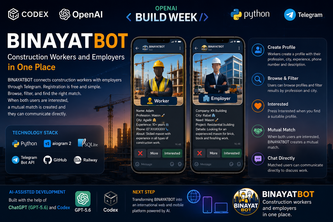
BINAYATBOT is a self-reported Telegram-based bot designed to connect construction workers with local employers in Morocco. The platform allows users to register profiles, browse others, express interest, and receive mutual matches for job opportunities. It was built as a proof-of-concept during a hackathon and is described as evolving into a full web/mobile platform.
What changed
The project started as a simple Telegram bot with basic matching logic and user flows. The author states that the next step involves transforming it into an international web and mobile platform, expanding beyond Morocco and adding features like AI-powered recommendations, marketplace capabilities, and support for engineers and contractors.
Single most important open question
Is there any evidence of real-world usage or traction from construction workers or employers in Morocco? The description contains no data on user numbers, engagement, revenue, or adoption — only claims about functionality and future plans.
What The Product Actually Is
The description states that BINAYATBOT is a Telegram bot built to connect construction workers with local employers. It includes:
- Worker and employer registration
- Profile creation (with profession, city, experience, phone number, photo)
- Search and filtering by profession or city
- Like-and-match system
- Notifications via Telegram
- Daily usage limits
- Premium subscriptions
- Administrative controls
It was built using:
- Python
- Aiogram
- SQLite
- Telegram Bot API
- GitHub
- Railway
The system uses finite-state machines to manage user interactions and registration flows.
Inference The product is described as a conversational interface, not a traditional website or app. It operates within the Telegram ecosystem and is intended for users who are more comfortable with messaging platforms than complex digital tools.
Positioning & Claim Evolution
The author states that BINAYATBOT was created to solve a problem in Morocco where construction workers often rely on informal networks, and employers struggle to find skilled labor.
Claims
- It makes the job-search process faster, simpler, and more organized.
- It is accessible without requiring technical knowledge or complicated applications.
- It uses Telegram because it's lightweight and familiar to users.
Inference The positioning appears to be local, informal, and user-friendly, targeting a segment of the workforce that may not engage with traditional job platforms. The evolution toward a full web/mobile platform suggests an ambition to scale beyond its initial use case.
Target Customer & ICP
The description identifies two main user groups:
- Construction workers looking for job opportunities
- Employers, contractors, companies, and homeowners seeking workers or services
It also mentions that the platform will expand to include:
- Civil engineers
- Architects
- Site managers
- Project managers
- Quantity surveyors
- Electricians
- Plumbers
- Welders
- Machine operators
- Construction technicians
- Engineering firms
- Contractors and suppliers
Inference The core ICP is construction workers and employers in Morocco, but the author claims a future expansion to include professionals across the construction and engineering sectors globally.
Business Model & Pricing Evidence
The description states that BINAYATBOT includes:
- Premium subscriptions
- Daily usage limits
- User reporting
- Administrative controls
It also mentions that the platform will support:
- Payments
- Subscriptions
- Secure messaging
- Job offers and service requests
Inference There is no explicit pricing information or evidence of a monetization model. The mention of premium subscriptions implies a potential freemium or tiered model, but no details are provided.
Technical & Delivery Signals
The project was built using:
- Python
- Aiogram (Telegram bot framework)
- SQLite
- Telegram Bot API
- GitHub for version control
- Railway for deployment
Key technical features include:
- Finite-state machines to manage user sessions
- Conversational registration flows
- Database management with validation
- Real-time notifications
- Matching logic that prevents duplicates and false matches
- Module-based architecture
Inference The technical stack is basic but functional, indicating a proof-of-concept level of development. The use of Telegram as the primary interface suggests a focus on accessibility over complexity.
Traction & Maturity Signals
The description states that:
- The project was built in a hackathon
- It has been deployed online for testing with real accounts
- It includes features like user registration, browsing, matching, and notifications
- It underwent repeated testing and debugging to improve functionality
Not evidenced
There is no evidence of:
- Real users or active usage
- Revenue or monetization
- Customer acquisition or retention metrics
- Adoption rates or engagement data
Competitive Context
The description does not mention specific competitors. However, it implies that the platform addresses a gap in the Moroccan construction labor market where informal networks dominate.
Inference
It likely competes with:
- Informal job networks (e.g., word-of-mouth, local phone calls)
- General job platforms like LinkedIn or Indeed, which may not be optimized for construction workers
- Local recruitment agencies or informal labor brokers
Open Questions & Risks
- No traction evidence: The project is described as a hackathon prototype with no real-world usage.
- Unverified claims: All features and future plans are self-reported without external validation.
- Limited scope: The current version only supports Telegram, which may limit scalability or user reach.
- Unclear monetization: No pricing or revenue model is described.
- High technical complexity for a simple tool: Features like matching logic and state management suggest a non-trivial implementation that may not be sustainable without further development.
Questions the description leaves open
- What real-world data exists on the demand for such a platform in Morocco?
- How many users have actually tested or used the Telegram version?
- Is there any evidence of employer or worker interest beyond the hackathon team?
- What is the plan to transition from Telegram to a full web/mobile platform?
- Are there any partnerships with construction firms, unions, or government bodies in Morocco?
- How will the AI features be implemented and validated?
- What are the technical challenges expected in scaling this to multiple countries?
Overall Assessment
Not evidenced.
The description provides no information on:
- Revenue or financial performance
- Customer base or user engagement
- Market size or TAM
- Competitive positioning or market share
- Team traction or prior experience
This is a self-reported hackathon project with no verified traction, revenue, or adoption data. The author describes an ambitious roadmap, but the current state of the product is limited to a prototype.
Confidence level Low
Next steps
If this were a due-diligence context, further investigation would be needed into:
- Real-world usage
- Market validation
- Team execution capability
- Product-market fit in Morocco
User Stories BotA demo video on every pull request
Get a demo video on every new feature
GitHub App that watches your pull requests and records a narrated, captioned demo.
Save time on demo prep and make informed decisions faster with a video walkthrough of every new feature.
Source
Submitted to the OpenAI 2026 hackathon on Devpost. Project home on Devpost. Back to the full gallery on Devpost.
This competitive analysis was produced by top-founders.com (opens in a new tab)
Generated by a language model from this project's public Devpost page — its tagline, the author's own write-up and any built-with tags listed there — as captured in August 2026. Short quotations are the author's words. It is an opinion on the idea as a business, not on the people behind it, and it reflects the description as published then. If the project has moved on, request a correction below. The analysis is not independent research and contains no verified traction, revenue or customer data.
An independent guide by KFG International LLC — not affiliated with, endorsed by, or connected to Devpost or OpenAI.