

Archive position — measured, not model output
0 likes on Devpost
2,263 of the 7,850 archived projects have more likes, and 5,587 share exactly 0 — so this project's #2,868 place in the like-ranked listing is a tie-break inside that group, not a ranking.
Projects (log scale)
Likes on Devpost. ▲ marks this project's group.
Show the figures
| Likes | Projects | Share of archive |
|---|---|---|
| 0 | 5,587 | 71.2% |
| 1 | 1,758 | 22.4% |
| 2 | 284 | 3.6% |
| 3–4 | 132 | 1.7% |
| 5–9 | 75 | 1.0% |
| 10+ | 14 | 0.2% |
 User Stories BotA demo video on every pull request
Get a demo video on every new feature
GitHub App that watches your pull requests and records a narrated, captioned demo.
Save time on demo prep and make informed decisions faster with a video walkthrough of every new feature.
Executive Summary
What the company appears to be
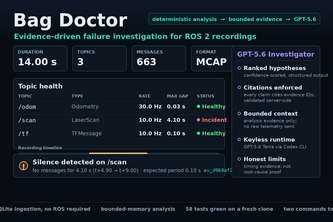
Bag Doctor is a self-reported tool for analyzing ROS 2 recordings (bag files) using deterministic analysis and GPT-5.6 to generate evidence-backed failure investigations. It claims to process large, multi-gigabyte recordings without requiring a ROS installation or deserializing message payloads.
What changed
The author states that the project was built as part of an OpenAI 2026 hackathon submission. The tool is described as a deterministic analysis engine with GPT-5.6 integration for investigative reasoning, and it includes a CLI and React-based dashboard.
Single most important open question — the commercial due-diligence read
Is there any evidence that Bag Doctor has been adopted or used in production environments beyond the author’s own development and testing? The description provides no information on customers, revenue, usage, or traction.
What The Product Actually Is
The description states that Bag Doctor is an “evidence-driven failure investigator for ROS 2 recordings.” It uses deterministic analysis to process MCAP and rosbag2 SQLite files without requiring a ROS installation. It measures topic activity, publication rates, timing classifications, inter-message gaps, and silence windows.
It then passes a bounded set of evidence to GPT-5.6 (via Terra) for hypothesis generation, with citations validated server-side. The system includes a CLI and React-based dashboard for investigation and reporting.
Evidence
- The author describes the product as an “evidence-driven failure investigator”.
- It uses deterministic analysis layers that ingest MCAP and rosbag2 SQLite files.
- It employs GPT-5.6 via Codex CLI and Terra, with bounded evidence access.
- A React-based dashboard is included for user interaction.
Inference The product appears to be a developer tool for robotics engineers working with ROS 2 data, focused on failure analysis and debugging.
Positioning & Claim Evolution
The author positions Bag Doctor as a tool that makes “robotics field data” easier to investigate by automating repetitive work. It emphasizes that the AI must show evidence behind its conclusions, and that it does not claim to prove physical root causes or repair bag files.
Evidence
- The tagline: “Bag Doctor turns ROS 2 recordings into bounded, evidence-backed failure investigations using deterministic analysis and GPT-5.6.”
- The author states: “I believe that an AI investigating robot failures should be required to show the evidence behind its conclusions.”
- It explicitly says: “Bag Doctor deliberately does not claim to prove physical root causes, repair bag files, or send raw telemetry to the model.”
Inference The positioning is focused on transparency and reproducibility in robotics failure analysis. The tool is positioned as a debugging assistant rather than a full automation or root-cause diagnosis system.
Target Customer & ICP
The author describes working with “lidar systems, rovers, and sensor pipelines” and mentions that the tool is for “robotics field data.” It is implied that the target user is a robotics engineer or developer working in ROS 2 environments.
Evidence
- The author states: “In my work, I deal with lidar systems, rovers, and sensor pipelines.”
- The product is built for ROS 2 recordings.
- The tool is described as useful for field data investigation.
Inference The primary customer is likely a robotics engineer or developer working in ROS 2 environments, particularly those dealing with large datasets and failure debugging.
Business Model & Pricing Evidence
There is no evidence of pricing, monetization strategy, or business model in the description. The project is presented as a hackathon submission.
Evidence
- No mention of pricing.
- No indication of revenue streams.
- No information on commercial use or licensing.
Inference No business model is evident from the description. It appears to be a prototype or proof-of-concept, not a commercial product.
Technical & Delivery Signals
The author reports that the backend uses Python, FastAPI, rosbags, MCAP, Pydantic, and SQLite. The frontend is built with React and TypeScript. It supports native ingestion of MCAP and rosbag2 files, and uses a disk-backed SQLite workspace for large recordings.
Evidence
- Backend: Python, FastAPI, rosbags, MCAP, Pydantic, SQLite.
- Frontend: React, TypeScript.
- Native support for MCAP and rosbag2 formats.
- Disk-backed SQLite workspace for processing large files.
- Server-Sent Events for progress tracking.
- GPT-5.6 Terra used via Codex CLI.
Inference The tool is built with a focus on performance and scalability, using deterministic analysis to avoid memory issues with large datasets.
Traction & Maturity Signals
There is no evidence of traction or adoption beyond the author’s own development. The project is described as a hackathon submission with no mention of users, customers, or revenue.
Evidence
- The project was submitted to an OpenAI 2026 hackathon.
- No mention of real-world usage.
- No customer data, revenue, or adoption metrics.
Inference No traction is evidenced. The tool appears to be in early development or prototype stage.
Competitive Context
The description does not provide any information on competitors or the broader market for robotics failure analysis tools.
Evidence
- No mention of existing tools or platforms.
- No competitive landscape described.
Inference No competitive context is evident. The tool may be a niche solution, but its place in the market is unknown.
Open Questions & Risks
- No traction or adoption: The project is presented as a hackathon submission with no evidence of real-world use.
- Unverified AI integration: GPT-5.6 is used via Terra and Codex CLI, but there is no verification of its performance or accuracy in practice.
- No commercialization strategy: No pricing, monetization, or business model is described.
- Limited scope: The tool does not claim to repair or fix data, which may limit its utility.
Evidence
- No revenue, customers, or usage data.
- No mention of a product roadmap beyond hackathon submission.
- No indication of commercial viability.
Questions the description leaves open
- What is the actual use case for this tool in production environments?
- Has it been tested on real-world robotics systems beyond the author’s own development?
- Are there any plans to monetize or commercialize the product?
- How does the deterministic analysis compare to existing tools in the ROS 2 ecosystem?
- What is the expected accuracy of GPT-5.6’s hypotheses, and how are false positives handled?
Overall Assessment
Not evidenced.
There is no evidence of revenue, customers, or traction to support a commercial due-diligence read. The project is described as a hackathon submission with no indication of product-market fit, adoption, or scalability.
The tool appears to be an early-stage prototype built for a specific niche (ROS 2 failure analysis) and lacks any commercialization signals.
Confidence Low — based on self-reported evidence only, with no external validation.
User Stories BotA demo video on every pull request
Get a demo video on every new feature
GitHub App that watches your pull requests and records a narrated, captioned demo.
Save time on demo prep and make informed decisions faster with a video walkthrough of every new feature.
Source
Submitted to the OpenAI 2026 hackathon on Devpost. Project home on Devpost. Back to the full gallery on Devpost.
This competitive analysis was produced by top-founders.com (opens in a new tab)
Generated by a language model from this project's public Devpost page — its tagline, the author's own write-up and any built-with tags listed there — as captured in August 2026. Short quotations are the author's words. It is an opinion on the idea as a business, not on the people behind it, and it reflects the description as published then. If the project has moved on, request a correction below. The analysis is not independent research and contains no verified traction, revenue or customer data.
An independent guide by KFG International LLC — not affiliated with, endorsed by, or connected to Devpost or OpenAI.