

Archive position — measured, not model output
0 likes on Devpost
2,263 of the 7,850 archived projects have more likes, and 5,587 share exactly 0 — so this project's #6,794 place in the like-ranked listing is a tie-break inside that group, not a ranking.
Projects (log scale)
Likes on Devpost. ▲ marks this project's group.
Show the figures
| Likes | Projects | Share of archive |
|---|---|---|
| 0 | 5,587 | 71.2% |
| 1 | 1,758 | 22.4% |
| 2 | 284 | 3.6% |
| 3–4 | 132 | 1.7% |
| 5–9 | 75 | 1.0% |
| 10+ | 14 | 0.2% |
 User Stories BotA demo video on every pull request
Get a demo video on every new feature
GitHub App that watches your pull requests and records a narrated, captioned demo.
Save time on demo prep and make informed decisions faster with a video walkthrough of every new feature.
Executive Summary
SmartGreenify is a self-reported Raspberry Pi–based smart-garden system that integrates real-time sensor data with local AutoML to inform irrigation decisions. The project was submitted by a single founder (kdorukdemirtas-star Demirt) for the OpenAI 2026 hackathon on Devpost. It is described as a hardware-software solution using Python, Flask, and machine learning to monitor environmental conditions and suggest optimal watering times.
The system claims to use local AutoML to compare multiple regression models and select the best-performing one based on validation error. It also includes a responsive web dashboard with live updates, PWA support, and reporting features such as PDF and Excel exports.
Key commercial due-diligence questions include: Is there any evidence of real-world usage or user feedback? What is the actual scope of the AutoML implementation beyond the hackathon prototype? How does this product differ from existing garden automation tools?
The single most important open question is whether SmartGreenify has progressed beyond a proof-of-concept to demonstrate commercial viability or traction.
What The Product Actually Is
The description states that SmartGreenify is a Raspberry Pi–based smart-garden system. It reads data from the following sensors:
- BME280 (temperature, humidity, pressure)
- ADS1115-connected capacitive soil-moisture sensor
- LDR light sensor
It uses local AutoML to compare regression models including Decision Trees, Random Forest, Extra Trees, Gradient Boosting, Histogram Gradient Boosting, and optional XGBoost. The system selects the most accurate model based on validation error.
The system includes:
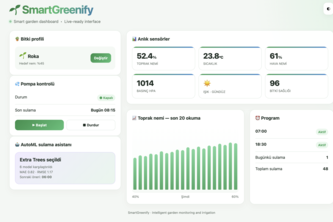
- A live dashboard showing sensor readings, historical charts, garden-health indicators, schedules, analytics, and pump status
- Web-based interface built with Flask, Chart.js, and WebSockets
- Pump relay control via GPIO 27
- Reporting features including PDF, Excel, and Plotly exports
The system is described as being built in Python using Flask, Flask-SocketIO, and various libraries such as scikit-learn, pandas, plotly, and socket.io.
Positioning & Claim Evolution
The author states that SmartGreenify was inspired by the question: "how can small-scale growing become more informed, efficient, and accessible without relying on expensive commercial greenhouse systems?"
It positions itself as a smart-garden assistant that turns manual observations into practical automation. The system claims to:
- Monitor real environmental conditions
- Help make better irrigation decisions
- Use local AutoML for intelligent model selection
- Provide live analytics and dashboard visualization
The project evolved from a hackathon submission to a complete Raspberry Pi system with hardware integration, software intelligence, and user-facing features like dashboards and reporting.
Target Customer & ICP
Not evidenced. The description does not specify target customers or identify a specific ideal customer profile (ICP). It only describes the system's functionality and technical components.
Business Model & Pricing Evidence
Not evidenced. There is no mention of pricing, revenue streams, or business model in the self-reported description.
Technical & Delivery Signals
The system is built using:
- Hardware: Raspberry Pi, BME280 sensor, ADS1115 sensor, LDR light sensor, pump relay
- Software: Python, Flask, Flask-SocketIO, scikit-learn, pandas, plotly, chart.js, websocket, PWA support
- Communication protocols: SPI (BME280), I²C (ADS1115), GPIO (LDR and pump relay)
- Data handling: real-time updates via WebSockets with HTTP fallback, time-aware model validation
The system includes:
- Live dashboard with sensor cards, trends, health indicators
- Resilient WebSocket behavior with reconnects and HTTP polling fallback
- Model selection based on newest 20% of data (chronological order preserved)
- PDF, Excel, and Plotly reporting capabilities
- PWA support for offline access
- Structured logging
Traction & Maturity Signals
Not evidenced. The description does not contain any evidence of traction, customers, revenue, or adoption beyond the hackathon submission.
Competitive Context
Not evidenced. There is no mention of competitors or market context in the self-reported description.
Open Questions & Risks
- The system is described as a hackathon project with no evidence of real-world usage or commercial deployment
- No information on whether the AutoML implementation has been tested beyond the prototype phase
- No evidence of user feedback, product-market fit, or customer validation
- The single-founder team suggests limited resources for scaling or development
- No mention of hardware costs, scalability, or manufacturing considerations
Questions the description leaves open
- Has SmartGreenify been tested in real-world conditions beyond the hackathon?
- What is the actual scope and performance of the AutoML implementation?
- Are there any users or customers currently using the system?
- How does the system handle sensor data noise or hardware failures?
- What are the hardware costs and scalability considerations for mass deployment?
- Have you considered how this product would integrate with existing gardening ecosystems?
Overall Assessment
Not evidenced. There is no evidence of revenue, customers, traction, or financial performance to support an investment or partnership decision. The project remains at a prototype stage as described by the author, with no indication of commercial viability or market validation.
User Stories BotA demo video on every pull request
Get a demo video on every new feature
GitHub App that watches your pull requests and records a narrated, captioned demo.
Save time on demo prep and make informed decisions faster with a video walkthrough of every new feature.
Source
Submitted to the OpenAI 2026 hackathon on Devpost. Project home on Devpost. Back to the full gallery on Devpost.
This competitive analysis was produced by top-founders.com (opens in a new tab)
Generated by a language model from this project's public Devpost page — its tagline, the author's own write-up and any built-with tags listed there — as captured in August 2026. Short quotations are the author's words. It is an opinion on the idea as a business, not on the people behind it, and it reflects the description as published then. If the project has moved on, request a correction below. The analysis is not independent research and contains no verified traction, revenue or customer data.
An independent guide by KFG International LLC — not affiliated with, endorsed by, or connected to Devpost or OpenAI.