

Archive position — measured, not model output
1 like on Devpost
505 of the 7,850 archived projects have more likes, and 1,758 share exactly 1 — so this project's #907 place in the like-ranked listing is a tie-break inside that group, not a ranking.
Projects (log scale)
Likes on Devpost. ▲ marks this project's group.
Show the figures
| Likes | Projects | Share of archive |
|---|---|---|
| 0 | 5,587 | 71.2% |
| 1 | 1,758 | 22.4% |
| 2 | 284 | 3.6% |
| 3–4 | 132 | 1.7% |
| 5–9 | 75 | 1.0% |
| 10+ | 14 | 0.2% |
 User Stories BotA demo video on every pull request
Get a demo video on every new feature
GitHub App that watches your pull requests and records a narrated, captioned demo.
Save time on demo prep and make informed decisions faster with a video walkthrough of every new feature.
Executive Summary
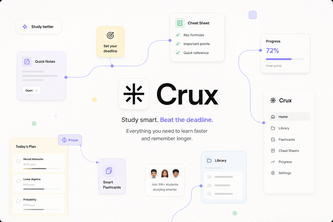
The company appears to be a student-focused study tool built for deadline-constrained learning environments. The product is described as a "deadline-aware study workspace" that turns syllabi, notes, and past papers into an explainable study plan using AI. It claims to help users make clear next-action decisions under time pressure.
What changed
The project was submitted to the OpenAI 2026 hackathon, indicating it is in early development or prototype stage. It leverages AI tools like GPT-5.6 and Codex for content processing and planning, with a focus on source-grounded outputs and minimal UI clutter.
The single most important open question
Is there evidence of user adoption or traction beyond the hackathon submission? The description does not indicate any revenue, customers, or usage metrics — only self-reported product features and design philosophy.
What The Product Actually Is
The description states that Crux is a deadline-aware study workspace. It operates through a core loop involving:
- Creation of a workspace with an exam date and constraints
- Upload of educational materials (PDFs, DOCX, PPTX, TXT, Markdown)
- Extraction of a Study Map — topics, dependencies, and cited source evidence
- Calibration of confidence via a fast check of what the user already knows
- Planning of a mission — time-budgeted sequence of learn / practice / review / skip
- Study and proof phases with source-grounded briefs, questions, and a review desk
The system is described as opinionated, pushing users toward one next action with evidence they can inspect. It uses AI to extract content, infer topics, and plan study paths, but avoids generic tutoring in favor of grounded responses.
Inference The product appears to be an AI-powered educational planning tool for students preparing for exams under tight time constraints.
Positioning & Claim Evolution
The description states that Crux was built "for that moment" — the point before an exam when decision paralysis is most acute. It contrasts itself with tools that assume weeks of preparation, instead targeting users who have only hours or days.
It positions itself as a deadline-first workspace, not a chatbot tutor. The key claims are:
- It helps students answer “What deserves the next 25 minutes?”
- It avoids black-box grade predictions.
- It provides explainable study plans with citations and confidence levels.
- It offers a “next action” clarity over dashboard-style interfaces.
Inference Crux positions itself as a focused, AI-assisted planning tool for students under time pressure — not a general-purpose learning platform or tutoring system.
Target Customer & ICP
The description states that Crux is built for students or anyone with a deadline and a problem in mind, particularly those preparing for exams with limited time. It explicitly mentions:
- Students who start preparing only 1–2 days before an exam
- Users who face “decision paralysis” rather than lack of content
- People needing to maximize marks within 12 hours
Inference The primary customer is a student or learner in a high-pressure, time-constrained academic setting — likely college or university students preparing for exams.
Business Model & Pricing Evidence
The description does not provide any information on pricing, monetization, or business model. It does not state whether the tool will be free, subscription-based, or offered through partnerships with educational institutions.
Not evidenced.
Technical & Delivery Signals
The product is built using:
- Frontend: Next.js 15 + React 19
- Backend: Supabase (Postgres, auth-ready architecture, private file storage), Drizzle ORM
- AI stack: Codex + GPT-5.6 for content processing and generation; OpenAI API for student-owned keys
- Other tools: Inngest for async ingestion, React Flow for Study Map UI, TanStack Query + Zustand for client state
It is described as using a bounded harness for AI generation — retrieve evidence → pack context → generate → validate → cite.
Inference The tool uses modern web and AI stacks to process documents and deliver structured study plans. It emphasizes explainability and grounding in user materials.
Traction & Maturity Signals
The description states that this project was submitted to the OpenAI 2026 hackathon, indicating it is likely a prototype or early-stage product.
It does not mention:
- Any revenue
- Customers or users
- Product adoption metrics
- Market traction beyond the hackathon submission
Not evidenced.
Competitive Context
The description does not provide any information about competitors, market positioning relative to existing tools, or how Crux differentiates from other study apps or AI tutoring platforms.
Not evidenced.
Open Questions & Risks
- No traction or revenue data: The product is described as a hackathon submission with no evidence of real-world usage.
- Unproven user base: It’s unclear whether the target audience (students) has adopted or engaged with the tool beyond its development phase.
- AI grounding limitations: While it claims to use grounded AI, there is no indication of how well this works in practice or how it handles ambiguous or incomplete inputs.
- Limited scope: The product is described as focused on exam prep under pressure — a narrow market segment. This may limit scalability.
Inference The project lacks commercial evidence and appears to be in early development with no demonstrated user engagement or business model.
Questions the description leaves open
- What is the current stage of development? Is this a prototype, MVP, or pre-launch product?
- Have you tested Crux with real students or users? If so, what feedback did you get?
- How do you plan to monetize the tool? Are there any partnerships or institutional buyers in mind?
- What are the technical limitations of document ingestion and extraction (e.g., OCR, PDF handling)?
- How does the system handle incomplete or low-quality inputs from users?
- Is there a plan for expanding beyond exam prep into broader learning scenarios?
Overall Assessment
The project is described as a hackathon submission with no evidence of traction, revenue, or customer engagement. It is positioned as an AI-powered study tool for students under time pressure, but lacks any commercial due-diligence signals.
Confidence: Low
- The description is self-reported and unverified.
- No data on users, customers, or revenue.
- Product maturity is unclear — likely early-stage.
- No indication of competitive positioning or business model.
Assessment Not ready for investment or partnership at this stage. Further evidence of traction, user testing, or commercial viability would be required to assess potential.
User Stories BotA demo video on every pull request
Get a demo video on every new feature
GitHub App that watches your pull requests and records a narrated, captioned demo.
Save time on demo prep and make informed decisions faster with a video walkthrough of every new feature.
Source
Submitted to the OpenAI 2026 hackathon on Devpost. Project home on Devpost. Back to the full gallery on Devpost.
This competitive analysis was produced by top-founders.com (opens in a new tab)
Generated by a language model from this project's public Devpost page — its tagline, the author's own write-up and any built-with tags listed there — as captured in August 2026. Short quotations are the author's words. It is an opinion on the idea as a business, not on the people behind it, and it reflects the description as published then. If the project has moved on, request a correction below. The analysis is not independent research and contains no verified traction, revenue or customer data.
An independent guide by KFG International LLC — not affiliated with, endorsed by, or connected to Devpost or OpenAI.