

Archive position — measured, not model output
0 likes on Devpost
2,263 of the 7,850 archived projects have more likes, and 5,587 share exactly 0 — so this project's #4,831 place in the like-ranked listing is a tie-break inside that group, not a ranking.
Projects (log scale)
Likes on Devpost. ▲ marks this project's group.
Show the figures
| Likes | Projects | Share of archive |
|---|---|---|
| 0 | 5,587 | 71.2% |
| 1 | 1,758 | 22.4% |
| 2 | 284 | 3.6% |
| 3–4 | 132 | 1.7% |
| 5–9 | 75 | 1.0% |
| 10+ | 14 | 0.2% |
 User Stories BotA demo video on every pull request
Get a demo video on every new feature
GitHub App that watches your pull requests and records a narrated, captioned demo.
Save time on demo prep and make informed decisions faster with a video walkthrough of every new feature.
Executive Summary
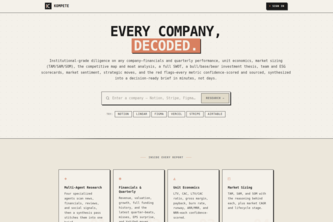
Kompete is an AI-powered research engine for investment analysts, described by its author as a tool that synthesizes fragmented company information into structured, decision-ready intelligence reports in under a minute. The product uses a multi-agent architecture powered by Gemini and orchestrated via FastAPI, with live streaming of results to a Next.js frontend and PostgreSQL persistence. It claims to simulate an analyst desk by deploying specialized AI agents for news, financials, reviews, social signals, and synthesis.
The description states that Kompete is built by one person (Mritunjay Sharma), submitted as a hackathon project to the OpenAI 2026 hackathon on Devpost. There is no evidence of revenue, customers, or traction beyond the self-reported project write-up.
Key open question: Does Kompete’s multi-agent architecture and live-streaming output represent a viable commercial product, or is it an experimental prototype with limited scalability?
What The Product Actually Is
The description states that Kompete is an AI research engine for investment analysts. It allows users to type any company name and receive in under a minute a structured intelligence report composed of:
- SWOT analysis
- Financial snapshot
- Unit-economics breakdown with assumptions shown
- Multi-quarter revenue trends
- Sentiment scoring
- Peer benchmarks
- Strategic moves
- Analyst-style investment thesis
The output is delivered live via Server-Sent Events (SSE) and can be exported as a clean PDF.
Inference: The product appears to be a prototype or proof-of-concept built in a hackathon environment, not yet a commercial-grade solution. It is described as a multi-agent system with five specialized agents working in parallel and a final synthesis agent.
Positioning & Claim Evolution
The author states that Kompete addresses the pain point of institutional investors, founders, and product teams who lack time to research companies but are expected to understand competitors or partners. The core claim is that it solves a “synthesis problem” rather than a data problem — that is, it aggregates and structures information from scattered sources into a coherent report.
The positioning has evolved from a general research tool to a specific solution for institutional-grade diligence, with emphasis on speed, transparency, and analyst-style output. The product is described as mimicking how a real analyst desk works, with agents handling different domains of research.
Inference: This is a self-positioned B2B SaaS or AI research tool aimed at financial professionals or deal teams. It is not yet positioned for mass adoption or general use — it is tailored to institutional users who value structured, trusted intelligence.
Target Customer & ICP
The description states that Kompete is built for investment analysts, founders, and product teams who need rapid access to company intelligence but lack time or resources to perform deep research manually. It is described as solving a problem faced by those in “deal meetings” or “launches” where understanding the other party is critical.
Inference: The initial ICP appears to be institutional investors, deal teams, and product managers who are already using some form of competitive intelligence or diligence tools. It is not yet clear if Kompete targets a specific vertical (e.g., private equity, venture capital) or a specific role within an organization.
Business Model & Pricing Evidence
The description does not state any pricing model, business model, or monetization strategy. It only describes the product’s functionality and architecture.
Not evidenced: No information on how Kompete would be sold, whether it is freemium, subscription-based, or one-time purchase. No mention of enterprise vs. individual users or tiered offerings.
Technical & Delivery Signals
Kompete is built with:
- Frontend: Next.js
- Backend: FastAPI
- AI: Gemini
- Database: PostgreSQL
- Streaming: Server-Sent Events (SSE)
- Architecture: Multi-agent pipeline
The system orchestrates five agents, each responsible for a domain of research (news, financials, reviews, social), with a final synthesis agent combining findings. The output is streamed live to the user and exported as PDF.
Inference: The technical stack suggests a modern, scalable architecture suitable for AI-driven workflows. However, it is not clear whether this is production-ready or a prototype built in a hackathon setting.
Traction & Maturity Signals
The description states that Kompete was submitted to the OpenAI 2026 hackathon and is built by one person (Mritunjay Sharma). It is described as a working end-to-end prototype with live streaming, clean PDF export, and transparent reasoning.
Not evidenced: No evidence of revenue, customers, usage metrics, or product adoption. The project is not described as having moved beyond the prototype stage.
Competitive Context
The description does not mention any direct competitors or competitive landscape. It only states that users either “burn hours on scattered Googling” or spend thousands on stale analyst reports.
Inference: Kompete appears to be positioned in a space where traditional research tools (e.g., Bloomberg, PitchBook, S&P Capital IQ) are either too slow, too expensive, or not tailored for rapid, structured synthesis. However, no specific competitors are named or described.
Open Questions & Risks
- Prototype vs. Product: The project is described as a hackathon submission by one person — no evidence of product-market fit or scalability.
- AI Reliability: Multi-agent AI systems are complex and prone to inconsistency; the description notes challenges in reconciling findings.
- Trust & Transparency: While transparency is a stated goal, it’s unclear how Kompete ensures accuracy or handles edge cases where AI agents contradict each other.
- Monetization: No business model or pricing strategy is described — a key risk for commercial viability.
Questions the description leaves open
- What is the current stage of development? Is this a prototype, MVP, or early product?
- How does Kompete ensure consistency and accuracy across agents in its multi-agent system?
- Has there been any user testing or feedback from target customers (analysts, investors)?
- What are the plans for data sources beyond news, financials, reviews, and social?
- Is there a plan to monetize this product? If so, what is the pricing model?
- How does Kompete handle edge cases or situations where data is missing or ambiguous?
- What is the long-term vision for Kompete — is it intended to be a standalone tool or integrated into larger platforms?
Overall Assessment
Kompete is described as a hackathon project by one person, with no evidence of revenue, customers, or traction. The product concept is compelling in theory — a fast, structured AI research engine for institutional users — but there is no indication that it has moved beyond the prototype stage.
Confidence: Low. The description is self-reported and unverified; no third-party validation or data on adoption, usage, or commercial viability exists.
Assessment: Not ready for investment or partnership at this time. It may be a promising idea with potential, but lacks evidence of product-market fit, scalability, or monetization strategy. A follow-up evaluation would require deeper due diligence into prototype performance, user feedback, and business model development.
User Stories BotA demo video on every pull request
Get a demo video on every new feature
GitHub App that watches your pull requests and records a narrated, captioned demo.
Save time on demo prep and make informed decisions faster with a video walkthrough of every new feature.
Source
Submitted to the OpenAI 2026 hackathon on Devpost. Project home on Devpost. Back to the full gallery on Devpost.
This competitive analysis was produced by top-founders.com (opens in a new tab)
Generated by a language model from this project's public Devpost page — its tagline, the author's own write-up and any built-with tags listed there — as captured in August 2026. Short quotations are the author's words. It is an opinion on the idea as a business, not on the people behind it, and it reflects the description as published then. If the project has moved on, request a correction below. The analysis is not independent research and contains no verified traction, revenue or customer data.
An independent guide by KFG International LLC — not affiliated with, endorsed by, or connected to Devpost or OpenAI.