

Archive position — measured, not model output
0 likes on Devpost
2,263 of the 7,850 archived projects have more likes, and 5,587 share exactly 0 — so this project's #2,869 place in the like-ranked listing is a tie-break inside that group, not a ranking.
Projects (log scale)
Likes on Devpost. ▲ marks this project's group.
Show the figures
| Likes | Projects | Share of archive |
|---|---|---|
| 0 | 5,587 | 71.2% |
| 1 | 1,758 | 22.4% |
| 2 | 284 | 3.6% |
| 3–4 | 132 | 1.7% |
| 5–9 | 75 | 1.0% |
| 10+ | 14 | 0.2% |
 User Stories BotA demo video on every pull request
Get a demo video on every new feature
GitHub App that watches your pull requests and records a narrated, captioned demo.
Save time on demo prep and make informed decisions faster with a video walkthrough of every new feature.
Executive Summary
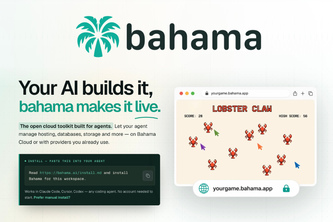
The company appears to be a solo project named Bahama, an open-source cloud toolkit built for coding agents. The author states that it enables agents to provision cloud resources, connect them securely, and deploy applications through a consistent interface. It includes a CLI, agent skill, and provider connections, with support for multiple cloud providers like Neon, Supabase, MongoDB, Vercel, Cloudflare, and Fly.io.
The project was built during OpenAI Build Week using Codex and GPT-5.6, and is described as an alpha release. It has no revenue or customer data, and the author does not claim any traction or adoption beyond its own development and submission to a hackathon.
The single most important open question
Is there evidence of real-world usage or integration by coding agents, or is this a proof-of-concept that remains untested in production?
What The Product Actually Is
- The description states that Bahama is an open-source cloud toolkit built for coding agents.
- It provides a CLI and agent skill, allowing agents to provision resources, connect them securely, deploy applications, and verify results.
- It supports multiple cloud providers, including Neon, Supabase, MongoDB, Vercel, Cloudflare, and Fly.io.
- The desired stack is defined in a
bahama.yamlfile, which generates a read-only plan showing providers, accounts, and operations. - Users approve consequential changes before Bahama executes them and verifies against live provider state.
- It aims to eliminate the need for copying secrets through chat or navigating multiple dashboards.
Inference: The product appears to be a developer tool that integrates with AI agents to automate cloud provisioning and deployment workflows. It is not a commercial SaaS offering but rather an open-source CLI-based toolkit.
Positioning & Claim Evolution
- The author positions Bahama as a tool for coding agents, designed to simplify cloud provisioning, connection, and deployment.
- It is described as a "seamless way" to manage cloud resources without lock-in.
- The project is presented as an open CLI with no vendor lock-in, intended to be used in conjunction with other tools like Codex.
- The tagline says: “Bahama gives coding agents a seamless way to provision cloud resources, connect them securely, and deploy applications.”
- The author claims that Bahama was built using Codex and GPT-5.6 during OpenAI Build Week.
Claim: Bahama is an open-source tool for AI agents to manage cloud infrastructure.
Inference: The positioning suggests a niche in developer tooling for AI-assisted development, but no evidence of market traction or adoption.
Target Customer & ICP
- The target customer is coding agents, which the author defines as AI systems that can perform tasks like provisioning and deploying applications.
- The product is intended for developers who use AI tools to automate infrastructure workflows.
- It supports multiple cloud providers (Neon, Supabase, MongoDB, Vercel, Cloudflare, Fly.io), suggesting a broad but not specific ICP.
Not evidenced: No explicit customer segments or personas are described. The author does not state who uses Bahama beyond "coding agents".
Business Model & Pricing Evidence
- The project is described as an open-source CLI.
- There is no mention of pricing, subscriptions, or monetization models.
- The author states that Bahama has no lock-in, implying it is a utility tool rather than a paid service.
Not evidenced: No business model or pricing information is provided. The project appears to be open source and non-commercial in nature.
Technical & Delivery Signals
- Built with: Codex, GPT-5.6, Neon, Node.js, npm, PostgreSQL, TypeScript, Vercel, Vitest, Zod
- The project includes a complex monorepo with CLI, Agent Skill, provider connections, and a first-party Bahama Cloud provider.
- The author notes that managing context was a challenge, so they invested in extensive documentation, including an AGENTS.md file.
- It supports integration with multiple cloud providers and is designed to work with AI agents.
Inference: The technical stack and architecture suggest a sophisticated tool for developers working with AI agents. However, no evidence of real-world usage or performance data is provided.
Traction & Maturity Signals
- The project was built during OpenAI Build Week and submitted to the 2026 OpenAI hackathon.
- It is described as an alpha release.
- The author states that Bahama was developed using AI tools (Codex, GPT-5.6) but does not provide evidence of adoption or usage beyond its own development.
Not evidenced: No data on user adoption, customer engagement, or product maturity beyond the alpha stage is provided.
Competitive Context
- The author does not name competitors.
- Bahama appears to target a niche in developer tooling for AI agents, particularly those managing cloud infrastructure.
- It competes with tools that enable developers to provision and deploy applications, such as Terraform, AWS CDK, or Vercel’s deployment tools.
Not evidenced: No competitive analysis or differentiation from existing tools is provided. The author does not reference any specific competitors.
Open Questions & Risks
- The project is a single-person effort (1 team member).
- It is described as an alpha, with no evidence of real-world usage.
- The author relies heavily on AI tools for development, which may indicate a lack of deep technical or operational experience.
- No revenue, customers, or traction data are provided — only self-reported claims.
Inference: The risk of product-market fit is high due to lack of user feedback or adoption. The reliance on AI for development may also raise questions about scalability and long-term maintainability.
Questions the description leaves open
- What specific use cases are you targeting with Bahama, and how do you plan to validate them?
- How does Bahama differ from existing tools like Terraform or AWS CDK in terms of functionality or user experience?
- Are there any early adopters or users who have tested the tool beyond the alpha stage?
- What is your roadmap for product development, and how do you plan to scale beyond a solo developer?
- How do you intend to monetize or sustain the project if it remains open-source?
Overall Assessment
- The project is self-reported as an open-source CLI built for AI agents.
- It has no revenue, customers, or traction data, and is described as an alpha product.
- It was submitted to a hackathon and is not yet proven in production.
- The author does not claim any commercial success or adoption.
Assessment: Not ready for investment or partnership. The project shows potential but lacks evidence of real-world usage or market validation. It may be a promising idea, but current evidence suggests it is still in early development.
User Stories BotA demo video on every pull request
Get a demo video on every new feature
GitHub App that watches your pull requests and records a narrated, captioned demo.
Save time on demo prep and make informed decisions faster with a video walkthrough of every new feature.
Source
Submitted to the OpenAI 2026 hackathon on Devpost. Project home on Devpost. Back to the full gallery on Devpost.
This competitive analysis was produced by top-founders.com (opens in a new tab)
Generated by a language model from this project's public Devpost page — its tagline, the author's own write-up and any built-with tags listed there — as captured in August 2026. Short quotations are the author's words. It is an opinion on the idea as a business, not on the people behind it, and it reflects the description as published then. If the project has moved on, request a correction below. The analysis is not independent research and contains no verified traction, revenue or customer data.
An independent guide by KFG International LLC — not affiliated with, endorsed by, or connected to Devpost or OpenAI.