

Archive position — measured, not model output
0 likes on Devpost
2,263 of the 7,850 archived projects have more likes, and 5,587 share exactly 0 — so this project's #2,871 place in the like-ranked listing is a tie-break inside that group, not a ranking.
Projects (log scale)
Likes on Devpost. ▲ marks this project's group.
Show the figures
| Likes | Projects | Share of archive |
|---|---|---|
| 0 | 5,587 | 71.2% |
| 1 | 1,758 | 22.4% |
| 2 | 284 | 3.6% |
| 3–4 | 132 | 1.7% |
| 5–9 | 75 | 1.0% |
| 10+ | 14 | 0.2% |
 User Stories BotA demo video on every pull request
Get a demo video on every new feature
GitHub App that watches your pull requests and records a narrated, captioned demo.
Save time on demo prep and make informed decisions faster with a video walkthrough of every new feature.
Executive Summary
What the company appears to be
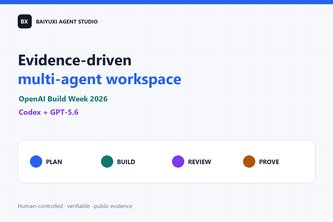
Baiyuxi Agent Studio is a self-reported software development workspace built around multi-agent AI collaboration. The author describes it as a coordination layer above agent CLIs such as Codex, aiming to support persistent agent identities, thread isolation, shared memory, and structured workflows for software changes.
What changed
During the OpenAI 2026 hackathon (Build Week), the author completed a migration of runtime code and test fixtures to a public agent identity model. They restored repository-wide runtime and quality gates, added an explicit conversation-title candidate flow, and verified the new workflow with focused tests and checks.
The single most important open question
Is Baiyuxi Agent Studio a functional product that users can install and operate, or is it a prototype or demonstration tool? The description does not clarify whether it's deployable beyond the author’s own environment, nor if there are any external users or customers.
What The Product Actually Is
The description states that Baiyuxi Agent Studio is “a coordination layer above agent CLIs such as Codex.” It supports multi-agent conversations, persistent agent identities, thread isolation, shared memory, skills, MCP tools, invocation records, cross-model review, and delivery gates within one workspace.
It allows users to route work with agent mentions, preserve decisions across long-running tasks, inspect which provider and tools handled an invocation, and move work through specification, implementation, review, testing, and release.
The platform integrates Codex as a first-class agent adapter. It can launch the Codex CLI, apply project instructions and MCP configuration, accept runtime model and reasoning settings, and preserve structured invocation events for the workspace.
It is built as a TypeScript monorepo with a Next.js and React frontend, a Fastify API, shared runtime types, and an MCP server. Redis provides persistent runtime state when enabled, SQLite stores local evidence, and Socket.IO supports live collaboration updates.
The author notes that this is not a presentation prototype but an installable product, though no further details are provided about deployment or distribution mechanisms.
Positioning & Claim Evolution
The description states the platform was built around one principle: “models set the ceiling, but the platform sets the quality and safety floor.” This suggests a positioning where AI models provide capability, while the platform ensures responsible use through structure, identity, memory, and decision points.
The author claims that Baiyuxi Agent Studio aims to change the relationship between humans and AI from being a router to one where the human provides intent, judgment, and final approval, while agents coordinate as a development team.
There is no evidence of prior versions or evolution in positioning beyond what was described during Build Week. The project appears to be a new iteration focused on improving agent coordination and safety features.
Target Customer & ICP
The description does not identify specific customer segments or personas. However, it implies a target audience of developers who work with AI tools like Codex and are looking for better coordination and persistence in multi-agent workflows.
It also suggests that the long-term goal is to make verified multi-agent delivery accessible to individuals who have ideas but do not have a traditional software team — indicating an ICP focused on solo developers or small teams without formal engineering resources.
No evidence of existing customers, user personas, or market segmentation is provided.
Business Model & Pricing Evidence
There is no evidence in the description of any business model or pricing structure. The author does not mention monetization strategies, subscriptions, licensing, or revenue streams.
The project appears to be a personal or hackathon effort without commercial intent evident from the description.
Technical & Delivery Signals
Baiyuxi Agent Studio is described as a TypeScript monorepo with:
- Next.js and React frontend
- Fastify API
- Shared runtime types
- MCP server
- Redis for persistent state (optional)
- SQLite for local evidence storage
- Socket.IO for live collaboration updates
Codex is integrated as a first-class agent adapter, supporting project instructions, MCP configuration, model settings, and structured invocation event preservation.
The author mentions that the Build Week release included:
- Migration of runtime code and test fixtures to public agent identity model
- Restoration of repository-wide quality gate after migration
- Addition of an explicit conversation-title candidate flow with human confirmation step
- Verification via focused API/frontend tests, TypeScript checks, formatting, and diff validation
No evidence of scalability, performance metrics, or production-grade infrastructure is provided.
Traction & Maturity Signals
The description does not provide any traction data such as:
- Revenue
- Customers
- Users
- Adoption rates
- Usage statistics
It indicates that the project existed before Build Week and that this submission focused on extending it during the event. It also notes that the author is the sole team member, suggesting a limited scale of operation.
There are no signs of product-market fit or market traction beyond the author’s own development efforts.
Competitive Context
The description does not mention competitors or existing solutions in the space of multi-agent AI development tools or coordination platforms. It only references Codex as an integrated agent CLI and does not compare Baiyuxi Agent Studio to other products or services.
No competitive analysis, market positioning relative to others, or differentiation strategy is evident.
Open Questions & Risks
- Unclear deployment status: The description says it's an installable product but provides no clarity on whether users can actually deploy or use it beyond the author’s environment.
- Single-person team: With only one member listed, there are concerns about scalability, long-term maintenance, and resource availability.
- No commercialization signals: No evidence of monetization, pricing, or business model is present.
- Limited external validation: The entire description is self-reported and unverified; no third-party feedback or user testing is mentioned.
- Prototype vs. product ambiguity: While described as installable, there’s no indication that it has been tested by others or used in real-world scenarios.
Questions the description leaves open
- Is Baiyuxi Agent Studio currently deployable by users outside the author's environment?
- What is the current status of the platform beyond Build Week — has it been iterated upon since then?
- Are there any plans for monetization or commercial use?
- How does the platform handle integration with other AI agents beyond Codex?
- Has the author considered how to scale beyond a single developer’s workflow?
- What are the key assumptions underlying the platform's design, and how have they been validated?
Overall Assessment
Not evidenced.
The description provides no information on financials, traction, or commercial viability that would support an investment or partnership decision. The project is described as a hackathon effort with no indication of market readiness, customer base, or revenue potential.
It remains unclear whether Baiyuxi Agent Studio represents a viable product or merely a prototype, and there is insufficient evidence to assess its strategic value for investors or partners.
User Stories BotA demo video on every pull request
Get a demo video on every new feature
GitHub App that watches your pull requests and records a narrated, captioned demo.
Save time on demo prep and make informed decisions faster with a video walkthrough of every new feature.
Source
Submitted to the OpenAI 2026 hackathon on Devpost. Project home on Devpost. Back to the full gallery on Devpost.
This competitive analysis was produced by top-founders.com (opens in a new tab)
Generated by a language model from this project's public Devpost page — its tagline, the author's own write-up and any built-with tags listed there — as captured in August 2026. Short quotations are the author's words. It is an opinion on the idea as a business, not on the people behind it, and it reflects the description as published then. If the project has moved on, request a correction below. The analysis is not independent research and contains no verified traction, revenue or customer data.
An independent guide by KFG International LLC — not affiliated with, endorsed by, or connected to Devpost or OpenAI.