

Archive position — measured, not model output
0 likes on Devpost
2,263 of the 7,850 archived projects have more likes, and 5,587 share exactly 0 — so this project's #2,873 place in the like-ranked listing is a tie-break inside that group, not a ranking.
Projects (log scale)
Likes on Devpost. ▲ marks this project's group.
Show the figures
| Likes | Projects | Share of archive |
|---|---|---|
| 0 | 5,587 | 71.2% |
| 1 | 1,758 | 22.4% |
| 2 | 284 | 3.6% |
| 3–4 | 132 | 1.7% |
| 5–9 | 75 | 1.0% |
| 10+ | 14 | 0.2% |
 User Stories BotA demo video on every pull request
Get a demo video on every new feature
GitHub App that watches your pull requests and records a narrated, captioned demo.
Save time on demo prep and make informed decisions faster with a video walkthrough of every new feature.
Executive Summary
What the company appears to be
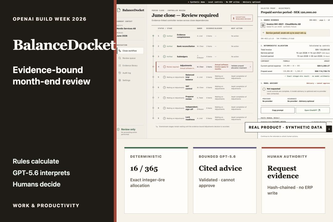
BalanceDocket is a self-reported tool for month-end accounting review processes. It claims to bundle evidence from multiple sources (invoices, policies, spreadsheets) into a single, inspectable path that includes deterministic calculations, GPT-5.6 interpretation, and human decision-making.
What changed
The project description indicates this was built as part of an OpenAI 2026 hackathon submission. It extends a pre-existing "Accounting Agent" repository with new functionality focused on synthetic workflows, evidence binding, and bounded AI interpretation in accounting contexts.
The single most important open question
Does BalanceDocket have any evidence of traction, revenue, customers or adoption beyond the author's own write-up? The description contains no information about actual use, market validation, or commercial deployment.
This analysis is based entirely on the self-reported project description provided by the caller. No external verification or historical data is available. All claims in this report are based on what the author states, not independently confirmed facts.
What The Product Actually Is
The description states that BalanceDocket:
- Bundles evidence from fragmented sources (ledger exports, invoices, policy notes, spreadsheets, chat threads, sign-off records) into one "evidence-bound path"
- Uses deterministic controls to calculate exact amounts (e.g., SEK 5,260.27 expense and SEK 114,739.73 prepaid asset)
- Integrates GPT-5.6 in a "bounded interpretive role" that connects ambiguous invoice wording with policy and exact control results
- Does not make any ERP writes or accounting actions
- Exports JSON workpapers without changing external systems
- Runs locally without network connection, API keys, or model credentials for its deterministic path
The product is described as a workflow tool that combines Python backend (evidence, controls, advisory-validation) with React/TypeScript frontend UI built using Vite.
Positioning & Claim Evolution
The description states BalanceDocket was inspired by "that missing chain" in month-end reviews where evidence lives across multiple places. It positions itself as:
- Not another "autonomous-accountant claim"
- Instead, a tool that provides "defensible chain showing what the source said, what the rules calculated, what the model contributed, and which human made the accountable decision"
The author claims the product addresses four basic questions reviewers struggle with: What source supports this? Who did the calculation? What did the model contribute? Who made the accountable decision?
It also states that GPT-5.6 has a "material but bounded product role" - interpreting synthetic invoice wording and policy in context of deterministic results, selecting citations, exposing uncertainty, flagging missing evidence - but cannot change calculations or claim approval authority.
Target Customer & ICP
The description states:
- The target users are "controllers" who need to review month-end close exceptions
- It references "Nordix Services AB's June 2026 close" as a synthetic case example
- The product is described as being built for "reviewer's evidence and authority boundaries"
- The author mentions "accounting managers" as potential future users in walkthrough sessions
The description does not state:
- Specific customer segments beyond "controllers"
- Size or industry of target organizations
- Whether it targets small businesses, mid-market, or enterprise customers
- Any named customers or use cases outside the synthetic example
Business Model & Pricing Evidence
Not evidenced.
The description contains no information about:
- Revenue streams
- Pricing models
- Customer acquisition costs
- Unit economics
- Monetization strategy
- Subscription tiers or pricing structures
Technical & Delivery Signals
The description states BalanceDocket:
- Combines Python evidence, controls, advisory-validation and decision-chain layer with React/TypeScript reviewer built with Vite
- Uses Playwright for browser verification
- Runs a loopback-only Python service serving the React UI
- Has a "judge bundle" that can run without rebuilding or installing Node.js
- Includes 17 focused BalanceDocket tests, 32 frontend tests, production build and bundle-parity check, and 344 full repository tests
- Supports responsive UI with keyboard accessibility, VoiceOver, Safari, Firefox, WebKit, reduced-motion, zoom/reflow, and automated accessibility coverage
- Uses SHA-256 hashes for evidence binding and append-only hash-chained events
- Has a deterministic baseline that is "model-free, network-off, API-free" and does not require OpenAI account
- Uses Codex for development acceleration but has separate optional Responses API route with explicit opt-in
Traction & Maturity Signals
Not evidenced.
The description contains no information about:
- Actual users or customers
- Revenue or ARR
- Customer adoption rates
- Product usage metrics
- Market traction
- Any form of commercial deployment or production use
- Customer feedback or testimonials
- Product iteration history beyond the hackathon submission
Competitive Context
Not evidenced.
The description contains no information about:
- Direct competitors
- Market size or growth trends
- Competitive positioning
- Differentiation from existing solutions
- Industry benchmarks or market share
- Any competitive landscape analysis
Open Questions & Risks
Inferences based on the self-reported description:
- No commercial evidence: The entire description is self-reported and unverified, with no evidence of revenue, customers, or adoption beyond the author's own account.
- Limited scope: The product only handles one synthetic case (Nordix Services AB) and has not been validated with actual controllers or accounting managers beyond planned walkthroughs.
- Unproven AI integration: While it claims GPT-5.6 has a "bounded interpretive role," the description does not show how this role is actually implemented or validated in practice.
- Development-only focus: The product appears to be primarily a development exercise rather than a commercial product, with no evidence of market validation or customer feedback loops.
- Technical complexity vs. commercial viability: The detailed technical implementation suggests significant engineering effort but does not demonstrate clear path to commercial success or scalability.
- Unclear monetization: No business model or pricing information provided, making it unclear how the product would generate revenue.
Questions the description leaves open
- What specific customer pain points did you identify that led to this solution?
- How many actual controllers or accounting managers have you tested this with beyond the planned walkthroughs?
- What is your plan for validating the product's utility before claiming time savings?
- How do you intend to monetize this tool in the marketplace?
- What are the key technical challenges that remain unresolved before production deployment?
- Have you considered how this would integrate with existing ERP systems or accounting software?
- What is the timeline for moving from the current synthetic case to real-world adoption?
- How do you plan to handle edge cases or ambiguous situations not covered in the synthetic example?
- What are the key assumptions about user behavior that underlie your design decisions?
- How do you plan to scale this solution beyond a single synthetic case?
Overall Assessment
Not evidenced.
The description contains no information about:
- Financial performance or projections
- Market opportunity size
- Competitive advantages
- Founders' track record
- Investment requirements or use of funds
- Partnership potential or strategic fit
- Any commercial viability metrics
This is a self-reported project description from a hackathon submission with no evidence of traction, revenue, customers, or adoption beyond the author's own account. The product appears to be primarily a technical demonstration rather than a commercial product in any meaningful sense.
User Stories BotA demo video on every pull request
Get a demo video on every new feature
GitHub App that watches your pull requests and records a narrated, captioned demo.
Save time on demo prep and make informed decisions faster with a video walkthrough of every new feature.
Source
Submitted to the OpenAI 2026 hackathon on Devpost. Project home on Devpost. Back to the full gallery on Devpost.
This competitive analysis was produced by top-founders.com (opens in a new tab)
Generated by a language model from this project's public Devpost page — its tagline, the author's own write-up and any built-with tags listed there — as captured in August 2026. Short quotations are the author's words. It is an opinion on the idea as a business, not on the people behind it, and it reflects the description as published then. If the project has moved on, request a correction below. The analysis is not independent research and contains no verified traction, revenue or customer data.
An independent guide by KFG International LLC — not affiliated with, endorsed by, or connected to Devpost or OpenAI.