

Archive position — measured, not model output
0 likes on Devpost
2,263 of the 7,850 archived projects have more likes, and 5,587 share exactly 0 — so this project's #6,799 place in the like-ranked listing is a tie-break inside that group, not a ranking.
Projects (log scale)
Likes on Devpost. ▲ marks this project's group.
Show the figures
| Likes | Projects | Share of archive |
|---|---|---|
| 0 | 5,587 | 71.2% |
| 1 | 1,758 | 22.4% |
| 2 | 284 | 3.6% |
| 3–4 | 132 | 1.7% |
| 5–9 | 75 | 1.0% |
| 10+ | 14 | 0.2% |
 User Stories BotA demo video on every pull request
Get a demo video on every new feature
GitHub App that watches your pull requests and records a narrated, captioned demo.
Save time on demo prep and make informed decisions faster with a video walkthrough of every new feature.
Executive Summary
What the company appears to be
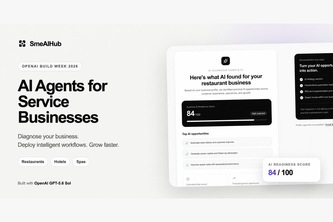
SmeAIHub is a self-reported AI-powered diagnostic tool for small and medium-sized service businesses (e.g., restaurants, hotels, spas). It claims to offer an industry-specific AI readiness score, automation opportunities, time-saving estimates, and growth projections—without requiring technical expertise. The product is described as built using GPT-5.6 Sol and Codex, with a deterministic prototype that does not currently integrate with OpenAI models at runtime.
What changed
The project evolved from an idea to a working prototype during a hackathon. It began as a marketing form and transformed into a multi-state experience (Form → Thinking → Results), incorporating AI for product design, development, and documentation. The current version is described as privacy-conscious and deterministic, while future versions are expected to use OpenAI APIs with structured outputs.
The single most important open question
Is there evidence of traction or commercial interest from service businesses beyond the prototype’s self-reported experience?
What The Product Actually Is
- The description states that SmeAIHub is a diagnostic tool for service businesses.
- It provides an industry-specific AI readiness score and prioritized automation opportunities.
- The product includes time-saving estimates, growth projections, and actionable roadmaps.
- It currently supports restaurants, hotels, and spas.
- The prototype uses a deterministic recommendation layer; no runtime OpenAI integration exists yet.
- The experience is structured as Form → Thinking → Results states.
- A lead-delivery workflow preserves email notifications to the SmeAIHub team.
Inference The product appears to be an early-stage AI diagnostic platform aimed at helping service businesses identify automation opportunities. It is not a chatbot or general-purpose AI assistant but rather a structured, outcome-driven experience.
Positioning & Claim Evolution
- The description states that the project started with the idea of “AI automation” but evolved into a more focused positioning: “AI agents for Service Businesses.”
- It was designed to reverse the typical AI product approach—starting with models or prompts and instead beginning with business problems.
- The author claims that the experience is built using GPT-5.6 Sol and Codex, which were used as collaborators in design, implementation, and documentation.
Inference Positioning has shifted from a generic automation platform to a more targeted one focused on service businesses and their specific needs. This evolution reflects an attempt to make AI more accessible and actionable for non-technical users.
Target Customer & ICP
- The description states that SmeAIHub targets small and medium-sized service businesses.
- Specific industries mentioned include restaurants, hotels, spas, and wellness businesses.
- The target audience is described as business owners who are busy and lack technical expertise.
- The tool aims to reduce time spent on repetitive tasks like customer questions, booking workflows, and follow-ups.
Inference The ideal customer profile (ICP) centers around small-to-medium service businesses that are looking for practical AI solutions without needing deep technical knowledge. The focus is on measurable value rather than general AI tools.
Business Model & Pricing Evidence
- No pricing information or business model details are provided in the description.
- The product appears to be a prototype with no revenue streams or monetization strategy described.
- The current version does not integrate with OpenAI models at runtime, suggesting it is still in development.
Inference There is no evidence of a defined business model or pricing structure. The project seems to be in an early stage, likely focused on validating the concept before pursuing commercialization.
Technical & Delivery Signals
- Built with Next.js 16, React 19, TypeScript, Tailwind CSS 4, Lucide React, Resend, and Vercel.
- Uses a client-side form → server-side validation → secure lead delivery workflow.
- Analytics (Google Analytics, Microsoft Clarity) load only after user consent.
- The prototype avoids runtime OpenAI integration; it uses deterministic logic.
- The experience includes honeypot protection, HTML escaping, and payload limits for security.
- Codex was used throughout the product lifecycle—from architecture to launch preparation.
Inference The technical stack is modern and production-ready. The use of Codex suggests a strong AI-assisted development process. However, there is no evidence of actual OpenAI integration in the current version.
Traction & Maturity Signals
- The project was built during a hackathon (OpenAI 2026).
- It includes a public demo video and screenshots.
- A README, changelog, and design reviews are part of the package.
- The prototype supports three industries: restaurants, hotels, and spas.
- No customer data, revenue figures, or usage metrics are mentioned.
Inference There is no evidence of traction or adoption beyond the prototype. The project is at a very early stage, likely in validation or pre-launch mode.
Competitive Context
- The description does not mention competitors directly.
- It positions itself as an alternative to generic AI tools that begin with models or prompts.
- It emphasizes simplicity and business-focused outcomes over chatbot-style interfaces.
- The approach contrasts with typical AI automation platforms by focusing on actionable insights rather than general-purpose AI.
Inference While no direct competitors are named, SmeAIHub appears to aim at filling a gap in the market for AI tools tailored specifically to service businesses. It competes with broader AI automation platforms but differentiates itself through its structured, outcome-driven approach.
Open Questions & Risks
- The prototype does not currently use OpenAI models at runtime, despite claims of using GPT-5.6 Sol and Codex.
- No evidence of revenue, customers, or traction.
- The project is described as a hackathon submission with no indication of commercial viability.
- There is no mention of data privacy policies beyond consent mechanisms.
- The roadmap includes future OpenAI integration, but the current version lacks it.
Inference The lack of runtime AI integration in the prototype raises questions about whether the product will meet its stated goals. Additionally, the absence of any traction or monetization strategy suggests a high risk of failure if not validated quickly.
Questions the description leaves open
- What specific business outcomes have you observed from users interacting with the current prototype?
- How do you plan to transition from deterministic logic to OpenAI-powered runtime analysis without compromising user trust or data privacy?
- Are there any early adopters or pilot customers who have expressed interest in using SmeAIHub beyond the prototype?
- What is your go-to-market strategy for reaching service businesses?
- Can you provide more details on how Codex was used in product design and development, and what role it played in shaping the final experience?
Overall Assessment
- The project is described as a hackathon submission with no evidence of traction or revenue.
- It shows potential for a niche market but lacks commercial readiness.
- The use of AI tools like Codex and GPT-5.6 Sol suggests strong development capabilities, but the current prototype does not demonstrate real-world utility.
- There is no indication of funding, partnerships, or customer validation.
Inference This project is in an exploratory phase with limited commercial evidence. It may be worth investing time in understanding its future trajectory, but there is insufficient data to support a formal investment or partnership decision at this stage.
User Stories BotA demo video on every pull request
Get a demo video on every new feature
GitHub App that watches your pull requests and records a narrated, captioned demo.
Save time on demo prep and make informed decisions faster with a video walkthrough of every new feature.
Source
Submitted to the OpenAI 2026 hackathon on Devpost. Project home on Devpost. Back to the full gallery on Devpost.
This competitive analysis was produced by top-founders.com (opens in a new tab)
Generated by a language model from this project's public Devpost page — its tagline, the author's own write-up and any built-with tags listed there — as captured in August 2026. Short quotations are the author's words. It is an opinion on the idea as a business, not on the people behind it, and it reflects the description as published then. If the project has moved on, request a correction below. The analysis is not independent research and contains no verified traction, revenue or customer data.
An independent guide by KFG International LLC — not affiliated with, endorsed by, or connected to Devpost or OpenAI.