

Archive position — measured, not model output
0 likes on Devpost
2,263 of the 7,850 archived projects have more likes, and 5,587 share exactly 0 — so this project's #6,801 place in the like-ranked listing is a tie-break inside that group, not a ranking.
Projects (log scale)
Likes on Devpost. ▲ marks this project's group.
Show the figures
| Likes | Projects | Share of archive |
|---|---|---|
| 0 | 5,587 | 71.2% |
| 1 | 1,758 | 22.4% |
| 2 | 284 | 3.6% |
| 3–4 | 132 | 1.7% |
| 5–9 | 75 | 1.0% |
| 10+ | 14 | 0.2% |
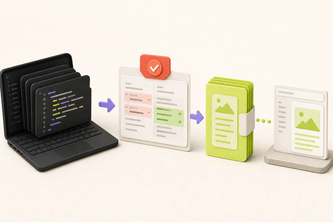
 User Stories BotA demo video on every pull request
Get a demo video on every new feature
GitHub App that watches your pull requests and records a narrated, captioned demo.
Save time on demo prep and make informed decisions faster with a video walkthrough of every new feature.
Executive Summary
What the company appears to be
Smol.ly is a self-reported tool that turns API repositories into reviewed, hosted documentation using Codex and Model Context Protocol (MCP). The author states it enables local-first analysis of private code, generates portable Markdown bundles with source provenance, and supports both human browsing and agent search through a shared artifact. It is described as a multi-tenant Next.js application deployed on Cloudflare.
What changed
The project description indicates development of a system that allows developers to document APIs locally using Codex, review the generated documentation before publishing, and host it with searchable web UI and MCP interfaces. It includes claims about local-first workflows, bounded retrieval, and community contribution safety.
Single most important open question
Is there evidence of actual usage or adoption beyond the author's own testing and development?
Note: This analysis is based entirely on the self-reported project description provided by the caller. No third-party verification, traction data, revenue figures, customer names, or independent sources are available. All statements should be treated as claims made by the author, not verified facts.
What The Product Actually Is
The description states that Smol.ly:
- Turns API repositories into reviewed, hosted documentation
- Uses Codex to read real implementation on developer's device (routes, schemas, authentication, middleware, tests, examples)
- Generates a portable Markdown bundle with source provenance
- Allows human review of Git diff before publishing
- Validates and hosts the bundle once approved
- Enables people to browse docs on web; coding agents to search deployment through MCP
- Uses one reviewed artifact for both web UI and agent interface
Inference: The product appears to be a documentation generation and hosting platform that emphasizes local analysis, human review, and agent accessibility.
Claim: "Smolify turns the reviewed bundle into: A fast, publicly searchable documentation website... Bounded MCP tools for search, page retrieval, source definitions, callers, callees, and connector paths."
Positioning & Claim Evolution
The author states:
- Smolify is a local-first documentation workflow
- Private source code does not cross new hosted trust boundary
- Generated docs behave like code (versioned, validated, attributable, diffable, reversible)
- Retrieval is bounded and inspectable
- Agents can contribute without taking over
- Documentation becomes more trustworthy when it behaves like code
Inference: The positioning evolved from a simple documentation tool to one that emphasizes trust, privacy, and agent integration while maintaining human control.
Claim: "The repository stays local" and "Generated docs behave like code"
Target Customer & ICP
The description states:
- Developers who want to document APIs
- Maintainers who want to control their documentation
- Coding agents that need bounded context for tasks
- Community contributors who want to improve docs without automatic publishing rights
Inference: The primary customer is developers or maintainers of API repositories, with secondary users being coding agents and community members.
Claim: "any developer or coding agent should be able to find a repository, understand how it works, and leave its documentation better for the next person"
Business Model & Pricing Evidence
Not evidenced. The description does not mention pricing, subscription models, monetization strategies, or any business model details.
Finding: No evidence of business model or pricing structure.
Technical & Delivery Signals
The description states:
- Built with Cloudflare, CodeDB, CodeGraff, Codex, Next.js
- Multi-tenant Next.js and TypeScript application deployed to Cloudflare through OpenNext
- Uses Cloudflare Workers for hosting
- Uses Cloudflare D1 for metadata and search indexes
- Uses Cloudflare R2 for storing bundles and documents
- Better Auth handles accounts, organizations, GitHub OAuth, MCP OAuth 2.1 authorization
- Model Context Protocol powers retrieval, reviews, proposals, and publishing
- Codex skills guide repository analysis and safe bundle generation
- Zod validates every generated bundle at trust boundary
Claim: "Smolify is a multi-tenant Next.js and TypeScript application deployed to Cloudflare through OpenNext"
Traction & Maturity Signals
Not evidenced. The description does not include any data on:
- Number of users or customers
- Revenue or funding rounds
- Adoption metrics
- Product usage statistics
- Customer testimonials or case studies
Finding: No evidence of traction or maturity beyond author's own development and testing.
Competitive Context
The description mentions:
- Comparison with DeepWiki, CodeDB, embeddings, and other retrieval designs
- The author notes Smolify performed "bounded deterministic retrieval" on a real architecture task
- It is described as being built for the OpenAI 2026 hackathon
Inference: The product competes in the documentation generation space with emphasis on local-first workflows and agent integration.
Open Questions & Risks
Key risks identified:
- Lack of traction or adoption - No evidence of users beyond author's own testing
- Single-person team - Only one member listed (Rach Pradhan)
- Unproven scalability - The system is described as working on a single repository with specific constraints
- Limited market validation - No mention of customer feedback or market demand
- Dependency on Codex and MCP - Reliance on proprietary tools that may not be widely adopted
Inference: The lack of evidence for users, customers, or revenue suggests the product is in early development or prototype stage.
Questions the description leaves open
- What specific use cases have you identified for Smol.ly beyond your own testing?
- How do you plan to scale beyond a single developer's workflow?
- Have you validated demand from potential customers or partners?
- What is the roadmap for monetization and customer acquisition?
- How do you intend to handle security and privacy concerns at scale?
- What are the technical limitations of the current implementation that would prevent broader adoption?
Overall Assessment
Not evidenced. The description does not contain any information about:
- Funding status or investment history
- Partnership opportunities
- Commercial viability
- Market opportunity size
- Go-to-market strategy
Finding: No evidence to support an investment or partnership assessment.
User Stories BotA demo video on every pull request
Get a demo video on every new feature
GitHub App that watches your pull requests and records a narrated, captioned demo.
Save time on demo prep and make informed decisions faster with a video walkthrough of every new feature.
Source
Submitted to the OpenAI 2026 hackathon on Devpost. Project home on Devpost. Back to the full gallery on Devpost.
This competitive analysis was produced by top-founders.com (opens in a new tab)
Generated by a language model from this project's public Devpost page — its tagline, the author's own write-up and any built-with tags listed there — as captured in August 2026. Short quotations are the author's words. It is an opinion on the idea as a business, not on the people behind it, and it reflects the description as published then. If the project has moved on, request a correction below. The analysis is not independent research and contains no verified traction, revenue or customer data.
An independent guide by KFG International LLC — not affiliated with, endorsed by, or connected to Devpost or OpenAI.