

Archive position — measured, not model output
0 likes on Devpost
2,263 of the 7,850 archived projects have more likes, and 5,587 share exactly 0 — so this project's #6,802 place in the like-ranked listing is a tie-break inside that group, not a ranking.
Projects (log scale)
Likes on Devpost. ▲ marks this project's group.
Show the figures
| Likes | Projects | Share of archive |
|---|---|---|
| 0 | 5,587 | 71.2% |
| 1 | 1,758 | 22.4% |
| 2 | 284 | 3.6% |
| 3–4 | 132 | 1.7% |
| 5–9 | 75 | 1.0% |
| 10+ | 14 | 0.2% |
 User Stories BotA demo video on every pull request
Get a demo video on every new feature
GitHub App that watches your pull requests and records a narrated, captioned demo.
Save time on demo prep and make informed decisions faster with a video walkthrough of every new feature.
Executive Summary
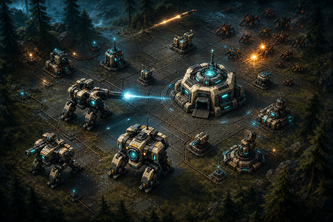
The description states that "Snackable mobile real time strategy game" is a browser-based, mobile-first RTS game built using AI tools like OpenAI's Codex. The author, Thomas Reid, describes it as a deliberately small and simple RTS game meant to be a quick pastime, with gameplay cycles of 5–25 minutes. It was developed in two hours by one person using AI for asset generation and code translation. The project is positioned as an educational tool that empowers children to become creators rather than consumers of digital media.
The most important open question is: What is the commercial potential of this concept, and how might it scale beyond a single developer's prototype?
This analysis is based entirely on self-reported information from the author. No evidence exists for revenue, customers, or traction. The project appears to be an experimental prototype with no known monetization model or user base.
What The Product Actually Is
The description states that this is a browser-based, mobile-first real-time strategy (RTS) game named "Snackable mobile real time strategy game" (worktitle: corefront mobil). It was built using CSS, HTML5, Node.js, Phaser.js, TypeScript, Vite, Vitest, WebGL. The author claims that every single asset — from the JavaScript engine to 3D graphics and soundtrack — was generated using OpenAI models.
Inferred from the description:
- The game is designed for mobile devices.
- It uses AI (specifically Codex) to generate both code and assets.
- Gameplay includes resource management, defensive structures, tech trees, and dynamic AI opponents.
- It supports English and German localization.
- It was built in two hours by one developer.
Not evidenced:
- Whether the game is actually playable or functional beyond a prototype.
- What specific gameplay mechanics are implemented.
- How the AI integration works in practice.
- Any actual user testing or feedback from children.
Positioning & Claim Evolution
The author positions the product as a snackable RTS game—a short, accessible alternative to traditional long-form RTS games that may lead to unhealthy screen time. The core claim is that it allows kids and non-programmers to create digital content without needing technical skills.
Key claims:
- The game aims to reduce screen time by making matches shorter (5–25 minutes).
- It encourages creativity and logical thinking.
- It turns users into active creators using AI tools like Codex.
- It bridges the gap between imagination and software creation.
Inferred from the description:
- The project is framed as an educational tool for children aged 10–14.
- The author sees it as a way to democratize game development through AI.
- There is no mention of monetization or commercial viability in the self-report.
Not evidenced:
- How the product differentiates itself from existing mobile RTS games.
- Whether the target audience has shown interest or demand.
- Any market positioning beyond the author’s personal narrative.
Target Customer & ICP
The description states that the game is intended for kids and their friends, particularly those who enjoy complex RTS games but are limited by time or hardware constraints. The author notes that these users are often passive consumers of digital media and should be empowered to become creators.
Inferred from the description:
- Primary user group: Children aged 10–14.
- Secondary audience: Parents, educators, or caregivers interested in safe screen-time alternatives.
- The game is meant to appeal to younger audiences who may not have coding experience.
Not evidenced:
- Actual customer data or demographics.
- Market size or demand for such a product.
- Any evidence of user engagement or retention.
- Whether the author has tested with actual children or conducted surveys.
Business Model & Pricing Evidence
The description does not contain any information about pricing, monetization, or business model. The author focuses on the educational and creative aspects of the project but does not describe how it would generate revenue.
Not evidenced:
- Revenue streams.
- Pricing models.
- Monetization strategy.
- Any indication that the product is intended for sale or distribution.
Technical & Delivery Signals
The description indicates that the game was built using:
- Technologies: CSS, HTML5, Node.js, Phaser.js, TypeScript, Vite, Vitest, WebGL
- AI tools: OpenAI Codex used to generate code and assets
- Development speed: First playable prototype deployed in two hours
Inferred from the description:
- The project uses modern web technologies.
- AI integration is central to development.
- The author emphasizes rapid prototyping.
Not evidenced:
- Performance metrics or scalability of the game.
- Technical architecture beyond initial setup.
- Any testing or optimization for mobile platforms.
- Whether the AI-generated components are stable or reusable.
Traction & Maturity Signals
The description states that the project was submitted to the OpenAI 2026 hackathon and that a prototype was created in two hours. The author mentions that kids were immediately engaged with the product, reacting positively to changes made via Codex.
Inferred from the description:
- A functional prototype exists.
- There is early user feedback from children.
- The project has been publicly shared (Devpost submission).
Not evidenced:
- Actual users or player base.
- Retention rates or usage data.
- Any revenue or monetization attempts.
- Long-term engagement or adoption.
Competitive Context
The description does not provide any information about competitors or the broader market landscape for mobile RTS games. The author focuses on the novelty of using AI to empower children rather than comparing the product to existing offerings.
Not evidenced:
- Competitor analysis.
- Market size or trends in mobile RTS games.
- Existing products targeting similar age groups or use cases.
Open Questions & Risks
Several risks and open questions emerge from the self-reported description:
- Unproven commercial viability: No evidence of revenue, customers, or monetization strategy.
- Prototype-only status: The project is described as a hackathon submission with no indication of further development or product-market fit.
- Dependency on AI tools: Heavy reliance on OpenAI Codex raises concerns about scalability, cost, and availability if those services change.
- Lack of user data: No evidence of actual users or feedback beyond the author’s own observations.
- No clear path to growth: No roadmap for expansion beyond the initial concept.
Not evidenced:
- Any financial risk analysis.
- Evidence of competitive threats.
- Risk mitigation strategies.
Questions the description leaves open
- What specific gameplay features are implemented in the prototype?
- How many children have played or tested the game so far?
- Have you validated demand for this type of product among parents or educators?
- Is there a plan to monetize the game, and if so, what model is being considered?
- Can you demonstrate how the AI integration works in practice?
- What are the technical limitations of the current implementation?
- How do you intend to scale beyond one developer?
- Are there any legal or ethical considerations around involving children in product development?
Overall Assessment
The description states that this is a prototype built by one person during a hackathon, with no evidence of traction, revenue, or customer base. The author describes the project as experimental and educational, emphasizing AI-driven creation rather than commercial success.
Inferred from the description:
- This is an early-stage idea with limited validation.
- It may have potential for educational or creative applications but lacks commercial readiness.
- There is no indication of a viable business model or path to profitability.
Not evidenced:
- Any financial performance or market traction.
- Evidence that the product will attract users beyond the author’s circle.
- A clear plan for scaling or building a sustainable venture.
Assessment: Not ready for investment or partnership. This appears to be an experimental prototype with no demonstrated commercial viability, user base, or monetization strategy.
User Stories BotA demo video on every pull request
Get a demo video on every new feature
GitHub App that watches your pull requests and records a narrated, captioned demo.
Save time on demo prep and make informed decisions faster with a video walkthrough of every new feature.
Source
Submitted to the OpenAI 2026 hackathon on Devpost. Project home on Devpost. Back to the full gallery on Devpost.
This competitive analysis was produced by top-founders.com (opens in a new tab)
Generated by a language model from this project's public Devpost page — its tagline, the author's own write-up and any built-with tags listed there — as captured in August 2026. Short quotations are the author's words. It is an opinion on the idea as a business, not on the people behind it, and it reflects the description as published then. If the project has moved on, request a correction below. The analysis is not independent research and contains no verified traction, revenue or customer data.
An independent guide by KFG International LLC — not affiliated with, endorsed by, or connected to Devpost or OpenAI.