

Archive position — measured, not model output
0 likes on Devpost
2,263 of the 7,850 archived projects have more likes, and 5,587 share exactly 0 — so this project's #2,823 place in the like-ranked listing is a tie-break inside that group, not a ranking.
Projects (log scale)
Likes on Devpost. ▲ marks this project's group.
Show the figures
| Likes | Projects | Share of archive |
|---|---|---|
| 0 | 5,587 | 71.2% |
| 1 | 1,758 | 22.4% |
| 2 | 284 | 3.6% |
| 3–4 | 132 | 1.7% |
| 5–9 | 75 | 1.0% |
| 10+ | 14 | 0.2% |
 User Stories BotA demo video on every pull request
Get a demo video on every new feature
GitHub App that watches your pull requests and records a narrated, captioned demo.
Save time on demo prep and make informed decisions faster with a video walkthrough of every new feature.
Executive Summary
Company: AutoEdit
Self-reported basis: The description is entirely self-reported and unverified, based on a Devpost submission for the OpenAI 2026 hackathon. No external corroboration exists.
What it appears to be: A local-first video editing engine that uses AI to produce professional-quality edits from raw footage, with an emphasis on narrative structure, continuity, and privacy.
What changed: The author describes building a system that analyzes audio, visual, and narrative elements to create context-aware edits without requiring cloud processing or external services.
Most important open question: Is there evidence of any real-world usage, user feedback, or product-market fit beyond the author's own development experience?
What The Product Actually Is
The description states that AutoEdit is an intelligent video editing engine designed to make professional-level editing accessible through local processing. It claims to analyze visuals, dialogue, audio, chronology, orientation, pacing, and narrative structure to produce a first-cut edit.
- Claimed functionality: Creates a complete, context-aware video edit from raw footage.
- Technical stack: Uses FFmpeg, Apple Vision, Whisper/Faster-Whisper, Ollama, NumPy, Remotion, and Python.
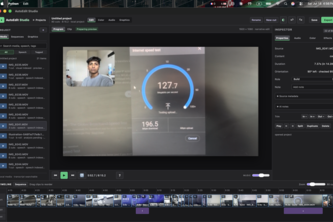
- Core feature: Produces professional edits with dialogue continuity, music synchronization, captions, reframing, B-roll decisions, and an editable Studio timeline.
- Privacy model: Built to run locally; all media and AI analysis remain on the user's device.
Inference: The product is described as a local-first editing tool, not a cloud-based or SaaS offering.
Not evidenced: No mention of actual users, revenue, or commercial adoption beyond the author’s own development.
Positioning & Claim Evolution
The author positions AutoEdit as an intelligent editor that understands storytelling and personality in footage, rather than just joining clips or removing silence.
- Original claim: To make video editing widely accessible.
- Evolution of positioning: From personal frustration with editing to a tool that mimics human editorial skills.
- Narrative focus: Emphasis on narrative structure, emotional pacing, and visual continuity over technical automation.
Inference: The product is positioned as a democratizing tool for creators who lack time or skill in traditional editing.
Not evidenced: No evidence of market positioning beyond the author's own perspective; no competitor comparisons or customer feedback are included.
Target Customer & ICP
The description does not explicitly define a target customer or ideal customer profile (ICP).
- Implicit audience: Likely self-employed creators, hobbyists, or small teams who want professional results but lack editing expertise.
- Use case: Personal or unreleased footage where privacy is important.
Inference: The product targets users who value local processing and narrative-driven editing.
Not evidenced: No stated customer segments, personas, or usage data.
Business Model & Pricing Evidence
There is no evidence of a business model or pricing strategy in the description.
- Self-reported approach: Local-first, privacy-focused.
- No mention: Of monetization, licensing, subscriptions, or paid features.
Inference: The product may be open-source or freemium, but this is not stated.
Not evidenced: No revenue model, pricing tiers, or commercial strategy are described.
Technical & Delivery Signals
The author describes a complex local pipeline using multiple technologies:
- Core tools: FFmpeg, Apple Vision, Whisper/Faster-Whisper, Ollama, NumPy, Remotion, Python.
- Development approach: Local-first architecture with AI reasoning and media intelligence.
- Features mentioned:
- Chronology preservation
- Context-aware pacing
- Audio continuity
- Visual continuity checks
- Editable Studio workflow
Inference: The product is technically sophisticated and built for performance on local machines.
Not evidenced: No evidence of actual delivery, scalability, or production readiness beyond the author’s development.
Traction & Maturity Signals
There is no evidence of traction, adoption, or maturity in the description.
- Team size: 1 person (the author).
- No users, customers, or feedback.
- No product releases, versions, or milestones.
- No commercial activity.
Inference: The project appears to be a prototype or proof-of-concept.
Not evidenced: No data on usage, retention, or product-market fit.
Competitive Context
The description does not mention any competitors or market context.
- No reference to existing video editing tools (e.g., Adobe Premiere, DaVinci Resolve, CapCut).
- No positioning relative to other AI editing tools or platforms.
- No mention of how AutoEdit differentiates from or competes with others.
Inference: The author may not have conducted competitive research.
Not evidenced: No competitive analysis or market positioning beyond the author’s own claims.
Open Questions & Risks
Several risks and open questions emerge from the lack of evidence:
- Single-person team: No team, no external validation.
- No traction or users: No real-world usage or feedback.
- Unproven commercial viability: No business model or monetization strategy.
- High technical complexity: Local-first AI editing is technically challenging; no evidence of successful execution.
- No market research: No indication of target audience, demand, or competitive landscape.
Inference: The project may be a personal experiment or prototype with limited commercial potential.
Not evidenced: No risk mitigation strategies or market validation are described.
Questions the description leaves open
- What specific user problems does AutoEdit solve that existing tools don’t?
- Have you tested the tool with real users? If so, what feedback did you get?
- How do you plan to monetize this product, and what is your go-to-market strategy?
- What are the technical limitations of running AI editing locally on consumer hardware?
- Are there any legal or privacy implications of local processing that you’ve considered?
- How does AutoEdit compare in performance and output quality to existing professional tools?
Overall Assessment
Not evidenced: No data to support a commercial due-diligence read.
- The project is described as a personal development effort, not a scalable business.
- There is no evidence of revenue, customers, or traction.
- The author’s own account does not demonstrate product-market fit or commercial viability.
- The technical stack and claims are ambitious but unproven in real-world use.
Inference: This appears to be an early-stage prototype or hackathon project with limited commercial potential.
Confidence level: Low — based on sparse, self-reported evidence only.
User Stories BotA demo video on every pull request
Get a demo video on every new feature
GitHub App that watches your pull requests and records a narrated, captioned demo.
Save time on demo prep and make informed decisions faster with a video walkthrough of every new feature.
Source
Submitted to the OpenAI 2026 hackathon on Devpost. Project home on Devpost. Back to the full gallery on Devpost.
This competitive analysis was produced by top-founders.com (opens in a new tab)
Generated by a language model from this project's public Devpost page — its tagline, the author's own write-up and any built-with tags listed there — as captured in August 2026. Short quotations are the author's words. It is an opinion on the idea as a business, not on the people behind it, and it reflects the description as published then. If the project has moved on, request a correction below. The analysis is not independent research and contains no verified traction, revenue or customer data.
An independent guide by KFG International LLC — not affiliated with, endorsed by, or connected to Devpost or OpenAI.