

Archive position — measured, not model output
0 likes on Devpost
2,263 of the 7,850 archived projects have more likes, and 5,587 share exactly 0 — so this project's #6,749 place in the like-ranked listing is a tie-break inside that group, not a ranking.
Projects (log scale)
Likes on Devpost. ▲ marks this project's group.
Show the figures
| Likes | Projects | Share of archive |
|---|---|---|
| 0 | 5,587 | 71.2% |
| 1 | 1,758 | 22.4% |
| 2 | 284 | 3.6% |
| 3–4 | 132 | 1.7% |
| 5–9 | 75 | 1.0% |
| 10+ | 14 | 0.2% |
 User Stories BotA demo video on every pull request
Get a demo video on every new feature
GitHub App that watches your pull requests and records a narrated, captioned demo.
Save time on demo prep and make informed decisions faster with a video walkthrough of every new feature.
Executive Summary
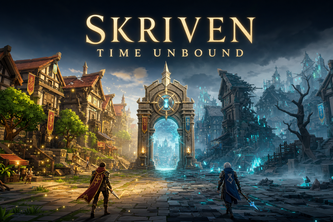
What the company appears to be: Skriven: Time Unbound is a solo RPG project authored by one individual (Chris Ochs), built using .NET, C#, GPT-5.6, Stride, and Quaternius. It is described as an experimental game that explores persistent worldbuilding in a classless RPG where the player competes with rival heroes to shape history.
What changed: The project was submitted to the OpenAI 2026 hackathon, indicating it is a prototype or early vertical slice built under time constraints.
Single most important open question: Is there evidence of traction, revenue, or customer engagement beyond the author’s own testing and vision?
What The Product Actually Is
The description states that Skriven: Time Unbound is a solo RPG where:
- Each seed generates the world's past.
- Cities may thrive or fall depending on the seed.
- Inhabitants share what they know, and rival heroes compete with the player.
- There is no predetermined villain; instead, people, cultures, monsters, and interests coexist.
- The game uses a classless character-building system and deterministic seeded simulation.
- It includes persistent rival heroes, knowledge-driven conversations, combat, objectives, systemic consequences, and individually saved world branches.
The product is described as a vertical slice demonstrating these ideas through counterfactual locations, persistent rival heroes, and deterministic systems.
Evidence: Self-reported by the author. No external validation or data on gameplay mechanics beyond the description.
Positioning & Claim Evolution
The author positions Skriven as:
- A solo RPG that avoids dependence on servers, schedules, or other players.
- A living world experience akin to MMOs but without multiplayer constraints.
- Designed for replayability through classless progression and deterministic history.
- Not centered around a chosen hero, but one among many in an ongoing history.
The project is positioned as experimental and exploratory — a prototype built under tight deadlines. It does not claim to be a commercial product or have any monetization strategy at this stage.
Evidence: Self-reported claims about design intent and gameplay philosophy. No evidence of positioning evolution or prior versions.
Target Customer & ICP
The description does not identify specific target customers or personas. The author describes the game as intended for players who enjoy:
- Living worlds.
- Classless RPGs.
- Persistent histories.
- Solo play experiences.
It is implied that the audience would be fans of RPGs, worldbuilding, and experimental games — but no explicit segmentation or customer profile is provided.
Evidence: Author’s own description. No evidence of market research or defined ICP.
Business Model & Pricing Evidence
There is no evidence of a business model or pricing strategy in the project description. The author does not mention monetization plans, sales channels, or any revenue-generating mechanisms.
Evidence: Not evidenced.
Technical & Delivery Signals
The game was built using:
- C# and .NET
- Stride engine
- GPT-5.6 (used for implementation lead)
- Quaternius (possibly for animation or asset tools)
Key technical features include:
- Deterministic simulation
- Separation of immutable geography from generated history
- Actors making decisions based on goals, capabilities, knowledge, and beliefs
- No runtime LLM or network service required
The author notes that Codex/GPT-5.6 contributed ~90% of the working code and technical iteration.
Evidence: Self-reported development stack and architecture. No evidence of scalability, performance metrics, or production readiness.
Traction & Maturity Signals
The project is described as a vertical slice built for a hackathon. It has not yet been released to players, nor does it show signs of traction or adoption.
The author states:
- This is an early vertical slice.
- Needs substantial work and polish.
- Has not been tested by actual players yet.
- The next steps involve expanding the world, deepening progression, improving combat and presentation, and building a character/environment pipeline.
Evidence: Author’s own account. No evidence of user engagement, sales, or usage data.
Competitive Context
The description does not provide any information about competitors or market context. It does not reference similar games or platforms in the RPG space.
Evidence: Not evidenced.
Open Questions & Risks
- Single-person team: The project is built by one person (Chris Ochs), which raises concerns about scalability, resource constraints, and long-term maintenance.
- Prototype nature: It is a vertical slice from a hackathon, not a finished product.
- Dependency on GPT-5.6: Heavy reliance on AI for implementation may pose risks related to availability, cost, or control over development.
- Visual production challenges: The author notes that visual asset creation was difficult and expensive, suggesting potential bottlenecks in future development.
- No commercial traction or monetization plan: No evidence of revenue, users, or business model.
Evidence: Inferred from the description. Not independently verified.
Questions the description leaves open
- What is the timeline for moving beyond the vertical slice?
- How does the team plan to scale beyond one person?
- Is there a plan to test with actual players before full release?
- What are the long-term goals for monetization or distribution?
- How will visual asset production be handled in future development?
- Are there any plans to integrate additional AI tools beyond GPT-5.6?
Evidence: Inferred from the description and general project maturity concerns.
Overall Assessment
This is a self-reported, unverified prototype built by one individual for a hackathon. There is no evidence of revenue, customers, or traction. The project shows creative ambition but lacks commercial signals or scalability indicators.
Confidence level: Low — based entirely on the author's own description.
Assessment: Not ready for investment or partnership at this stage. Further development and validation are required before any strategic move can be considered.
User Stories BotA demo video on every pull request
Get a demo video on every new feature
GitHub App that watches your pull requests and records a narrated, captioned demo.
Save time on demo prep and make informed decisions faster with a video walkthrough of every new feature.
Source
Submitted to the OpenAI 2026 hackathon on Devpost. Project home on Devpost. Back to the full gallery on Devpost.
This competitive analysis was produced by top-founders.com (opens in a new tab)
Generated by a language model from this project's public Devpost page — its tagline, the author's own write-up and any built-with tags listed there — as captured in August 2026. Short quotations are the author's words. It is an opinion on the idea as a business, not on the people behind it, and it reflects the description as published then. If the project has moved on, request a correction below. The analysis is not independent research and contains no verified traction, revenue or customer data.
An independent guide by KFG International LLC — not affiliated with, endorsed by, or connected to Devpost or OpenAI.