

Archive position — measured, not model output
0 likes on Devpost
2,263 of the 7,850 archived projects have more likes, and 5,587 share exactly 0 — so this project's #6,750 place in the like-ranked listing is a tie-break inside that group, not a ranking.
Projects (log scale)
Likes on Devpost. ▲ marks this project's group.
Show the figures
| Likes | Projects | Share of archive |
|---|---|---|
| 0 | 5,587 | 71.2% |
| 1 | 1,758 | 22.4% |
| 2 | 284 | 3.6% |
| 3–4 | 132 | 1.7% |
| 5–9 | 75 | 1.0% |
| 10+ | 14 | 0.2% |
 User Stories BotA demo video on every pull request
Get a demo video on every new feature
GitHub App that watches your pull requests and records a narrated, captioned demo.
Save time on demo prep and make informed decisions faster with a video walkthrough of every new feature.
Executive Summary
What the company appears to be
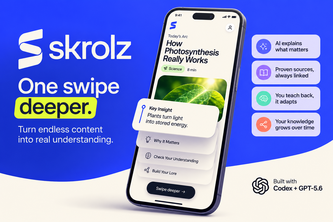
Skrolz is a self-reported mobile-first learning app built for educational content consumption. The author describes it as an adaptive learning experience that uses GPT-5.6 to generate explanations grounded in source material, structured into finite "Knowledge Arcs" with defined progression and evidence.
What changed
The project was submitted to the OpenAI 2026 hackathon. It is described as a prototype built over a short timeframe (Build Week), using Expo, React Native, Firebase, and GPT-5.6 for adaptive learning paths.
Single most important open question — the commercial due-diligence read
Is there evidence of any traction, revenue, or customer adoption beyond the author’s own demonstration? The description contains no data on users, usage, monetization, or market validation.
What The Product Actually Is
The description states that Skrolz is a mobile learning app built with Expo and React Native. It presents educational content in structured "Knowledge Arcs" that guide learners through a sequence of steps: Hook → Prediction → Explanation → Evidence → Counterpoint → Teach-back → Original source → Later memory check.
Each arc ends when the learner has understood and can recall the idea. The app uses GPT-5.6 to adapt explanations based on learner responses, but only within human-approved boundaries. It includes features like receipts showing evidence sources, offline recovery, and scheduled memory checks.
The product is described as having a browser-based demo experience (no installation required) and a signed Android APK for native testing.
Evidence
- The author describes the app as a mobile learning tool.
- It uses React Native and Expo.
- Knowledge Arcs are defined with specific steps.
- GPT-5.6 is used to generate explanations based on learner input.
- Receipts show evidence mapping.
- Browser and Android versions exist.
Inference The app appears designed for short, focused learning experiences rather than long-form content consumption.
Positioning & Claim Evolution
The author positions Skrolz as a mobile-first educational platform that improves upon traditional feeds by focusing on depth over duration. It is not about screen time or behavior control but about making each swipe meaningful.
Key claims:
- Feeds are designed for continuation, not understanding.
- Skrolz organizes ideas into finite arcs with clear goals.
- Every claim comes with receipts (evidence).
- GPT-5.6 enables adaptive explanations without turning the app into a chatbot.
- The system avoids presenting AI-generated content as academic grades; instead, it tracks "Lore" — mastery through recall.
Evidence
- The author describes the problem as “swiping without understanding.”
- The app is built around the concept of finite Knowledge Arcs.
- GPT-5.6 is used for adaptive learning within strict human-defined boundaries.
- Receipts and provenance are part of the UI.
- No formal grades or assessments are presented.
Inference The positioning suggests a focus on personal knowledge retention over engagement metrics, which may appeal to educators or learners seeking structured self-study tools.
Target Customer & ICP
The author identifies two main user groups:
- Younger generations (Gen Z) who scroll endlessly.
- Millennials who also engage in aimless digital consumption.
The app is described as meeting people "where they already are" and asking a different question: “What if every swipe took you deeper into one idea?”
It is not framed as a tool for formal education or institutional use, but rather for personal learning and exploration.
Evidence
- The author notes that both Gen Z and millennials scroll aimlessly.
- The app targets those who want to learn something meaningful from each interaction.
- No explicit mention of schools, teachers, or corporate training.
Inference The ICP seems to be individual learners seeking focused, source-grounded knowledge acquisition in a mobile-first format. There is no indication of institutional or B2B targeting.
Business Model & Pricing Evidence
There is no evidence provided about pricing, monetization, or business model. The author does not describe how the app would generate revenue or whether it intends to charge users or partners.
Evidence
- No mention of subscriptions, freemium tiers, ads, or enterprise licensing.
- No indication of creator or publisher compensation models.
- No reference to any commercial partnerships or sales channels.
Inference The business model remains undefined. The project appears to be a prototype with no stated path to monetization.
Technical & Delivery Signals
The app is built using:
- Expo Router and React Native
- Next.js for marketing and admin surfaces
- Firebase (Firestore, Functions, App Check, Storage)
- GPT-5.6 via OpenAI Responses API
- Structured Outputs, versioned prompts, moderation, idempotency keys, timeouts
Automated tests cover:
- Human-approved fallbacks
- Receipts and evidence mapping
- Reading-progress resume
- Gesture alternatives
- Keyboard navigation
- Accessibility checks
- Light/dark themes
- Offline recovery
- Direct Arc links
The app supports both browser and Android versions. A signed APK passed physical-device verification.
Evidence
- Technical stack includes React Native, Expo, Firebase, GPT-5.6.
- Backend integrates with Firebase Cloud Functions.
- Structured outputs and deterministic validation are used.
- Automated tests cover multiple aspects of functionality.
- Android version tested on physical device.
Inference The technical architecture is well-documented and shows a focus on security, privacy, and reliability. However, there is no evidence of production-scale infrastructure or performance metrics.
Traction & Maturity Signals
There is no evidence of traction, revenue, customer adoption, or user engagement beyond the author’s own demonstration. The project is described as a Build Week hackathon submission with no mention of users, usage data, or market validation.
Evidence
- No mention of active users, retention rates, or feedback.
- No revenue figures, funding rounds, or customer list.
- No public launch or distribution beyond the Devpost submission.
- The app is described as a prototype, not a live product.
Inference The project lacks any measurable traction or maturity indicators. It appears to be an experimental proof-of-concept.
Competitive Context
There is no evidence of competitors or market positioning in relation to existing platforms like Duolingo, Khan Academy, Coursera, or other adaptive learning tools.
Evidence
- No mention of similar products or competitive analysis.
- No indication of how Skrolz differentiates from existing educational apps.
- No reference to the broader edtech landscape or target market size.
Inference Without any competitive context, it is unclear whether Skrolz addresses a gap in the market or replicates known solutions.
Open Questions & Risks
- No traction or revenue: The project is described as a prototype with no evidence of real-world usage.
- Unproven scalability: The technical stack suggests a small-scale implementation; no evidence of production readiness or large-scale deployment.
- Unclear monetization strategy: No business model or path to profitability is described.
- Dependency on GPT-5.6 and OpenAI: Heavy reliance on external APIs introduces risk if access or pricing changes.
- Single-founder project: With only one team member, there are concerns about execution capacity and long-term sustainability.
Evidence
- No user data, revenue, or adoption metrics.
- No indication of team size beyond one person.
- No mention of future development plans or funding.
Inference The lack of traction, scalability, and monetization signals raises significant risk for investment or partnership consideration.
Questions the description leaves open
- What is the intended user acquisition strategy?
- How do you plan to scale beyond a single developer’s effort?
- Are there any plans for monetization or revenue generation?
- What are the key assumptions about user behavior and learning outcomes?
- Is there any feedback from early users or pilot testing?
- How does the team intend to manage dependencies on GPT-5.6 and OpenAI services?
- What is the long-term vision for Skrolz beyond this prototype?
Overall Assessment
Not evidenced.
There is no evidence of revenue, customers, traction, or commercial viability. The project is described as a self-contained hackathon submission with no indication of market validation or business sustainability.
The author states that the app uses GPT-5.6 and Firebase to create an adaptive learning experience, but there is no data on performance, user engagement, or product-market fit.
Confidence Level Low This analysis is based entirely on self-reported information from a single source — the project description provided by the caller. No external verification, historical data, or third-party sources are available to support any claims beyond what was written in the submission.
Conclusion
Skrolz appears to be an experimental prototype with strong technical execution and clear intent. However, without evidence of traction, revenue, or a viable business model, it cannot be recommended for investment or partnership at this stage.
User Stories BotA demo video on every pull request
Get a demo video on every new feature
GitHub App that watches your pull requests and records a narrated, captioned demo.
Save time on demo prep and make informed decisions faster with a video walkthrough of every new feature.
Source
Submitted to the OpenAI 2026 hackathon on Devpost. Project home on Devpost. Back to the full gallery on Devpost.
This competitive analysis was produced by top-founders.com (opens in a new tab)
Generated by a language model from this project's public Devpost page — its tagline, the author's own write-up and any built-with tags listed there — as captured in August 2026. Short quotations are the author's words. It is an opinion on the idea as a business, not on the people behind it, and it reflects the description as published then. If the project has moved on, request a correction below. The analysis is not independent research and contains no verified traction, revenue or customer data.
An independent guide by KFG International LLC — not affiliated with, endorsed by, or connected to Devpost or OpenAI.