

Archive position — measured, not model output
0 likes on Devpost
2,263 of the 7,850 archived projects have more likes, and 5,587 share exactly 0 — so this project's #4,786 place in the like-ranked listing is a tie-break inside that group, not a ranking.
Projects (log scale)
Likes on Devpost. ▲ marks this project's group.
Show the figures
| Likes | Projects | Share of archive |
|---|---|---|
| 0 | 5,587 | 71.2% |
| 1 | 1,758 | 22.4% |
| 2 | 284 | 3.6% |
| 3–4 | 132 | 1.7% |
| 5–9 | 75 | 1.0% |
| 10+ | 14 | 0.2% |
 User Stories BotA demo video on every pull request
Get a demo video on every new feature
GitHub App that watches your pull requests and records a narrated, captioned demo.
Save time on demo prep and make informed decisions faster with a video walkthrough of every new feature.
Executive Summary
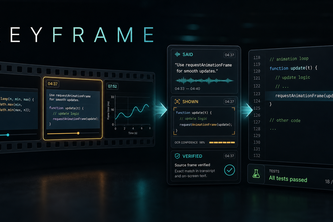
What the company appears to be: Keyframe is a self-reported local MCP server and plugin designed to enable AI agents like Codex and ChatGPT to understand both visual and spoken content in videos. It indexes video elements such as on-screen actions, OCR text, and timestamps, allowing these agents to retrieve relevant evidence for code building, verification, and explanation.
What changed: The project description indicates that Keyframe was built using GPT-5.6 via Codex, with an architecture separating deterministic video processing from model reasoning. It supports various video formats including uploaded files, YouTube, Loom, and animated GIFs.
Single most important open question: Is there any evidence of actual usage or adoption beyond the author's personal testing? The description states that Keyframe is "an open source project" but does not indicate whether it has been used by others or integrated into workflows outside of the author’s own development process.
What The Product Actually Is
The description states that Keyframe is a local MCP server and plugin. It gives AI agents like Codex and ChatGPT the ability to understand both what videos say and what they visually show.
Keyframe indexes:
- Explanation
- On-screen actions
- Visible code
- OCR text
- Important frames
It supports:
- Uploaded videos
- Public YouTube and Loom videos
- Animated GIFs
The system is designed for use in developer demonstrations, bug reproductions, internal walkthroughs, tutorials, and any workflow where showing an agent is easier than prompting it.
Inference: The product appears to be a tool that bridges video input with AI reasoning capabilities by extracting structured data from media and making it retrievable by language models. However, no evidence of actual deployment or integration into production systems is provided.
Positioning & Claim Evolution
The author claims Keyframe allows GPT-5.6 to watch videos and use them as evidence for building, verifying, and explaining its work. It aims to improve AI agent capabilities by enabling visual understanding through video input.
Keyframe is positioned as a solution that:
- Turns videos into timestamped visual and spoken evidence
- Enables Codex to build, verify, and explain its work using this evidence
- Reduces the need for long prompts by allowing demonstration over explanation
Inference: The positioning suggests Keyframe is intended to enhance agentic AI workflows, particularly in developer contexts. However, there is no indication of whether this has been validated with users or adopted beyond the author’s own use case.
Target Customer & ICP
The description states that Keyframe is designed for:
- Developer demonstrations
- Bug reproductions
- Internal walkthroughs
- Tutorials
- Any workflow where showing an agent is easier than prompting it
It also mentions support for:
- Uploaded videos
- Public YouTube and Loom videos
- Animated GIFs
- Tutorial discovery through web search
Inference: The primary target appears to be developers who want to demonstrate tasks or workflows to AI agents. However, no evidence exists regarding actual customer segmentation, user feedback, or market validation beyond the author’s personal experience.
Business Model & Pricing Evidence
The description states that Keyframe will remain an open source project so that developers worldwide can use it to enhance their agentic AI building experience.
There is no mention of any commercial model, pricing structure, monetization strategy, or paid features.
Inference: The business model appears to be open-source with no direct revenue streams. No evidence exists regarding potential future monetization plans or community-based funding models.
Technical & Delivery Signals
Keyframe was built primarily using Codex and GPT-5.6, starting with a detailed specification and then implementing the ingestion pipeline, MCP tools, local indexing, OCR, frame extraction, retrieval, plugin integration, tests, and documentation.
The architecture intentionally separates:
- Deterministic video processing
- Model reasoning
Keyframe handles:
- Acquisition
- Transcription
- OCR
- Indexing
- Timestamp retrieval
- Source frames locally
GPT-5.6 is responsible for interpreting evidence, applying it to user tasks, modifying code, and running tests.
Inference: The technical approach shows a clear separation of concerns between processing and reasoning components. However, no information exists about scalability, performance metrics, or production readiness beyond the author’s testing environment.
Traction & Maturity Signals
The description states:
- Keyframe is an open source project
- The author has used it already in some videos to help build projects
- It's impressive enough that the author plans to keep using it in the future with Codex
There is no evidence of:
- Customer adoption or usage beyond the author’s own testing
- Revenue, ARR, or funding rounds
- Headcount or team size beyond one person (Matthew Oscar Wyatt)
- Any measurable impact on developer workflows or time savings
Inference: The project lacks any traction indicators. It remains in early-stage development and has not demonstrated adoption or measurable value beyond the author’s personal use.
Competitive Context
The description mentions:
- All the MCP servers and plugins that exist for ChatGPT and Codex
- Personal experience with how AI doesn’t know how to watch videos
No specific competitors are named, nor is there any indication of existing tools addressing similar functionality in the market.
Inference: While Keyframe operates within a space involving AI agents and video processing, no evidence exists about competitive positioning or prior art. The author does not reference other tools or platforms offering comparable features.
Open Questions & Risks
- Lack of external validation: No evidence of usage by others, customers, or real-world impact.
- Single-person team: Only one developer is involved, raising questions about scalability and long-term maintenance.
- Unverified claims: The author states that Keyframe works but provides no independent verification or data to support this.
- No commercialization strategy: As an open-source project, there is no clear path to monetization or growth.
- Unclear maturity level: Despite being submitted to a hackathon, the product does not appear to have progressed beyond prototype stage.
Inference: The lack of traction, team size, and commercial viability raises significant concerns about the likelihood of future success or adoption in enterprise settings.
Questions the description leaves open
- What specific workflows or use cases are you seeing developers adopt Keyframe for?
- How many developers have tried Keyframe beyond yourself, and what feedback did they provide?
- Are there any plans to move beyond open-source into a commercial offering?
- Have you identified any technical bottlenecks or scalability issues in current usage?
- What is the timeline for expanding beyond personal testing to broader adoption?
Overall Assessment
Not evidenced
There is no evidence of:
- Revenue or ARR
- Customers or user base
- Funding rounds or valuations
- Team size beyond one person
- Product-market fit or traction indicators
The description indicates that Keyframe is an open-source project built during a hackathon, with no indication of commercialization or adoption beyond the author’s own use. It remains in early-stage development and lacks any measurable impact or validation.
Confidence Level: Low — based on minimal self-reported evidence and absence of external signals.
User Stories BotA demo video on every pull request
Get a demo video on every new feature
GitHub App that watches your pull requests and records a narrated, captioned demo.
Save time on demo prep and make informed decisions faster with a video walkthrough of every new feature.
Source
Submitted to the OpenAI 2026 hackathon on Devpost. Project home on Devpost. Back to the full gallery on Devpost.
This competitive analysis was produced by top-founders.com (opens in a new tab)
Generated by a language model from this project's public Devpost page — its tagline, the author's own write-up and any built-with tags listed there — as captured in August 2026. Short quotations are the author's words. It is an opinion on the idea as a business, not on the people behind it, and it reflects the description as published then. If the project has moved on, request a correction below. The analysis is not independent research and contains no verified traction, revenue or customer data.
An independent guide by KFG International LLC — not affiliated with, endorsed by, or connected to Devpost or OpenAI.