

Archive position — measured, not model output
0 likes on Devpost
2,263 of the 7,850 archived projects have more likes, and 5,587 share exactly 0 — so this project's #2,824 place in the like-ranked listing is a tie-break inside that group, not a ranking.
Projects (log scale)
Likes on Devpost. ▲ marks this project's group.
Show the figures
| Likes | Projects | Share of archive |
|---|---|---|
| 0 | 5,587 | 71.2% |
| 1 | 1,758 | 22.4% |
| 2 | 284 | 3.6% |
| 3–4 | 132 | 1.7% |
| 5–9 | 75 | 1.0% |
| 10+ | 14 | 0.2% |
 User Stories BotA demo video on every pull request
Get a demo video on every new feature
GitHub App that watches your pull requests and records a narrated, captioned demo.
Save time on demo prep and make informed decisions faster with a video walkthrough of every new feature.
Executive Summary
What the company appears to be
AutoForge Classroom is a self-reported educational video generation tool that transforms lesson objectives into classroom-ready MP4s using a multi-agent AI workflow. It integrates GPT-5.6 Terra for planning, writing and storyboarding; OpenAI TTS and DALL-E 3 for media generation; and FFmpeg for video assembly.
What changed
The project evolved from a basic FastAPI prototype into an education-focused product with structured workflows, validation layers, atomic state persistence, and deterministic testing paths during the OpenAI 2026 hackathon build week. The authors claim to have added reliability features like storyboard contract validation, media stream verification, and provider-neutral safety code.
The single most important open question
Is there evidence of real-world usage or traction beyond the hackathon submission? The description states no revenue, customers, or adoption data exist outside of the self-reported build week work.
What The Product Actually Is
The description states that AutoForge Classroom is a tool that takes one lesson objective and outputs a complete classroom-ready MP4. It uses a multi-agent workflow with GPT-5.6 Terra as the reasoning layer across three stages:
- The Director creates an audience-aware lesson plan.
- The Writer generates a concise teaching script.
- The Storyboard Agent converts the script into inspectable shots with exact narration and visual prompts.
OpenAI TTS and DALL-E 3 are used for audio and image generation. FFmpeg assembles the final video after validation steps ensure media integrity.
The interface shows every stage, generated frame, failure, and final result. A Sample Lesson path allows judges to test the product without live provider credentials.
Evidence
- The description explicitly describes these components and workflows.
- It names specific technologies: FastAPI, GPT-5.6 Terra, OpenAI TTS, DALL-E 3, FFmpeg, WebSockets.
- It mentions integration points such as src/config.py for model usage.
Inference It is inferred that this is a proof-of-concept or prototype product built during a hackathon, not yet commercialized.
Positioning & Claim Evolution
The description states that AutoForge Classroom targets teachers, tutors, and instructional designers who need short explainers but lack time or tools for video production. The core idea is not just AI video generation, but "reliable educational generation" — structured teaching artifacts remain inspectable, failures visible, and invalid media cannot silently become final classroom assets.
It positions itself as an alternative to black-box "prompt-to-video" tools by emphasizing transparency and trustworthiness in the workflow.
Evidence
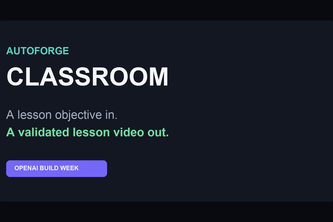
- The tagline: “A lesson objective in. A validated classroom video out.”
- The claim that it makes workflows easier to trust, review, and adapt than black-box tools.
- The emphasis on inspectability of each stage (plan, script, storyboard, frames).
Inference It is inferred that the positioning evolved from a general AI video tool to a specialized educational solution focused on reliability and auditability.
Target Customer & ICP
The description states that AutoForge Classroom is aimed at teachers, tutors, and instructional designers who need short explainers but lack time or specialist tools for video production.
Evidence
- Explicit mention of target personas: teachers, tutors, instructional designers.
- Focus on users needing "short explainers" and lacking "video-production time or specialist tools."
Inference It is inferred that the ICP likely centers around educators in K–12 or higher education settings who want to create educational content quickly.
Business Model & Pricing Evidence
Not evidenced. The description does not contain any information about pricing, monetization strategy, or business model.
Technical & Delivery Signals
The project uses FastAPI for backend, GPT-5.6 Terra as the primary reasoning engine, OpenAI TTS and DALL-E 3 for media generation, and FFmpeg for video assembly. It includes:
- Multi-agent workflow with structured stages.
- Validation of storyboard and generated artifacts before publishing.
- Atomic state persistence and interruption recovery.
- Provider-neutral safety code.
- Deterministic testing path without credentials.
- WebSocket and polling fallbacks for progress tracking.
Evidence
- Mention of FastAPI, GPT-5.6 Terra, OpenAI TTS, DALL-E 3, FFmpeg, WebSockets.
- Specific features like atomic state persistence, validation before media generation, and error handling.
- Use of Codex for engineering collaboration during build week.
Inference It is inferred that the technical stack reflects a focus on reliability, modularity, and testability — key traits for an educational tool requiring trustworthiness.
Traction & Maturity Signals
Not evidenced. There is no mention of revenue, customers, user base, or adoption metrics beyond the hackathon submission.
Competitive Context
Not evidenced. The description does not reference competitors, market size, or competitive positioning in any way.
Open Questions & Risks
- Unverified claims: All descriptions are self-reported and unverified.
- No traction data: No evidence of revenue, customers, or usage beyond the hackathon.
- Limited scope: The product appears to be a prototype built for a single event (OpenAI 2026 hackathon).
- Model dependency: Heavy reliance on proprietary models like GPT-5.6 Terra and OpenAI APIs may pose risks if access changes.
- Single-person team: Only one team member is listed, which could limit execution capacity.
Questions the description leaves open
- What was the actual duration of development outside of the hackathon?
- Are there any plans to move beyond the prototype stage?
- Has the product been tested with real educators or in a classroom setting?
- How does the team plan to monetize this tool if at all?
- What are the risks associated with dependency on OpenAI APIs and models?
- Is there any internal testing or feedback from teachers or instructional designers?
Overall Assessment
Not evidenced. No data exists regarding valuation, funding rounds, or investment interest beyond the hackathon submission.
User Stories BotA demo video on every pull request
Get a demo video on every new feature
GitHub App that watches your pull requests and records a narrated, captioned demo.
Save time on demo prep and make informed decisions faster with a video walkthrough of every new feature.
Source
Submitted to the OpenAI 2026 hackathon on Devpost. Project home on Devpost. Back to the full gallery on Devpost.
This competitive analysis was produced by top-founders.com (opens in a new tab)
Generated by a language model from this project's public Devpost page — its tagline, the author's own write-up and any built-with tags listed there — as captured in August 2026. Short quotations are the author's words. It is an opinion on the idea as a business, not on the people behind it, and it reflects the description as published then. If the project has moved on, request a correction below. The analysis is not independent research and contains no verified traction, revenue or customer data.
An independent guide by KFG International LLC — not affiliated with, endorsed by, or connected to Devpost or OpenAI.