

Archive position — measured, not model output
0 likes on Devpost
2,263 of the 7,850 archived projects have more likes, and 5,587 share exactly 0 — so this project's #2,788 place in the like-ranked listing is a tie-break inside that group, not a ranking.
Projects (log scale)
Likes on Devpost. ▲ marks this project's group.
Show the figures
| Likes | Projects | Share of archive |
|---|---|---|
| 0 | 5,587 | 71.2% |
| 1 | 1,758 | 22.4% |
| 2 | 284 | 3.6% |
| 3–4 | 132 | 1.7% |
| 5–9 | 75 | 1.0% |
| 10+ | 14 | 0.2% |
 User Stories BotA demo video on every pull request
Get a demo video on every new feature
GitHub App that watches your pull requests and records a narrated, captioned demo.
Save time on demo prep and make informed decisions faster with a video walkthrough of every new feature.
Executive Summary
Project: Atlas Memory Engine
Self-reported basis: The description is entirely from the author’s own submission to the OpenAI 2026 hackathon on Devpost. No external verification or historical data is available.
Commercial due-diligence read: Atlas Memory Engine appears to be a local-first desktop application that enables semantic search across personal files using AI embeddings and vector databases. It is described as a proof-of-concept or prototype, built by one individual. The author states it uses Tauri, React, FastAPI, Chroma, and local embedding models. There is no evidence of revenue, customers, traction, or commercialization beyond the self-reported project description.
Key open question: Is this a viable product concept that could scale into a commercial offering, or is it a personal hackathon project with limited market potential?
What The Product Actually Is
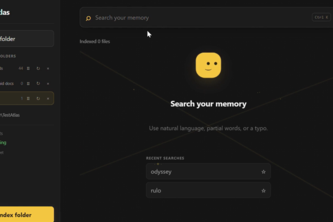
The description states that Atlas Memory Engine is a local-first desktop application designed to search through local files using semantic search. It indexes documents like PDFs, DOCX, Markdown, and text files by extracting text, splitting into chunks, converting them into embeddings, and storing them in a local Chroma vector database.
When a user searches, the query is embedded similarly and a semantic similarity search retrieves relevant chunks instead of relying on exact keyword matching. The system runs entirely locally, ensuring no data leaves the user’s computer.
Inference: The product is described as a desktop application built with Tauri, React, and FastAPI, suggesting it functions as a standalone app rather than a web or cloud-based service.
Positioning & Claim Evolution
The author claims that Atlas aims to make file search feel more like “talking to an AI” rather than manually searching folders. The core positioning is that users can search by meaning (e.g., “that accounting project with the balance sheet”) instead of by filename or exact text.
Inference: This positions Atlas as a tool for personal knowledge management or productivity, leveraging AI and semantic search to improve recall and reduce friction in accessing stored information.
Target Customer & ICP
The description does not explicitly name target customers. However, it implies the product is aimed at individual users who manage large volumes of local files and struggle with traditional file-search methods.
Inference: The user base likely includes professionals or knowledge workers who rely on local storage for sensitive or personal documents and want a smarter way to find content without cloud-based solutions.
Business Model & Pricing Evidence
There is no evidence in the description of any pricing model, monetization strategy, or business model. The project is described as a hackathon submission and a personal prototype.
Inference: It is unclear whether this will ever be commercialized or how it would generate revenue.
Technical & Delivery Signals
The author states that Atlas was built using:
- Frontend: Tauri, React, TypeScript
- Backend: FastAPI
- Vector DB: Chroma
- Embedding Model: Local embedding model (not specified)
- File Types Supported: PDFs, DOCX, Markdown, text files
The system is described as running locally, with no data leaving the user’s machine.
Inference: The technical stack suggests a modern, cross-platform desktop app built using web technologies. It uses vector search and embeddings for semantic similarity, which are advanced features for personal file search.
Traction & Maturity Signals
There is no evidence of any traction, customers, or adoption beyond the author’s own development of the project. The team size is listed as one person (Syed Hamza Pervez), and it was submitted to a hackathon.
Inference: This appears to be a prototype or personal project with no commercial traction or user base.
Competitive Context
The description does not mention any competitors. However, based on the described functionality — local semantic search for personal files — it would fall into a category similar to tools like:
- Notion, Obsidian, or Roam Research (for knowledge management)
- Local file search tools with AI features
- Personal AI assistants that index local content
Inference: The product concept is not unique, but it is positioned as a privacy-first, local solution, which may differentiate it from cloud-based alternatives.
Open Questions & Risks
- Single-person team: No evidence of a team or organizational structure.
- No commercialization plan: No pricing, monetization, or go-to-market strategy.
- Prototype nature: Built as a hackathon project; no indication of scalability or long-term development.
- Technical complexity: The author notes significant challenges in building the frontend/backend integration and indexing system — suggesting potential technical risks for future development.
- No user feedback or testing: No evidence of user trials, feedback loops, or iterative improvements.
Questions the description leaves open
- What is your long-term vision for Atlas? Is it intended to be a personal productivity tool or a commercial product?
- Have you tested the system with other users beyond yourself?
- How do you plan to scale this from a single-person hackathon project to a product that could serve a broader audience?
- Are there any plans to support cloud-based indexing or collaboration features in the future?
- What are your thoughts on monetization — would you consider a freemium model, subscription, or one-time purchase?
Overall Assessment
Not evidenced: There is no evidence of revenue, customers, traction, or commercial viability beyond the author’s own account.
Inference: Based on the self-reported description alone, Atlas Memory Engine appears to be a personal prototype with strong technical execution and a potentially valuable concept. However, it lacks any commercial dimension or market validation. It is not yet a product ready for investment or partnership unless further development and traction are demonstrated.
User Stories BotA demo video on every pull request
Get a demo video on every new feature
GitHub App that watches your pull requests and records a narrated, captioned demo.
Save time on demo prep and make informed decisions faster with a video walkthrough of every new feature.
Source
Submitted to the OpenAI 2026 hackathon on Devpost. Project home on Devpost. Back to the full gallery on Devpost.
This competitive analysis was produced by top-founders.com (opens in a new tab)
Generated by a language model from this project's public Devpost page — its tagline, the author's own write-up and any built-with tags listed there — as captured in August 2026. Short quotations are the author's words. It is an opinion on the idea as a business, not on the people behind it, and it reflects the description as published then. If the project has moved on, request a correction below. The analysis is not independent research and contains no verified traction, revenue or customer data.
An independent guide by KFG International LLC — not affiliated with, endorsed by, or connected to Devpost or OpenAI.