

Archive position — measured, not model output
0 likes on Devpost
2,263 of the 7,850 archived projects have more likes, and 5,587 share exactly 0 — so this project's #4,179 place in the like-ranked listing is a tie-break inside that group, not a ranking.
Projects (log scale)
Likes on Devpost. ▲ marks this project's group.
Show the figures
| Likes | Projects | Share of archive |
|---|---|---|
| 0 | 5,587 | 71.2% |
| 1 | 1,758 | 22.4% |
| 2 | 284 | 3.6% |
| 3–4 | 132 | 1.7% |
| 5–9 | 75 | 1.0% |
| 10+ | 14 | 0.2% |
 User Stories BotA demo video on every pull request
Get a demo video on every new feature
GitHub App that watches your pull requests and records a narrated, captioned demo.
Save time on demo prep and make informed decisions faster with a video walkthrough of every new feature.
Executive Summary
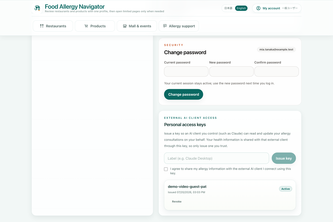
The company appears to be a solo-developer project named Food Allergy Navigator, self-described as an application to help people with food allergies or dietary restrictions find suitable dishes, share their profile with restaurants, and communicate safely abroad using built-in translation. The author states that the app was initially prototyped before Build Week and expanded during a hackathon event (OpenAI 2026 hackathon), incorporating AI tools like Claude, Codex, and MCP for functionality.
What changed: During Build Week, the project evolved from a basic allergen-filtering prototype into a more complex system involving bilingual communication workflows, human-approved messaging, and integration with AI agents through MCP (Model Control Protocol). A key development was the implementation of grounding-verification pipelines to ensure accurate allergen classification and safety-critical decision-making.
The single most important open question: Is there any evidence of real-world adoption or partnerships with hospitality providers? The description states that the current version is limited to demonstration using fictional data, and no operational testing has occurred yet with actual businesses. This raises critical questions about whether the product is ready for commercial deployment or if it remains in a pre-launch phase.
What The Product Actually Is
The description states that Food Allergy Navigator is an application designed to help users with food allergies or dietary restrictions:
- Find suitable dishes
- Share their allergy profile with restaurants and hotels in advance
- Communicate safely abroad using built-in translation
Key technical elements include:
- Built with Next.js 14 App Router and next-intl for internationalization
- Uses Japanese and English URL prefixes
- Deployed on a VPS using PM2 and Nginx
- Integrates AI tools such as Claude, Codex, MCP (Model Control Protocol)
- Implements deterministic code for safety-critical decisions
The system is designed to prevent life-threatening errors by ensuring that:
- Original text is preserved
- Nothing is sent without explicit human approval
- Final judgment always remains with a human
- GPT provides translation but does not make final decisions
Inference: The product appears to be a prototype or early-stage MVP, not yet operational in real-world settings.
Positioning & Claim Evolution
The author positions the app as a solution for individuals with food allergies who face challenges when dining out, especially while traveling internationally. It aims to reduce fear and inconvenience associated with food allergies by enabling proactive communication between users and service providers.
Claims made:
- The app helps people avoid dangerous situations caused by accidental consumption of allergens.
- It supports international travel through built-in translation.
- AI is used for translation but not for making life-critical decisions.
- The system uses deterministic logic to ensure safety.
Inference: The positioning has evolved from a simple filtering tool to a more sophisticated platform that includes communication workflows and integration with AI agents via MCP. However, the author emphasizes that this is still a demonstration-level implementation.
Target Customer & ICP
The description states that the target customer is:
- People with food allergies or dietary restrictions
- Particularly those who travel internationally and face challenges in communicating their needs to restaurants or hotels
There is no evidence of segmentation beyond this broad group. No specific personas, user types, or market size data are provided.
Inference: The ICP likely centers around individuals with severe allergies who need reliable tools for safe dining experiences abroad. However, the lack of detailed customer profiling suggests that the project has not yet moved into market validation or user research phases.
Business Model & Pricing Evidence
No information is provided about pricing models, monetization strategies, or business model assumptions in the description.
Inference: The project appears to be at a very early stage (pre-MVP), and no commercial structure or revenue streams are evident. There is no indication of how the service would be monetized, whether through subscriptions, transaction fees, or partnerships with restaurants/hotels.
Technical & Delivery Signals
The author reports:
- Built using Next.js 14 App Router and next-intl
- Uses Japanese and English URL prefixes for i18n
- Deployed on a VPS with PM2 and Nginx
- Integrated AI tools including Claude, Codex, MCP
- Deterministic code handles safety-critical decisions (e.g., mode control, scope, consent)
- Original text is preserved in all communications
- Human approval gates are required before sending messages
Challenges mentioned:
- Difficulty trusting AI output for allergen classification
- Need to verify quotations and cross-check semantics to avoid misclassification errors
Accomplishments:
- Successfully built a grounding-verification pipeline
- Implemented MCP Stage 1 with 15 tools, token store, audit logging
- Completed i18n overhaul including URL-based locale handling and official English translations for 29 allergens
Inference: The technical architecture shows strong attention to safety and compliance. However, the system is described as a demonstration-level prototype, not yet operational in real-world settings.
Traction & Maturity Signals
The description states:
- A simple prototype existed before Build Week
- During Build Week, significant enhancements were made including full workflow implementation and MCP integration
- The current version is limited to demonstration using fictional data
- No real-world partnerships or operational testing with hotels or restaurants have occurred
- Real consultations with hotels are planned but not yet implemented
Inference: There is no evidence of traction, revenue, or customer adoption. The project remains in a pre-launch phase and has not achieved any measurable user engagement or business outcomes.
Competitive Context
No information is provided about competitors or market positioning relative to existing solutions.
Inference: The competitive landscape is unknown. The description does not mention any existing platforms offering similar services for allergy management or communication with hospitality providers.
Open Questions & Risks
Key risks identified:
- Lack of real-world testing: The system has only been demonstrated using fictional data and lacks operational validation.
- Unclear path to monetization: No business model or pricing strategy is evident.
- Dependency on AI accuracy: Despite safeguards, there's still a risk of misclassification due to reliance on AI tools like GPT.
- Limited team size: Only one developer (Soh 000) is involved, which may limit scalability and development speed.
- Legal compliance concerns: The need for legal review under Japan’s Radio Act indicates potential regulatory hurdles.
Open questions:
- No evidence of customer feedback or user testing
- No mention of any partnerships or pilot programs with real businesses
- No indication of how the product will scale beyond a single developer
Questions the description leaves open
- What is the timeline for moving from demonstration to operational use?
- Have you identified specific hospitality partners who are willing to test or adopt this system?
- How do you plan to validate the accuracy of AI-generated allergen classifications in real-world scenarios?
- Are there any legal or regulatory barriers that must be overcome before launching in commercial settings?
- What is your strategy for scaling beyond a single developer?
- Do you have plans for monetization, and how will you generate revenue from this service?
Overall Assessment
Not evidenced.
The description indicates that the project is at an early stage (pre-MVP), with no demonstrated traction, revenue, or customer adoption. While the technical implementation shows strong attention to safety and compliance, there is insufficient evidence to assess commercial viability or potential return on investment.
Inference: This appears to be a proof-of-concept or prototype project that has not yet entered the market. It may be suitable for incubation or early-stage funding if further development leads to validated user needs and partnerships, but as of now, it lacks the indicators of readiness for investment or partnership.
User Stories BotA demo video on every pull request
Get a demo video on every new feature
GitHub App that watches your pull requests and records a narrated, captioned demo.
Save time on demo prep and make informed decisions faster with a video walkthrough of every new feature.
Source
Submitted to the OpenAI 2026 hackathon on Devpost. Project home on Devpost. Back to the full gallery on Devpost.
This competitive analysis was produced by top-founders.com (opens in a new tab)
Generated by a language model from this project's public Devpost page — its tagline, the author's own write-up and any built-with tags listed there — as captured in August 2026. Short quotations are the author's words. It is an opinion on the idea as a business, not on the people behind it, and it reflects the description as published then. If the project has moved on, request a correction below. The analysis is not independent research and contains no verified traction, revenue or customer data.
An independent guide by KFG International LLC — not affiliated with, endorsed by, or connected to Devpost or OpenAI.