

Archive position — measured, not model output
0 likes on Devpost
2,263 of the 7,850 archived projects have more likes, and 5,587 share exactly 0 — so this project's #2,587 place in the like-ranked listing is a tie-break inside that group, not a ranking.
Projects (log scale)
Likes on Devpost. ▲ marks this project's group.
Show the figures
| Likes | Projects | Share of archive |
|---|---|---|
| 0 | 5,587 | 71.2% |
| 1 | 1,758 | 22.4% |
| 2 | 284 | 3.6% |
| 3–4 | 132 | 1.7% |
| 5–9 | 75 | 1.0% |
| 10+ | 14 | 0.2% |
 User Stories BotA demo video on every pull request
Get a demo video on every new feature
GitHub App that watches your pull requests and records a narrated, captioned demo.
Save time on demo prep and make informed decisions faster with a video walkthrough of every new feature.
Executive Summary
What the company appears to be
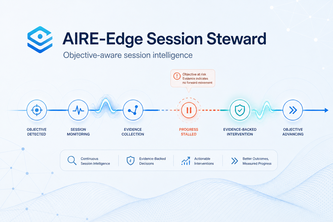
AIRE-Edge Session Steward is described as a product that monitors long-running technical sessions and evaluates whether they are still advancing toward a declared objective. It introduces "objective-aware session intelligence" — distinguishing between system health and progress toward a defined outcome.
What changed
The project description states this is an MVP built for the OpenAI 2026 hackathon, with no evidence of prior traction or commercial deployment. It was built by one person (Shubham Kumar) using cloudflare-workers, codex, gpt-5.6, next.js, node.js, react, typescript.
Single most important open question
Is there evidence that the product concept — detecting when technically healthy work has stalled — is viable in real-world technical workflows beyond a hackathon demo?
What The Product Actually Is
The description states that AIRE-Edge Session Steward is a replayable MVP that monitors long-running technical sessions and evaluates whether they are advancing toward a declared outcome.
It introduces:
- A session contract with ordered steps and measurable success criteria.
- A deterministic session engine that tracks event ordering, elapsed time, evidence freshness, and missing follow-through.
- An intelligence layer using GPT-5.6 to explain state changes and recommend next actions.
- The product is split into two layers:
- Deterministic engine (controls safety-relevant facts).
- Intelligence boundary (interprets state for different audiences).
The demo follows an edge-routing experiment with a defined goal: validate whether new routing improves video QoE under constrained bandwidth without increasing packet loss.
It is described as not a dashboard, but a system that detects when technically healthy systems produce no decision-grade advancement.
Confidence level Based on self-reported description only. No evidence of actual deployment or usage beyond the demo.
Positioning & Claim Evolution
The author states:
- The product is positioned as objective-first, not logs-first or metrics-first.
- It addresses a gap in observability tools: “Is the work still moving toward its objective?”
- The core idea is encapsulated in: “The system is healthy. The session is not.”
This positions Session Steward as a new category of product — one that evaluates progress toward outcomes, rather than just system health.
It claims to:
- Detect when technically healthy activity has stopped producing meaningful progress.
- Provide evidence-backed interventions.
- Distinguish between infrastructure activity and objective advancement.
Inference The positioning suggests a shift from reactive monitoring to proactive session intelligence, but this is not yet proven in real-world use cases.
Target Customer & ICP
The description does not name specific customers or personas. However, it implies:
- Teams working on long-running technical workflows such as AI experiments, deployment rollouts, validation pipelines, and edge-routing changes.
- Users who need to monitor progress toward defined outcomes, not just system health.
It is implied that the product targets:
- DevOps engineers
- Platform teams
- Technical stakeholders in complex systems
The demo focuses on an edge-routing experiment, suggesting a focus on edge computing or distributed systems.
Confidence level Not evidenced. No customer names, use cases, or personas are provided.
Business Model & Pricing Evidence
The description does not contain any information about:
- Revenue model
- Pricing structure
- Monetization strategy
- Customer acquisition plans
It is described as an MVP for a hackathon.
Confidence level Not evidenced. No commercial or pricing data available.
Technical & Delivery Signals
The product is built with:
- Cloudflare Workers
- Codex
- GPT-5.6
- Next.js, React, Node.js, TypeScript
It uses a two-layer architecture:
- Deterministic session engine (controls facts like event order, state transitions).
- Intelligence service boundary (interprets state using GPT).
The MVP is described as:
- Replayable
- Offline-capable
- Typed domain model
- Local intelligence layer
Inference The architecture suggests a hybrid deterministic + AI approach, with clear separation of concerns.
Traction & Maturity Signals
The description states:
- This is an MVP for a hackathon
- Built by one person (Shubham Kumar)
- No evidence of revenue, customers, or adoption beyond the demo
- No mention of funding rounds, headcount, or product roadmap
Confidence level Not evidenced. No traction data available.
Competitive Context
The description does not reference:
- Direct competitors
- Market size
- Competitive advantages
- Existing solutions in the space
It positions itself as a new category — objective-aware session intelligence — distinct from logs-first or metrics-first tools.
Inference The product may compete with observability platforms, but no specific competitive landscape is described.
Open Questions & Risks
- No commercial traction: MVP only, built for a hackathon.
- Single founder: No team structure or scalability evidence.
- Unproven concept: The idea of detecting “session stalling” in technical workflows is not validated beyond a demo.
- AI dependency: Reliance on GPT-5.6 for interpretation may be fragile without deterministic grounding.
- Limited scope: Demo is narrowly focused on edge routing, with no evidence of broader applicability.
Inference The product concept is novel but untested in real-world environments.
Questions the description leaves open
- What are the key assumptions about session contracts and progress evaluation that underpin this product?
- How does the deterministic engine handle edge cases or unexpected behavior in real workflows?
- Has the product been tested beyond the demo scenario, and what were the results?
- What is the plan for scaling from a hackathon MVP to a production-ready solution?
- How do you intend to monetize this product, and who are your target customers?
- What are the limitations of GPT-5.6 in the intelligence layer, and how are they mitigated?
Overall Assessment
The description states that AIRE-Edge Session Steward is a hackathon MVP built by one person for the OpenAI 2026 hackathon.
It introduces an unproven but conceptually interesting idea: objective-aware session intelligence, which may be valuable in complex technical workflows.
However:
- There is no evidence of traction, revenue, or customer adoption.
- The product is not yet commercialized.
- The architecture is described but not validated in practice.
- The team size is one, with no indication of scalability or execution capability.
Assessment Not ready for investment or partnership. Conceptual novelty and early-stage engineering are present, but no evidence of viability or market readiness. This is a pre-MVP idea, not a product in the market.
User Stories BotA demo video on every pull request
Get a demo video on every new feature
GitHub App that watches your pull requests and records a narrated, captioned demo.
Save time on demo prep and make informed decisions faster with a video walkthrough of every new feature.
Source
Submitted to the OpenAI 2026 hackathon on Devpost. Project home on Devpost. Back to the full gallery on Devpost.
This competitive analysis was produced by top-founders.com (opens in a new tab)
Generated by a language model from this project's public Devpost page — its tagline, the author's own write-up and any built-with tags listed there — as captured in August 2026. Short quotations are the author's words. It is an opinion on the idea as a business, not on the people behind it, and it reflects the description as published then. If the project has moved on, request a correction below. The analysis is not independent research and contains no verified traction, revenue or customer data.
An independent guide by KFG International LLC — not affiliated with, endorsed by, or connected to Devpost or OpenAI.