

Archive position — measured, not model output
0 likes on Devpost
2,263 of the 7,850 archived projects have more likes, and 5,587 share exactly 0 — so this project's #2,588 place in the like-ranked listing is a tie-break inside that group, not a ranking.
Projects (log scale)
Likes on Devpost. ▲ marks this project's group.
Show the figures
| Likes | Projects | Share of archive |
|---|---|---|
| 0 | 5,587 | 71.2% |
| 1 | 1,758 | 22.4% |
| 2 | 284 | 3.6% |
| 3–4 | 132 | 1.7% |
| 5–9 | 75 | 1.0% |
| 10+ | 14 | 0.2% |
 User Stories BotA demo video on every pull request
Get a demo video on every new feature
GitHub App that watches your pull requests and records a narrated, captioned demo.
Save time on demo prep and make informed decisions faster with a video walkthrough of every new feature.
Executive Summary
What the company appears to be
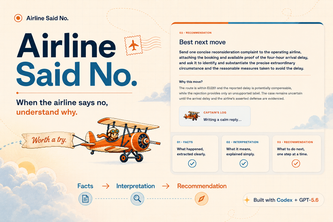
Airline Said No is a self-reported tool that helps travelers understand airline compensation claim refusals by analyzing rejection letters and offering plain-language explanations, highlighting missing evidence, and generating editable reply drafts. It uses AI (specifically GPT-5.6) for document analysis and draft generation, with a focus on explainability and user control.
What changed
The project was built as part of the OpenAI 2026 hackathon submission. The author states it evolved from an initial concept into a production-ready application using Next.js, React, TypeScript, and Tailwind CSS, supported by Codex for implementation and development tasks.
Single most important open question
Is there any evidence of user adoption or traction beyond the author's own use case?
What The Product Actually Is
The description states that Airline Said No is a tool designed to help travelers interpret airline compensation claim refusals. It allows users to either paste text or upload PDF/JPG/PNG documents of rejection letters. The system uses GPT-5.6 for structured document analysis and draft generation, with the output being fully editable and not automatically sent.
The application reconstructs facts, explains the airline’s reasoning in plain language, highlights missing or contradictory evidence, and suggests one realistic next step. It avoids making predictions about claim outcomes, instead focusing on explainable second opinions.
It is built using Next.js 16, React 19, TypeScript, and Tailwind CSS, with support from Codex during development.
Evidence
- The author describes how users can upload or paste rejection letters.
- GPT-5.6 is used for document analysis and reply draft generation.
- Output is editable and not auto-submitted.
- The tool focuses on fact reconstruction, interpretation, and recommendation without legal prediction.
- Built with Next.js, React, TypeScript, Tailwind CSS.
Inference The product appears to be a single-user web application focused on post-claim analysis and response drafting.
Positioning & Claim Evolution
The description states that the tool was created to help people understand airline compensation refusals that are often difficult to interpret due to legal jargon or vague statements like “extraordinary circumstances.” The author emphasizes that it does not act as a legal advisor or predict outcomes, but instead offers an explainable second opinion.
A key design principle is: Facts → Interpretation → Recommendation, which guides the user experience and ensures clarity over certainty.
The positioning is clear: a tool for travelers who want to understand their claim refusals before taking further action, not one that replaces legal judgment or automates claims.
Evidence
- The tool aims to explain complex rejection letters in plain language.
- It avoids predicting success or acting as a legal advisor.
- Design principle of “Facts → Interpretation → Recommendation” is explicitly stated.
Inference The product positions itself as an educational and assistive tool rather than a decision-making engine or automated claims platform.
Target Customer & ICP
The description states that the target audience includes travelers who receive airline compensation refusals and struggle to interpret them. These users are likely individuals seeking clarity before deciding whether to escalate their claim.
No specific segmentation beyond “travelers” is mentioned, nor is there evidence of a defined persona or buyer journey.
Evidence
- The tool targets people receiving airline compensation refusals.
- Users may find the letters hard to interpret due to legal terminology.
- No further customer segmentation or ICP details provided.
Inference The primary user group is individual travelers, possibly with some familiarity with air travel and compensation processes. There is no evidence of enterprise or B2B targeting.
Business Model & Pricing Evidence
There is no evidence in the description of a business model or pricing structure. The project is described as a hackathon submission, and there is no mention of monetization, subscriptions, fees, or paid features.
Evidence
- No information about revenue streams.
- No mention of pricing tiers or commercial use cases.
- Project was submitted to a hackathon; no indication of commercial viability.
Inference The tool appears to be non-commercial in nature, possibly intended for personal or educational use only.
Technical & Delivery Signals
The project is built using modern web technologies including Next.js 16, React 19, TypeScript, and Tailwind CSS. It integrates with OpenAI’s GPT-5.6 for document analysis and reply generation, and uses OCR tools to process uploaded files.
Codex was used during development to assist in implementation, testing, accessibility improvements, refactoring, production hardening, and documentation.
The application supports file uploads (PDF, PNG, JPG, JPEG) and text input, with uploaded files being request-scoped and not stored beyond the current session.
Evidence
- Built with Next.js 16, React 19, TypeScript, Tailwind CSS.
- Uses GPT-5.6 for document analysis and draft generation.
- OCR tools are used to process documents.
- Codex was used in development.
- Files remain request-scoped and are not stored.
Inference The tool is a web-based SaaS-like interface with AI-driven content processing, likely hosted on Vercel or similar platform.
Traction & Maturity Signals
There is no evidence of user traction, adoption, or customer base. The project is described as a hackathon submission and lacks any data points related to usage, retention, or revenue.
Evidence
- Submitted to OpenAI 2026 hackathon.
- No mention of users, customers, or product usage metrics.
- No evidence of monetization or commercial deployment.
Inference The tool is in early-stage development and has not yet demonstrated real-world traction or maturity.
Competitive Context
There is no evidence provided about competitors or market positioning. The author does not reference existing tools for interpreting airline compensation claims, nor does the description suggest a competitive landscape.
Evidence
- No mention of competitors.
- No indication of market analysis or differentiation strategy.
Inference The competitive context is unknown; it's unclear whether similar tools exist or how this product would fit into an existing ecosystem.
Open Questions & Risks
- Lack of commercial traction: The tool is described as a hackathon submission with no evidence of real-world usage.
- Unclear business model: No indication of monetization, pricing, or scalability beyond personal use.
- AI dependency without oversight: Heavy reliance on GPT-5.6 raises concerns about accuracy and consistency without human review or control mechanisms.
- No user feedback or iteration history: The tool is presented as a single version with no evidence of iterative improvements or user testing.
- Limited scope: Focused only on interpreting rejection letters, not on claim filing or escalation.
Evidence
- No mention of users, customers, or product usage metrics.
- No indication of monetization or commercial viability.
- No evidence of feedback loops or iteration history.
Inference The tool is highly experimental and lacks any demonstration of real-world utility or scalability.
Questions the description leaves open
- What was the actual user feedback during the hackathon or early development phase?
- How does the tool handle edge cases, such as ambiguous or incomplete rejection letters?
- Is there a plan to scale beyond personal use, and if so, what would that look like?
- Have you considered legal liability or accuracy concerns when providing interpretations?
- What are your plans for monetization or commercial deployment?
Overall Assessment
Not evidenced.
The project is described as a hackathon submission with no evidence of traction, revenue, or customer base. It lacks any indication of a viable business model or commercial strategy. The tool appears to be an experimental prototype focused on personal use rather than scalable product development.
Evidence
- Submitted to a hackathon.
- No signs of user adoption or monetization.
- No evidence of commercial viability or strategic direction.
Inference At this stage, the project is not suitable for investment or partnership consideration unless there is a clear path toward traction and commercialization.
User Stories BotA demo video on every pull request
Get a demo video on every new feature
GitHub App that watches your pull requests and records a narrated, captioned demo.
Save time on demo prep and make informed decisions faster with a video walkthrough of every new feature.
Source
Submitted to the OpenAI 2026 hackathon on Devpost. Project home on Devpost. Back to the full gallery on Devpost.
This competitive analysis was produced by top-founders.com (opens in a new tab)
Generated by a language model from this project's public Devpost page — its tagline, the author's own write-up and any built-with tags listed there — as captured in August 2026. Short quotations are the author's words. It is an opinion on the idea as a business, not on the people behind it, and it reflects the description as published then. If the project has moved on, request a correction below. The analysis is not independent research and contains no verified traction, revenue or customer data.
An independent guide by KFG International LLC — not affiliated with, endorsed by, or connected to Devpost or OpenAI.