

Archive position — measured, not model output
0 likes on Devpost
2,263 of the 7,850 archived projects have more likes, and 5,587 share exactly 0 — so this project's #2,590 place in the like-ranked listing is a tie-break inside that group, not a ranking.
Projects (log scale)
Likes on Devpost. ▲ marks this project's group.
Show the figures
| Likes | Projects | Share of archive |
|---|---|---|
| 0 | 5,587 | 71.2% |
| 1 | 1,758 | 22.4% |
| 2 | 284 | 3.6% |
| 3–4 | 132 | 1.7% |
| 5–9 | 75 | 1.0% |
| 10+ | 14 | 0.2% |
 User Stories BotA demo video on every pull request
Get a demo video on every new feature
GitHub App that watches your pull requests and records a narrated, captioned demo.
Save time on demo prep and make informed decisions faster with a video walkthrough of every new feature.
Executive Summary
What the company appears to be
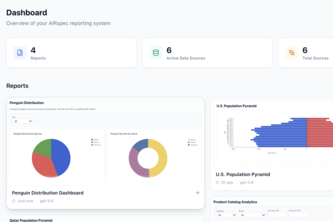
AIRspec is a self-reported open specification for generating interactive dashboards from natural language prompts using AI. The system defines a declarative JSON format that describes reports (charts, filters, interactions) without allowing code or expressions. It enforces security by ensuring AI-generated documents are validated against a catalog of allowed datasets and operations, preventing unauthorized access to data.
What changed
The author states they built the specification first, then implemented tools around it including a JSON schema, validator, rendering engine, and demo app. They used OpenAI models extensively in building and testing the system. The project was submitted to the OpenAI 2026 hackathon.
Single most important open question
Is there evidence of real-world usage or adoption of this specification beyond the author’s own implementation? The description does not indicate any customers, revenue, or external integrations — only an internal prototype and self-contained tooling.
What The Product Actually Is
The description states that AIRspec is:
- An open specification for generating interactive dashboards from natural language.
- A system where AI generates declarative JSON documents, not executable code.
- These documents describe what to show, how to chart it, filters, interactions, and derived fields using a closed vocabulary defined by a JSON schema.
- The system includes:
- A schema validation layer
- A semantic check layer
- An authorization layer against a catalog of datasets
- A data broker that executes only approved queries
- A deterministic rendering engine
The author claims the specification is model-independent and supports various chart types, math operations (e.g., quantity × price), and theming.
Inference This appears to be a framework for secure, AI-driven report generation that separates user intent from data access. It is not a product per se but a specification and tooling ecosystem around it.
Positioning & Claim Evolution
The author states:
- The problem: Sales/operations teams request dashboards, which require developers to write code, often resulting in obsolete reports.
- The solution: Let AI describe reports in plain English while keeping data locked behind developer-controlled catalogs.
- Key positioning: “SQL gave databases a safe language for questions. AIRspec gives AI a safe language for reports.”
- Security model: AI never touches production data; it only describes what to show.
Inference The author positions AIRspec as a secure, declarative alternative to code-based dashboard generation, targeting internal business intelligence or analytics teams who want self-service reporting without compromising data security.
Target Customer & ICP
The description states:
- The target pain point is: “Someone in sales or operations needs a report, so they file a ticket, and a developer stops real work to write a dashboard.”
- The ideal user is someone who wants to ask for reports in natural language without needing developer involvement.
- The system is designed for developers to define authorized datasets and fields, and for non-developers to request dashboards via AI.
Inference
The ICP likely includes:
- Internal business intelligence or analytics teams
- Developers managing secure data access
- Organizations seeking self-service reporting tools with strong security controls
Business Model & Pricing Evidence
Not evidenced. The description does not mention any pricing, monetization strategy, or commercial model.
Technical & Delivery Signals
The author states:
- Built using GitHub, OpenAI, and React
- Specification was written first, then tooling followed
- Includes:
- JSON Schema
- Conformance suite (valid/invalid fixtures)
- Browser validator (client-side)
- Reference rendering engine on npm
- Demo app on Supabase edge functions
- AI used for drafting spec, writing fixtures, debugging, and deployment
- The system supports:
- Charting grammar called AIRMark
- Derived fields with arithmetic operations
- Structured math system (JSON tree with fixed operation vocabulary)
- Error feedback loop to AI for correction
Inference The technical stack is lightweight and modular. The author emphasizes a spec-first approach, which suggests a strong focus on correctness and interoperability. There is no evidence of commercial delivery or productization beyond the prototype.
Traction & Maturity Signals
Not evidenced. No customers, revenue, usage metrics, or adoption data are provided. The description only mentions:
- A demo app
- A validator page
- npm packages
- Conformance suite
- Submission to a hackathon
Inference This is an early-stage prototype with no demonstrated traction or market validation.
Competitive Context
Not evidenced. No mention of competitors, existing solutions, or market positioning against other dashboarding tools or AI analytics platforms.
Open Questions & Risks
- No external adoption or usage: The system exists only as a prototype and self-contained tooling.
- Single-person team: The project is built by one person (Brian Zalk), suggesting limited scalability or support.
- Unverified claims: All assertions are self-reported, with no independent validation of security model or performance.
- Hackathon submission context: This implies a proof-of-concept rather than a commercial product.
- No pricing or monetization strategy: No indication of how the specification would be monetized or distributed.
Questions the description leaves open
- What is the actual security model, and has it been tested in real-world scenarios?
- Are there any external integrations or implementations beyond your own?
- How do you plan to scale beyond a single developer’s capacity?
- Is there any interest from enterprises or developers in adopting this specification?
- What are the limitations of the current AI integration, and how does it handle ambiguous prompts?
- Have you considered how this would work with different data sources or query engines?
Overall Assessment
Not evidenced. No financials, traction, or commercial viability indicators are provided. The project is described as a prototype built for a hackathon, with no evidence of market demand, customer feedback, or business model.
Confidence level Low This is a self-reported, unverified concept, not a product or company with demonstrated traction. It may be an interesting idea, but there is no basis to assess its commercial viability or investment potential from the information provided.
User Stories BotA demo video on every pull request
Get a demo video on every new feature
GitHub App that watches your pull requests and records a narrated, captioned demo.
Save time on demo prep and make informed decisions faster with a video walkthrough of every new feature.
Source
Submitted to the OpenAI 2026 hackathon on Devpost. Project home on Devpost. Back to the full gallery on Devpost.
This competitive analysis was produced by top-founders.com (opens in a new tab)
Generated by a language model from this project's public Devpost page — its tagline, the author's own write-up and any built-with tags listed there — as captured in August 2026. Short quotations are the author's words. It is an opinion on the idea as a business, not on the people behind it, and it reflects the description as published then. If the project has moved on, request a correction below. The analysis is not independent research and contains no verified traction, revenue or customer data.
An independent guide by KFG International LLC — not affiliated with, endorsed by, or connected to Devpost or OpenAI.