

Archive position — measured, not model output
0 likes on Devpost
2,263 of the 7,850 archived projects have more likes, and 5,587 share exactly 0 — so this project's #4,553 place in the like-ranked listing is a tie-break inside that group, not a ranking.
Projects (log scale)
Likes on Devpost. ▲ marks this project's group.
Show the figures
| Likes | Projects | Share of archive |
|---|---|---|
| 0 | 5,587 | 71.2% |
| 1 | 1,758 | 22.4% |
| 2 | 284 | 3.6% |
| 3–4 | 132 | 1.7% |
| 5–9 | 75 | 1.0% |
| 10+ | 14 | 0.2% |
 User Stories BotA demo video on every pull request
Get a demo video on every new feature
GitHub App that watches your pull requests and records a narrated, captioned demo.
Save time on demo prep and make informed decisions faster with a video walkthrough of every new feature.
Executive Summary
What the company appears to be
HREVN AgentProof is a self-reported tool that claims to generate cryptographically verifiable receipts for Codex agent sessions. It is described as a system that converts observed AI coding agent actions into tamper-evident, privacy-preserving Evidence Bundles anchored on Ethereum Sepolia.
What changed
The project was built during the OpenAI 2026 hackathon and introduces a new layer to an existing HREVN system. It adds functionality for capturing and verifying Codex agent sessions without duplicating core HREVN logic, using tools like GitHub Actions, Docker, FastAPI, and cryptographic commitments.
Single most important open question
Is there any evidence of real-world usage or adoption beyond the demo and self-reported claims?
What The Product Actually Is
The description states that HREVN AgentProof:
- Converts observed Codex sessions into a privacy-preserving, tamper-evident Evidence Bundle.
- Uses SHA-256 commitments for file states and diffs, while keeping prompts, source code, stdout, stderr, and diff contents private.
- Anchors the canonical receipt in an Ethereum Sepolia transaction using Ed25519 signing.
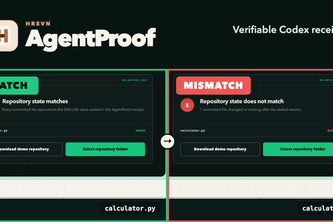
- Provides a browser-based verification process where reviewers can compare repository files against sealed commitments without uploading them.
- Includes a reusable GitHub Action that verifies repositories before sealing evidence.
- Operates with a CLI capture adapter and public interface built in Python, FastAPI, and JavaScript.
Inference The system appears to be designed for AI agent auditing or trust verification in software development workflows. It is not described as a general-purpose tool but rather one tailored for Codex-based agents.
Positioning & Claim Evolution
The description states:
- AgentProof replaces “trust the agent” with a portable, independently verifiable receipt.
- It aims to prove integrity and order of events observed by an instrumented collector.
- The system is described as tamper-evident but not exhaustive — it does not claim to observe bypassed actions.
Inference The positioning centers on trust in AI agents through cryptographic verification. The evolution from a general HREVN system to a specific layer for agent sessions suggests a targeted application within the AI coding space.
Target Customer & ICP
The description states:
- AgentProof is built for developers or reviewers who need to audit Codex agent actions.
- It supports use cases in CI/CD pipelines via GitHub Actions.
- A reviewer can verify the integrity of a repository without needing an account or access to sensitive content.
Inference The primary ICP appears to be developers or teams using AI coding agents (e.g., Codex) in software development workflows, particularly those concerned with auditability and trust in automated actions.
Business Model & Pricing Evidence
Not evidenced. The description does not mention pricing, monetization, or business model details.
Technical & Delivery Signals
The description states:
- Built using Python, FastAPI, JavaScript, Docker, GitHub Actions, Ethereum Sepolia.
- Uses Ed25519 signing and SHA-256 commitments.
- Implements a browser-based verification process with Web Crypto API.
- Includes a CLI capture adapter, public interface, and GitHub Action.
- The system is described as reproducible via Git diff and includes Apache-2.0 license.
Inference The technical stack suggests a developer-oriented tool built for integration into CI/CD pipelines. The use of cryptographic commitments and Ethereum anchoring indicates a focus on verifiability rather than performance or scalability.
Traction & Maturity Signals
Not evidenced. There is no mention of revenue, customers, usage metrics, or product maturity beyond the hackathon demo.
Competitive Context
Not evidenced. No information is provided about competitors or market positioning in relation to other tools for AI agent auditing or verification.
Open Questions & Risks
- The project is described as a hackathon submission with no evidence of traction or real-world adoption.
- It relies on a single developer (Miguel Herrero) and lacks team or organizational structure.
- No external validation, third-party audits, or independent verification are mentioned.
- The system is described as “deliberately” not exhaustive — it does not claim to observe all actions, which may limit its utility in high-security environments.
Questions the description leaves open
- What is the actual use case for this tool beyond the demo?
- Has there been any real-world testing or feedback from users?
- How does AgentProof handle edge cases like agent runtime failures, network interruptions, or malicious inputs?
- Is there a plan to expand support beyond Codex agents?
- What are the long-term maintenance and scalability plans for this system?
Overall Assessment
Not evidenced. No information is provided about funding, valuation, or strategic interest from investors or partners. The project appears to be an experimental hackathon submission with no commercial traction or evidence of a viable business model.
User Stories BotA demo video on every pull request
Get a demo video on every new feature
GitHub App that watches your pull requests and records a narrated, captioned demo.
Save time on demo prep and make informed decisions faster with a video walkthrough of every new feature.
Source
Submitted to the OpenAI 2026 hackathon on Devpost. Project home on Devpost. Back to the full gallery on Devpost.
This competitive analysis was produced by top-founders.com (opens in a new tab)
Generated by a language model from this project's public Devpost page — its tagline, the author's own write-up and any built-with tags listed there — as captured in August 2026. Short quotations are the author's words. It is an opinion on the idea as a business, not on the people behind it, and it reflects the description as published then. If the project has moved on, request a correction below. The analysis is not independent research and contains no verified traction, revenue or customer data.
An independent guide by KFG International LLC — not affiliated with, endorsed by, or connected to Devpost or OpenAI.