

Archive position — measured, not model output
0 likes on Devpost
2,263 of the 7,850 archived projects have more likes, and 5,587 share exactly 0 — so this project's #4,550 place in the like-ranked listing is a tie-break inside that group, not a ranking.
Projects (log scale)
Likes on Devpost. ▲ marks this project's group.
Show the figures
| Likes | Projects | Share of archive |
|---|---|---|
| 0 | 5,587 | 71.2% |
| 1 | 1,758 | 22.4% |
| 2 | 284 | 3.6% |
| 3–4 | 132 | 1.7% |
| 5–9 | 75 | 1.0% |
| 10+ | 14 | 0.2% |
 User Stories BotA demo video on every pull request
Get a demo video on every new feature
GitHub App that watches your pull requests and records a narrated, captioned demo.
Save time on demo prep and make informed decisions faster with a video walkthrough of every new feature.
Executive Summary
What the company appears to be
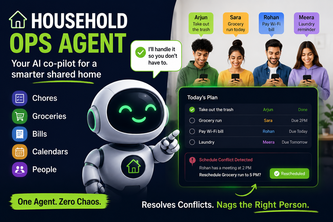
Household Ops Agent is an AI-powered household coordination tool built as a self-contained web application. The description states it is designed to help households manage chores, bills, groceries, and schedules by reviewing live context and proposing human-approved assignments or nudges.
What changed
The project was submitted as part of the OpenAI 2026 hackathon. It represents a proof-of-concept product built in a short timeframe using modern web technologies and LLMs, with an emphasis on user control and explainable AI outputs.
Single most important open question
Is there evidence that this concept has traction or demand beyond the authors' own household use case?
What The Product Actually Is
The description states that Household Ops Agent is an AI-powered shared household workspace. It reviews:
- Chores and recurring responsibilities
- Grocery planning and errand ownership
- Bills, due dates, and payment reminders
- Shared calendar events
- Agent-generated findings and recommendations
It proposes human-approved assignments or nudges instead of group-chat noise.
The agent receives structured context about members, preferences, chores, groceries, bills, events, and recent findings. It returns structured JSON validated by Zod before storage.
Manual and scheduled runs use the same pipeline. Scheduled runs occur weekly via Vercel Cron at 9:00 AM IST on Sundays.
Not evidenced: No mention of actual user data, customer base, or real-world usage beyond the authors’ own household.
Positioning & Claim Evolution
The description states that the product aims to be "more useful than a shared to-do list" and focuses on connecting context across chores, bills, groceries, schedules, preferences, and workload.
It positions itself as an alternative to scattered group chats or memory-based coordination, aiming to reduce missed tasks, late bills, and duplicated efforts.
The authors claim the system avoids uncontrolled authority by requiring human approval for all actions and nudges. They emphasize that the agent does not automatically change data but instead generates explainable findings with severity, confidence, reasoning, and suggested action.
Inferred: The positioning implies a shift from reactive to proactive household management through AI, though no evidence of market validation or adoption exists.
Target Customer & ICP
The description states that Household Ops Agent is intended for households managing shared responsibilities such as chores, bills, groceries, and schedules.
It targets users who experience issues like missed chores, late bills, duplicated trips, and reminders sent to everyone instead of the person who can act.
Not evidenced: No specific demographic or segment data, no evidence of target customer personas, or user interviews.
Business Model & Pricing Evidence
The description does not contain any information about pricing, monetization, or business model.
Inferred: The project was built for a hackathon and deployed as an open-source tool with MIT license. No commercial revenue or pricing structure is described.
Technical & Delivery Signals
The project was built using:
- Next.js, React, TypeScript
- Tailwind CSS and shadcn/ui for UI
- Clerk for authentication
- Supabase Postgres for data storage
- OpenRouter with a configurable free model for LLM reasoning
- Zod for validating structured agent output
- Resend for email delivery
- Vercel Cron for scheduled runs
- Vercel for deployment
The agent pipeline supports both manual and automated runs, with validation of outputs and prevention of duplicate or unsafe changes.
Codex reportedly accelerated development across schema, workflows, testing, and UI polish.
Not evidenced: No information on scalability, performance metrics, or production-grade infrastructure beyond the hackathon build.
Traction & Maturity Signals
The description states that the product was built for a hackathon and includes documentation such as setup instructions, sample data, migrations, cron testing, and an MIT license.
It mentions that the agent can be run manually or via scheduled cron jobs, and that it supports a dark theme and responsive navigation.
Not evidenced: No evidence of customer adoption, usage statistics, revenue, or product-market fit beyond the authors’ own use case.
Competitive Context
The description does not mention any competitors or existing solutions in the household coordination space.
Inferred: The project appears to address a gap in shared household management tools that rely on group chat or static lists. However, no competitive analysis or differentiation strategy is provided.
Open Questions & Risks
- No commercial traction: The product was built for a hackathon and lacks evidence of real-world usage or adoption.
- Limited scope: The system appears tailored to small households and does not support multi-household use cases.
- Unverified claims: All features are self-reported without independent verification.
- Lack of monetization strategy: No pricing, revenue model, or business plan is described.
- Dependency on LLMs: Reliance on a configurable free OpenRouter model may limit scalability or reliability in production.
Questions the description leaves open
- What specific household coordination problems are you solving, and how do you know these are real?
- Have you tested this with more than one household?
- How do you plan to scale beyond a single household?
- Is there any evidence of user feedback or iteration from early adopters?
- What is your roadmap for monetization or product evolution?
- Are there plans to integrate with calendar services or other third-party tools?
Overall Assessment
Not evidenced: No financials, revenue, customer data, or traction metrics are available.
Inferred: This appears to be a hackathon prototype with no demonstrated commercial viability or market demand. It lacks the evidence required for investment or partnership consideration at this stage.
The project shows technical capability and conceptual clarity but does not demonstrate product-market fit, scalability, or monetization potential.
User Stories BotA demo video on every pull request
Get a demo video on every new feature
GitHub App that watches your pull requests and records a narrated, captioned demo.
Save time on demo prep and make informed decisions faster with a video walkthrough of every new feature.
Source
Submitted to the OpenAI 2026 hackathon on Devpost. Project home on Devpost. Back to the full gallery on Devpost.
This competitive analysis was produced by top-founders.com (opens in a new tab)
Generated by a language model from this project's public Devpost page — its tagline, the author's own write-up and any built-with tags listed there — as captured in August 2026. Short quotations are the author's words. It is an opinion on the idea as a business, not on the people behind it, and it reflects the description as published then. If the project has moved on, request a correction below. The analysis is not independent research and contains no verified traction, revenue or customer data.
An independent guide by KFG International LLC — not affiliated with, endorsed by, or connected to Devpost or OpenAI.